

A million for a ram (continuation)
"The most expensive and pointless shashlik": what is known about the ram sold for a million dollars
A Million for a Ram (Continued)
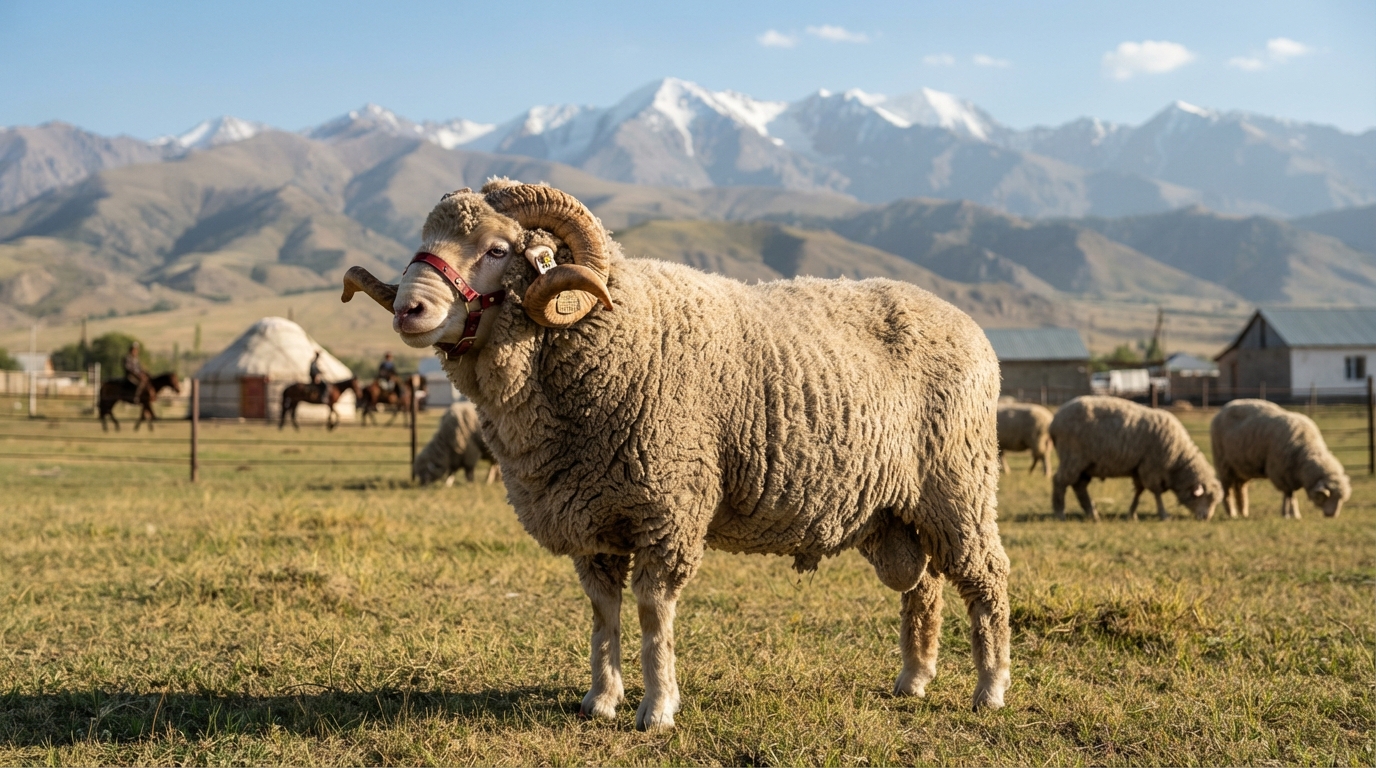
In Kyrgyzstan, an unusual transaction in the breeding livestock market is still being discussed — the sale of a young ram of the "Arashan" meat-and-lard breed for $1 million. The story received wide resonance after the international festival of the "Arashan" breed, which took place in Kyrgyzstan on September 19 with the participation of livestock breeders from Kyrgyzstan, Kazakhstan, Uzbekistan, Tajikistan, and Russia.
According to Radio Free Europe/Radio Liberty (RFE/RL), the sold ram is named Antibiotik. Kyrgyz sheep breeder Ulan Atabaev claims that the animal was sold to Kazakh breeder Kuanysh Myktybaev. At the same time, the buying side has not publicly confirmed the exact price. A lawyer, to whom Myktybaev's representatives redirected RFE/RL's questions, only stated that Antibiotik was purchased for a "significant sum."
The ram comes from the famous Frankel breeding line. Frankel himself was sold in 2023 for $150,000, after which his offspring became particularly sought after by breeders in the region.
At the September festival, another representative of this line was also shown — Don Frankel, whom the owners valued at $5 million. However, this refers specifically to an estimated value, not an actual sale.
The breeding of the "Arashan" breed began back in the 1970s. To create it, Hissar rams, imported from Tajikistan in 1977, were crossed with local Kyrgyz coarse-wool sheep. The new meat-and-lard breed was officially registered in Kyrgyzstan on April 15, 2021.
"Arashans" are distinguished by their large size. According to the breed characteristics, adult breeding rams must weigh at least 140 kg, and individual specimens significantly exceed this figure. The animals are also valued for their rapid growth and adaptability to the mountainous climate of Kyrgyzstan.
The news of the million-dollar sale sparked a lively discussion in the Kyrgyz segment of social media. Some users took it as confirmation of the success of local breeding and growing interest in the breed, while others doubted the reality of such a price and suggested that the loud sum might be used to promote "Arashan."
So far, only the fact of Antibiotik's sale to the Kazakh breeder has been reliably confirmed. The sum of $1 million remains a statement by market participants and has not been independently verified.
A specialist in pedigree sheep breeding, farmer Sergey Rudyy from the Astrakhan region of the Russian Federation, explained in an interview with the "MK" publication what must be so special about an "Arashan" ram for a fortune to be paid for it.
– Is the "Arashan" breed so rare that people pay such money for it?
– "Arashan" differs from other breeds in its huge size; they can weigh over 200 kg. But the breed itself is not unique. Only elite representatives represent value. Apparently, the million was shelled out for the ram's pedigree. They looked at who his father was, his grandfather, and what the performance of his offspring was. In short, a ram from a top-tier family was put up for auction.
– Isn't a million dollars for a ram too much?
– The price is not reasonable. A ram cannot cost a million dollars. Such money can only be paid for an outstanding sire with a very valuable pedigree. At auctions, people do not pay for the ram as such, but for the opportunity to get a large number of expensive offspring from him.
– What is the real price for an "Arashan"?
– They are sold for hundreds or several thousand dollars. A good breeding ram costs tens of thousands, but not a million! For truly outstanding sires, they can ask hundreds of thousands of dollars. If you take a ram for a million and one for a thousand, a non-specialist won't notice the difference. But for many breeders, the animal's pedigree, its conformation, health, quality of offspring, and how consistently these traits are passed on to the next generations are important.
– Why is a buyer willing to pay huge money for one ram instead of buying a whole flock for a million?
– Because one outstanding sire can change the quality of the entire flock.
– So, this ram will definitely not be turned into shashlik?
– At that price, it would be the most expensive and meaningless shashlik in history. Putting such a sire to meat is like dismantling an expensive racing car for scrap metal. The value of such an animal is precisely in breeding. It will be protected as much as possible and used as a breeding sire.
– Who even buys animals for such money?
– Usually, these are large breeders, owners of breeding farms, or associations of several breeders. A famous sire raises the status of the farm and the value of all offspring.
– Is it realistic to recoup a million on such a ram?
– Only on the condition that the animal is truly outstanding and the demand for its genetics persists for many years. But this is an investment with risk, because the animal can get sick, get injured, or simply fail to pass the expected qualities to its offspring.
– Are there "Arashan" rams in Russia?
– The breed is common in Kyrgyzstan and Central Asia, but our livestock breeders do have an interest in it. They are imported into Russia, though rarely, but nobody pays a million.
– If they are not going to put such a ram to meat, what will it actually do next? Just live, eat, and please the owner?
– You can admire it, of course, but the main task of such an animal is still to produce offspring. It will be mated with selected ewes, lambs will be obtained, and they will see what qualities it passes on to the offspring. Moreover, the more successful the offspring turns out to be, the higher the value of the ram itself becomes. If his lambs are large, gain weight quickly, and inherit the desired conformation, the sons of such a sire can also be sold very expensively. So a high-priced ram is not a pet, but a continuer of the lineage.
– Does a million-dollar ram need to be fed some special delicacies?
– A ram for a million eats about the same as a ram for a thousand dollars. That is grass, hay. It doesn't need any black caviar.
– Do people eat "Arashan" meat?
– Of course they eat it! It is raised, among other things, for meat.
– Is it noticeable by taste that it is an expensive breed?
– An ordinary person is unlikely to distinguish "Arashan" from another breed. The taste of mutton depends more on age and feed than on the breed.
– Is "Arashan" meat more expensive than regular mutton?
– The million-dollar price of a breeding ram absolutely does not mean that a kilogram of its meat will cost hundreds of times more. Breeding value and meat value are different things. A regular "Arashan" raised for meat is valued by weight, age, carcass quality, and demand. If a restaurant specifically emphasizes the breed and origin of the meat, the price may be higher than average, but not by much.
– Can one try this meat in Russia?
– Probably, it can be found from farmers or farms that specifically deal with Central Asian breeds, but in a regular store, it will most likely not be separately labeled as "Arashan" meat.
– So, one could eat "Arashan" meat and not even know it?
– Quite possibly. If the seller does not specifically indicate the breed, for the buyer, it will just be good mutton. Unlike, for example, premium beef, where the breed is often turned into a separate brand.
– And if, purely theoretically, the million-dollar ram were still turned into shashlik, how much would one skewer cost then?
– If you divide the purchase price by the amount of meat, you get an absurd sum. After slaughter, you can get several dozen kilograms of meat from a large ram. Then one kilogram of such a million-dollar ram would cost many thousands of dollars, and a few pieces on a skewer would cost hundreds, if not thousands of dollars. But I say again, it will definitely not be turned into shashlik! As long as the ram is healthy and capable of producing offspring, slaughter would mean destroying the main asset. On the meat, the owner would return only a negligible fraction of the invested money.
– And what happens to such expensive rams when they grow old and can no longer produce offspring?
– Some live out their days on the farm, especially if they have become a symbol of a breeding line. The biomaterial of the most valuable animals can be harvested in advance and used even after the ram itself has stopped participating in breeding. If it is a famous sire that has brought many valuable offspring to the farm and made a name for the owner, the attitude towards him can be special. Such a ram already becomes part of the farm's history.