

"A law enforcement officer must protect justice", but how? Discussion of the topic
October 25 is the Day of Internal Affairs Officers in Uzbekistan. On the occasion of this date, Gazeta organized a conversation dedicated to drawing a portrait of representatives of the sector. It discusses issues such as who an internal affairs officer ideally is, and what professional and human qualities they should possess.
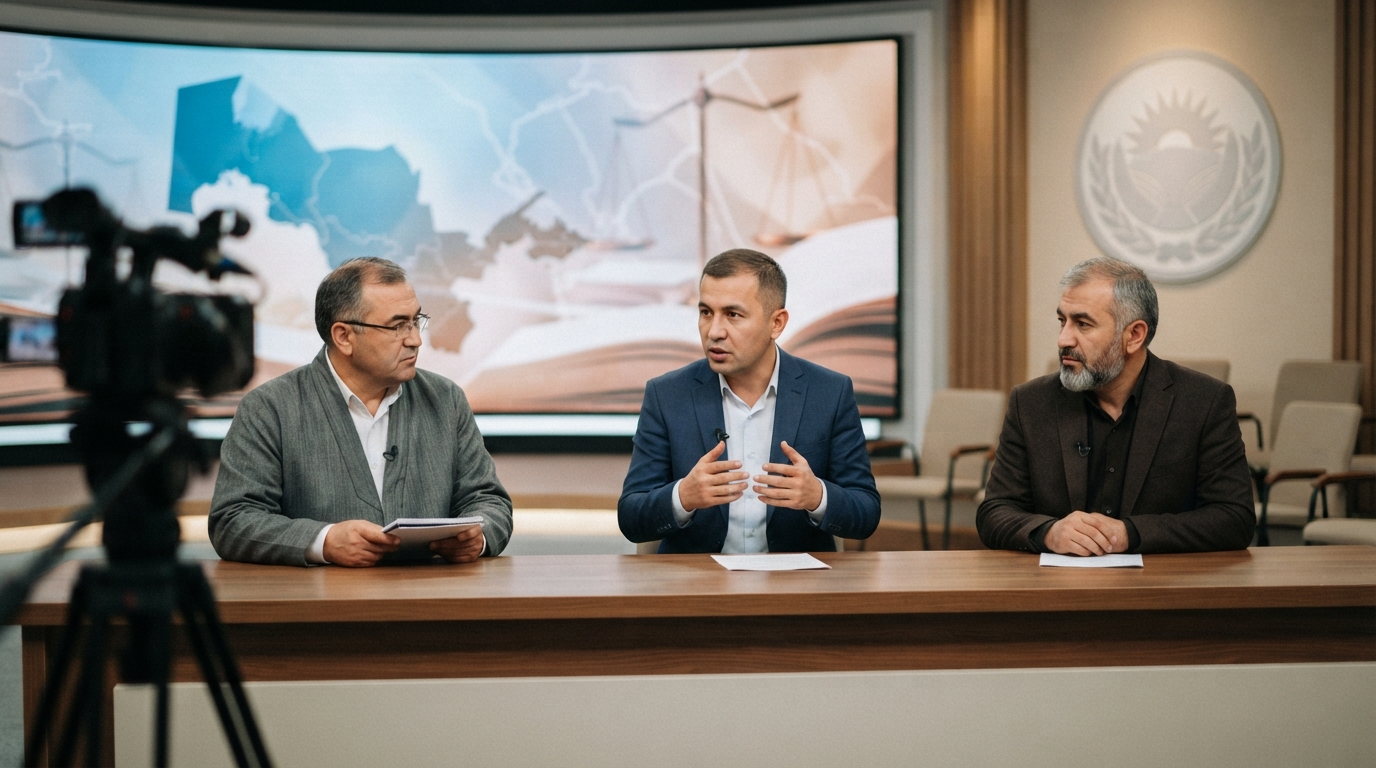
“A law enforcement officer must protect justice,” but how should this look in practice? Discussion of the topic
This year marks the 35th anniversary of the establishment of Uzbekistan’s internal affairs system. The large system is celebrating its middle age. So, what is this sector experiencing today? How should it actually work? Who should come to mind when we say an internal affairs officer? Whom are they responsible for protecting?
Human rights activist Abdurahmon Tashanov and political analyst Hamid Sodiq shared their thoughts on this topic. As a reminder, a representative from the Ministry of Internal Affairs was also invited to this conversation, but no officials attended.
— Who should we picture when we talk about internal affairs officers? What is their image?
First of all, we congratulate the Ministry of Internal Affairs and all its employees on their professional holiday. Because they are working professionally as the children and dedicated sons of our people. I know very well that their work is difficult. Because the internal affairs staff, that is, the personnel, are our own sons, daughters, and brothers. They are not aliens.
Very harsh statements are made on social networks regarding their honor and dignity, because in the eyes of the public, they are the agency responsible for maintaining our peace and tranquility. Overall, before answering this question, I would like to touch upon whether an agency named internal affairs exists in the world and where this name originated.
For example, the concept of police exists all over the world, and the entire system is united under this name. Even in our neighboring countries, it is called police. Its primary priority task is to maintain public order. But unfortunately, in our country, the scope of the internal affairs bodies is extremely broad.
According to the information I have, today the personnel of the Ministry of Internal Affairs of Uzbekistan exceeds 143,500. In other words, this is a fairly large army. We could even call it an army. At any rate, it can be said to be the highest and most numerous force among the security agencies. If we look at the scale of the State Security Service or the prosecution authorities, this agency is 2–3, or even 4 times larger.
Secondly, internal affairs officers can be described as a unique agency team that works directly with the people, penetrates into the public, and therefore participates in processes at all points of statehood. Overall, the current system works according to old agency methods left over from Soviet times. We have spoken much about how this system should have been converted into a police force long ago, redundant structures should have been reduced, and certain powers should have been redistributed to other agencies. However, under authoritarian conditions, that is, during the era of Islam Karimov, the internal affairs agencies strengthened immensely, even reaching a level where they replaced the army.
At that time, the capacity of the defense and special services was not very high. Later, part of the powers was transferred from the MIA to the National Guard, but despite this, it still remains an extremely large army, based on an administrative-command system. The system has been preserved as a large agency capable of inspiring fear on the one hand and trust on the other. It can be said that the leaders of this agency are among the most unique and influential figures in the government portfolio.
For example, whether it was Almatov, Bobojonov (former MIA ministers) or Aziz Toshpo‘latov (current MIA minister) up until now — all of them have been highly capable individuals with a penchant for authoritarian management.
Hamid aka, in general management, whom should the internal affairs officers, or representatives of the organization called police in many countries, serve? Whom should they protect? There is also the question of whether it is the citizen, the state, or the government.
First of all, I also congratulate the internal affairs employees — in a sense, my former colleagues — on their holiday. For 10 years, I also studied and worked in this system, and I believe we must truly understand the difficulty of this work. Today, first and foremost, this agency is fulfilling its function, meaning whether it is good or bad, high-quality or low-quality is another matter, but from the perspective of powers granted by the state in Uzbekistan, it must be said that it is fulfilling its duty as the state's security apparatus.
If it had not fulfilled it, some kind of disorder would have arisen. But in my view, today this system needs reform. It even needs serious reform. Why? Because after Uzbekistan gained independence, we fully adopted the system of colonial internal affairs bodies. Even in the philosophy of this agency today lies working as a colonial internal affairs body. That is, a system of this nature perceives the people as the greatest threat. For colonial states, this is normal.
Why are the people a threat to them? Because they might demand independence or their rights and drive out the invaders. Security structures are established with such a mindset and view the people as criminals in advance. The essence of internal affairs agencies established upon this philosophy does not change. Previously it was called NKVD (People's Commissariat for Internal Affairs), before that it was called Cheka, and later these were divided into special services and internal affairs bodies. Thus, as we gained independence, Islam Karimov absolutely did not want to change this philosophy.
As it was, internal affairs agencies — that is, just as the MVD was — the MIA also transitioned to this side in the same manner. But after 2016, its nature began to change, meaning certain freedoms began in the state. It was these exact freedoms that affected the nature and activities of the internal affairs bodies. Because if you do not give internal affairs bodies the opportunity to intimidate, if you take it away, the prestige of the internal affairs bodies begins to drop.
Because such a system built its reputation through intimidation; this is not simple fear, it is institutional fear. It intimidates totally. Now there is the concept of bloggers, and the media is quite open. If they do something, it immediately becomes public knowledge, and it is precisely this situation that is causing a staff shortage among them. Today, as a person who personally worked in this agency, I speak with heartache that it is not easy for any employee of the internal affairs bodies. I understand this from deep within.
The workload assigned to them, the insufficiency of their salaries, psychological pressure, and on top of that, as the media becomes free, the continuous pressure on them has created a difficult situation. Therefore, the people responsible for the system must ask themselves a serious question: how do we completely get rid of colonial traits?
Once the answer to this question is found, there will be change; the people will begin to be viewed not as a majority that might take away power, but as the source of power. Right there, many things will be resolved. Only after that will we begin to look at this organization not as a force structure, but as a law enforcement body.
— Hamid aka, at this point, can we conclude that agency officers should protect the people, not the government? But a system with a colonial mindset serves more to maintain power. Is that so?
Hamid Sodiq:
It prioritizes maintaining power and protecting the elite. That is, this is deeply ingrained. In general, it is like this across all law enforcement bodies, whether we call it the prosecution office or judicial bodies — all of them. Let us recall certain khokims (regional governors); even when they order a building to be demolished with a person inside it, internal affairs officers observe silently. This in itself shows their nature.
That is, whatever the executive elite says, the law drops to the next level. If there is a return to the framework of the law, an internal affairs officer will be formed who can say, "respected khokim, it is impossible to do this," that is, an officer who protects rights and justice. This does not mean they will not protect the government. The government must be protected by standing on the side of justice.
Only then can they also protect the people by standing on the side of justice, and then other personnel will also begin to arrive. Overall, if you simply take away the intimidation factor of colonial internal affairs bodies, nobody will be interested in them. Because young people aspiring to join the organization are interested in the opportunity to trade human destinies.
Abdurahmon aka, when news about criminal cases and imprisonments related to internal affairs officers is published, the system calls them "those who entered by mistake."
At this point, let us also talk about what kind of professional ethics and human qualities they should possess in general. What is the picture around the world in this regard?
Overall, throughout the world, people have a hostile view toward the police. This is a general trend; it is like this on an international level. For example, whether you go to America, India, or Malaysia, such a mood can be encountered in all of them. Generally speaking, the internal affairs system was inherited as part of central governance during the Soviet period. For example, the traffic safety system operated for 25 years without a Constitutional law.
On one hand, their rights were also infringed upon. Because there was no law itself to protect their rights. It worked under temporary regulations. For example, if an internal affairs ministry employee was unlawfully removed from office and we took it to court, the court would not accept it either because there was no law.
After 2015, a law was adopted, but even that was not fully adopted. In the 2000s, through international organizations, we made many appeals to the Karimov government regarding the law on internal affairs bodies, saying let us adopt it, let their activities be legalized, let us adopt the law on the State Security Service, they are working outside the law.
Unfortunately, the government and the state did not listen to this, and as a result, a social consciousness formed among them that "we are the children who sacrificed ourselves for the motherland." If you look at service vehicles, "VSF" is written on them, which means "sons loyal to the motherland" (vatanga sodiq farzandlar). There must be loyalty to the motherland and patriotism, but a little brain must work too. There must also be knowledge. Here I also draw attention to the legal framework, because in practice we encounter many situations related to the legal literacy of internal affairs officers.
They invented unique ways of protecting themselves. If there are those who blunder or commit a crime, they say this person is not one of us. They became so deeply involved in patriotism that they even take criticisms from bloggers as a rebellion against the motherland. As soon as you start criticizing a place or rulers to whom they are loyal, a mindset immediately emerges that "they are against the motherland."
The people protecting the motherland themselves must have a high level of worldview. At the beginning of this year, I spoke with the Minister of Internal Affairs. This person left a very good impression on me. In the sense that, firstly, he is very eager to work. For example, we also speak with other agencies and ministers, and you do not see such enthusiasm in them.
During our conversation, the minister said a couple of things jokingly. According to him, those who graduated school with grades of 3 or 4 become policemen. Now, this admission itself shows that the situation is not good. From this point of view, there are things today that must be seriously reformed.
Recently, they organized a press conference and also began threatening bloggers and journalists. Excuse me, such times have already passed. Currently, methods of intimidation, manipulation, or psychological influence are considered outdated methods.
During the broadcast, topics were also discussed regarding how the agency's activities have been evaluated, the main criteria in performance evaluation, accountability, as well as short- and long-term solutions to problems.