

A journey through the Navoi region: why are tourists increasingly choosing Navoi?
Ancient petroglyphs, a turquoise lake in the middle of a desert, Silk Road caravanserais, and hospitable ethnic villages. The Navoi Region is gradually revealing a completely different side of Uzbekistan to travelers — distinctive, mysterious, and surprisingly diverse. Uzbekistan is a country where every trip turns into an encounter with a new story. Here, Eastern hospitality is combined with centuries-old traditions, ancient cities preserve the memory of the great […]
**Traveling Through the Navoi Region: Why Are Tourists Increasingly Choosing Navoi?**
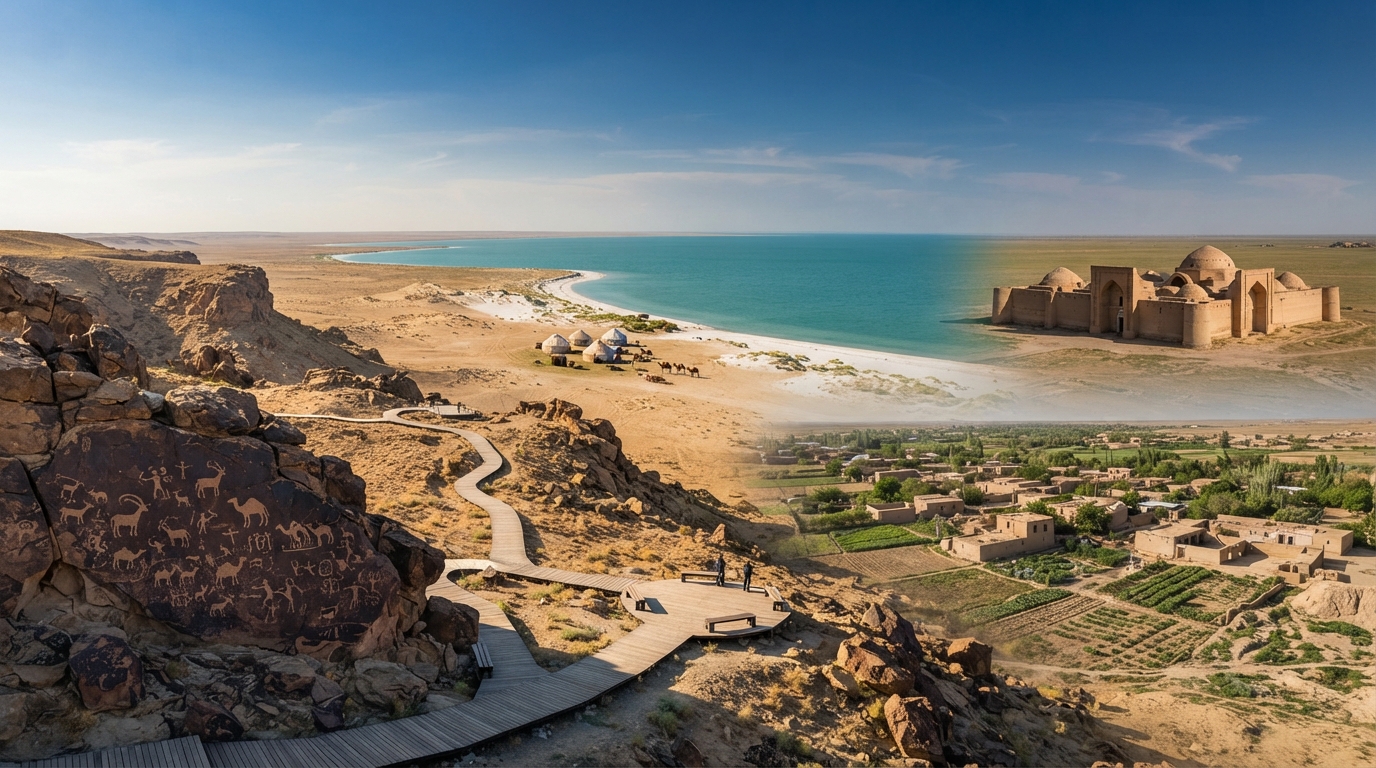
Ancient petroglyphs, a turquoise lake amidst the desert, caravanserais of the Great Silk Road, and hospitable ethnic villages—the Navoi region is gradually revealing a completely different Uzbekistan to travelers: authentic, mysterious, and strikingly multifaceted.
Uzbekistan is a country where every journey becomes an encounter with a new story. Eastern hospitality here intertwines with centuries-old traditions, ancient cities preserve the memory of great civilizations, and natural landscapes amaze with their diversity. Millions of foreign guests visit the country every year, choosing it for educational, medical and wellness, sports, and gastronomic tourism.
At the same time, the tourist map of Uzbekistan is by no means limited to Samarkand, Bukhara, and Khiva. Every region has its own treasures that are yet to be discovered by a wide audience of travelers.
One such region is the Navoi region, located in the central part of the country. It is the largest region of Uzbekistan by territory, primarily known for its industry and significant contribution to the state's economy. But behind its industrial facade lies a completely different world: the endless expanses of the Kyzylkum, ancient rock carvings, historical monuments of the Great Silk Road, the picturesque Lake Aydarkul, and small settlements where a traditional way of life is still carefully preserved.
Here you can venture into the desert, see traces of ancient civilizations, stay in a national yurt, taste traditional dishes, and get acquainted with the culture of the local residents. The Navoi region is gradually becoming a destination that offers tourists not just an excursion, but a full-fledged journey with immersion in the history, nature, and traditions of the region.
Which places should be included in the itinerary, and why is Navoi increasingly coming into travelers' focus? Let's set off to explore the region.
## Sarmishsay: Messages from the Depths of Millennia
There are places where history is not hidden behind museum display cases—it is literally carved in stone. One of them is the Sarmishsay Gorge, located in the Navbahor District of the Navoi Region.
Sarmishsay is famous for its numerous petroglyphs—rock carvings left by ancient humans. These drawings are of particular value to archaeologists and historians, as they allow us to imagine what the surrounding world was like thousands of years ago, what people did, what they hunted, and which animals inhabited this territory.
Images of aurochs, bison, wild horses, mountain goats, argali, camels, as well as predators—lions, leopards, and cheetahs—have been preserved on the rocks. Individual compositions are dedicated to hunting, daily life, economic activities, and ritual actions of the ancient inhabitants.
According to available data, about 10,000 rock carvings have been discovered on the territory of the gorge. They combine dozens of plots and thematic images. Many of the drawings were made using stone and metal tools, and over time their surface became covered with a characteristic dark patina.
Of particular interest are the images of animals that are no longer found in the local fauna today. Thanks to these drawings, one can trace how different the region's wildlife was in the distant past. In addition to petroglyphs, inscriptions in Arabic can be found among the rocks. They bear witness to the fact that this territory remained significant in subsequent historical eras as well. Today, Sarmishsay holds the status of a state museum-reserve and is considered not only an important archaeological site, but also a promising tourist destination.
Malik Hamidovich Mamedov, head of the Sarmishsay State Museum-Reserve, spoke about how the territory is changing and what conditions are being created for visitors.
Malik Mamedov, Head of the Sarmishsay State Museum-Reserve: "The Sarmishsay State Museum-Reserve was established in accordance with Resolution No. 440 of the Cabinet of Ministers of the Republic of Uzbekistan in 2019. After its creation, primary attention was paid to creating the necessary conditions for local and foreign tourists. Previously, the condition of the road leading to the gorge was unsatisfactory, and the arrival of visitors caused certain difficulties. Thanks to the support of the leadership of the republic, the region, and the Cultural Heritage Agency, more than 20 kilometers of paved road have been repaired. Today, gazebos are equipped on the territory, and pedestrian paths with a length of about three kilometers have been arranged. Repair work continues, binoculars are being installed so that visitors can view the rock carvings without climbing difficult mountain sections. Tourists come to us from Italy, Spain, England, Canada, and other countries. Among the foreign guests, there are many older people who find it difficult to move around mountainous terrain. Therefore, we strive to make visiting the reserve comfortable for all categories of tourists."
According to the head of the museum-reserve, its total area is about 5,000 hectares. The section most densely populated with petroglyphs is located along the gorge, which extends for about 2.5 kilometers.
"Drawings created by our ancestors thousands of years ago have been preserved here. The stones depict animals, tools of hunting, agriculture, and crafts, elements of the flora, as well as the people themselves. Each drawing is a unique testament to the life of ancient generations," Malik Mamedov noted.
Today, Sarmishsay is gradually becoming one of the significant centers of historical and educational tourism in the region. In the future, the development of tourist infrastructure is planned here, including the creation of a tourist center on an area of 32 hectares, the development of a master plan, and the further strengthening of measures to preserve cultural heritage.
## Aydarkul: A Turquoise Sea in the Middle of the Kyzylkum
After exploring the ancient petroglyphs, the route can be continued to one of the most unusual natural corners of Uzbekistan—Lake Aydarkul.
It is often called a turquoise sea in the middle of the desert. Indeed, the view of a huge expanse of water surrounded by the sandy expanses of the Kyzylkum leaves a strong impression. Here, the usual concept of a desert changes: instead of endless sands, a real lake with beaches, birds, and a rich underwater world opens up before the traveler.
Aydarkul is one of the largest lakes in Uzbekistan, located on the border of the Navoi and Jizzakh regions and part of the Aydar-Arnasay lake system.
The history of its appearance is unusual. In its modern form, the lake formed in 1969 after severe flooding on the Syr Darya River. To prevent the overflow of the Chardara Reservoir, part of the water was directed into the Arnasay Depression. Thus, among the arid desert landscapes, a huge body of water gradually emerged.
Over time, Aydarkul became an important part of the region's natural ecosystem. Its shores turned into a habitat and stopping point for numerous waterfowl and migratory birds. Here you can spot pelicans, herons, swans, and ducks, as well as representatives of rare species listed in the Red Data Book.
The lake is also famous for its fish resources. Carp, pike-perch, catfish, asp, bream, and other fish species inhabit its waters. Therefore, Aydarkul attracts not only lovers of peaceful relaxation, but also fishing enthusiasts.
However, the main attraction of this place is its special atmosphere. Here you can spend time on the sandy coast, go swimming during the warm season, observe birds, or simply enjoy the silence broken only by the wind over the water.
Trips through the desert, acquaintance with local nature, stays in traditional yurt camps, and camel rides are also organized for tourists. At the same time, recreation is gradually becoming more comfortable: individual camps feature yurts equipped with air conditioners and necessary amenities.
## Navoi Region: From Historical Heritage to Modern Tourist Infrastructure
Natural and historical attractions are only part of the region's tourist potential. Today, the Navoi region is actively developing infrastructure, creating new routes, and attracting investments to the tourism industry.
Over the next two years, the region plans to increase tourist flow to 6 million people, including attracting up to 1 million foreign guests.
The scale of the industry's development is also reflected in statistics. According to the presented data, since the beginning of 2026, the region has been visited by more than 3 million tourists, including 551 thousand foreign citizens. Over the past five years, the number of foreign tourists has increased 21 times, and domestic tourists—2.5 times.
Over nine years, 355 hotels and guesthouses have been established in the region, and the hotel capacity has grown 20-fold. To date, 373 accommodation facilities operate here with a total capacity of 9,348 beds, along with 106 tourist organizations.
By the end of 2027, the opening of another 120 accommodation facilities is planned, as well as the creation of about 30 new tour operators and travel agencies.
One of the promising projects will be the "Ancient Karmana" tourist center, the investment cost of which is 100 billion soums. The project provides for the reconstruction of 2.4 kilometers of Karmana Street in an ethnic style and the integration of historical monuments, a market, and recreation areas into a single tourist route.
A special place in this route will be occupied by the Qosim Shaikh complex, individual structures of which date back to the 16th century.
The Karmana District preserves other testaments to the era of the Great Silk Road as well. Among them is Rabat-i Malik, an 11th-century architectural monument built during the reign of Shams al-Mulk Nasr of the Karakhanid dynasty.
Originally, the complex served as a fortified residence of rulers, and later became a caravanserai where merchants and travelers stopped. Nearby is the Sardoba Malik, a historical reservoir that supplied caravans and wayfarers with water during long crossings through arid territories.
The significance of this heritage is also confirmed by international recognition. On September 17, 2023, the transnational site "Silk Roads: Zarafshan-Karakum Corridor," which includes 31 historical sites in Uzbekistan, Tajikistan, and Turkmenistan, was inscribed on the UNESCO World Heritage List.
Thus, the Navoi region is becoming part of a large-scale cultural and historical route connecting the heritage of several Central Asian countries.
At the same time, historical tourism here is gradually being complemented by modern formats of family recreation.
Located along the M37 international highway is Malik Karvon Family Park—a 4-hectare tourist complex created with an investment volume of 8 million dollars.
Tropical and subtropical gardens, family recreation areas, children's playgrounds, rides, and a restaurant have been arranged on its territory. Greenhouses growing strawberries, blueberries, tomatoes, and cucumbers are in operation. The implementation of the project provides for the creation of 150 jobs.
## Ethnic Villages: A Journey into the Authentic Life of the Region
However, the most valuable aspect of traveling through the Navoi region is the opportunity to become acquainted not only with its history and nature, but also with the people who preserve local traditions.
In recent years, rural and ethnic tourism has been actively developing in the region. Its defining feature is that the traveler becomes not just an observer, but a direct participant in local life.
You can stay in a family guesthouse, taste national cuisine, experience the traditions of hospitality, witness the daily life of rural residents, and learn how life is structured in remote settlements.
Over the past three years, seven tourist villages have been established in the Navoi region. More than 150 family guesthouses operate in them, providing employment for about 400 local residents.
One such destination is the tourist village of Kichiksay in the Nurota District.
On August 25, 2026, Kichiksay was officially granted the status of a tourist village. Infrastructure development is carried out within the framework of tasks provided for by Resolution No. PP-58 of the President of the Republic of Uzbekistan dated February 11, 2026.
Today, 20 family guesthouses operate here, offering about 15 types of tourist services. The development of the tourism sector has made it possible to provide permanent employment for about 150 local residents, including women.
Kichiksay attracts travelers with its combination of mountain landscapes, rural lifestyle, and historical and cultural sites. In the vicinity of the settlement, remnants of ancient fortifications and rock carvings have been preserved, which are of interest to archaeology and history enthusiasts.
Guests are invited to stay in family homes, taste national dishes, and get acquainted with local customs and traditions. This format allows visitors to see the region from the inside—not through excursion routes, but through the everyday life of its inhabitants.
Kichiksay is not the only settlement becoming part of the region's tourist map. Among the region's tourist villages, Sentob, Chuya, Mushkan, Langar, Angidon, and Yangigazgan also stand out.
The development of these territories is important not only for the tourism industry, but also opens up additional opportunities for family entrepreneurship, creates jobs, promotes economic activity among the rural population, and helps preserve the cultural characteristics of local communities.
## Navoi — A Region Worth Rediscovering
The Navoi region is gradually changing the established perception of itself. A region that for a long time was associated primarily with industry and the mining sector is today increasingly asserting its tourism potential.
Here you can walk in the footsteps of ancient civilizations in the Sarmishsay Gorge, see the turquoise waters of Aydarkul in the middle of the Kyzylkum, touch the history of the Great Silk Road in Karmana, and stay as a guest in an ethnic village.
Each of these destinations reveals its own side of the Navoi region. One tells of the millennial history of humanity, another surprises with natural contrasts, a third introduces architectural heritage, and a fourth allows you to feel the atmosphere of traditional Uzbek hospitality.
The development of new tourist sites, the modernization of infrastructure, and support for local initiatives are gradually shaping a diverse tourist environment in the region.
And this is precisely where the main advantage of Navoi lies: here you can still discover places for yourself that have not yet become familiar points on mass tourist routes, but already possess everything necessary to captivate travelers.
Navoi is not just another stop on the tourist map of Uzbekistan. It is a destination that unfolds gradually, leaving behind not only beautiful photographs, but also a desire to return.