

A Japanese town wrestles with identity after protests over its first mosque
As Japan increasingly relies on foreign workers, it is also grappling with how to integrate new cultures and religions.
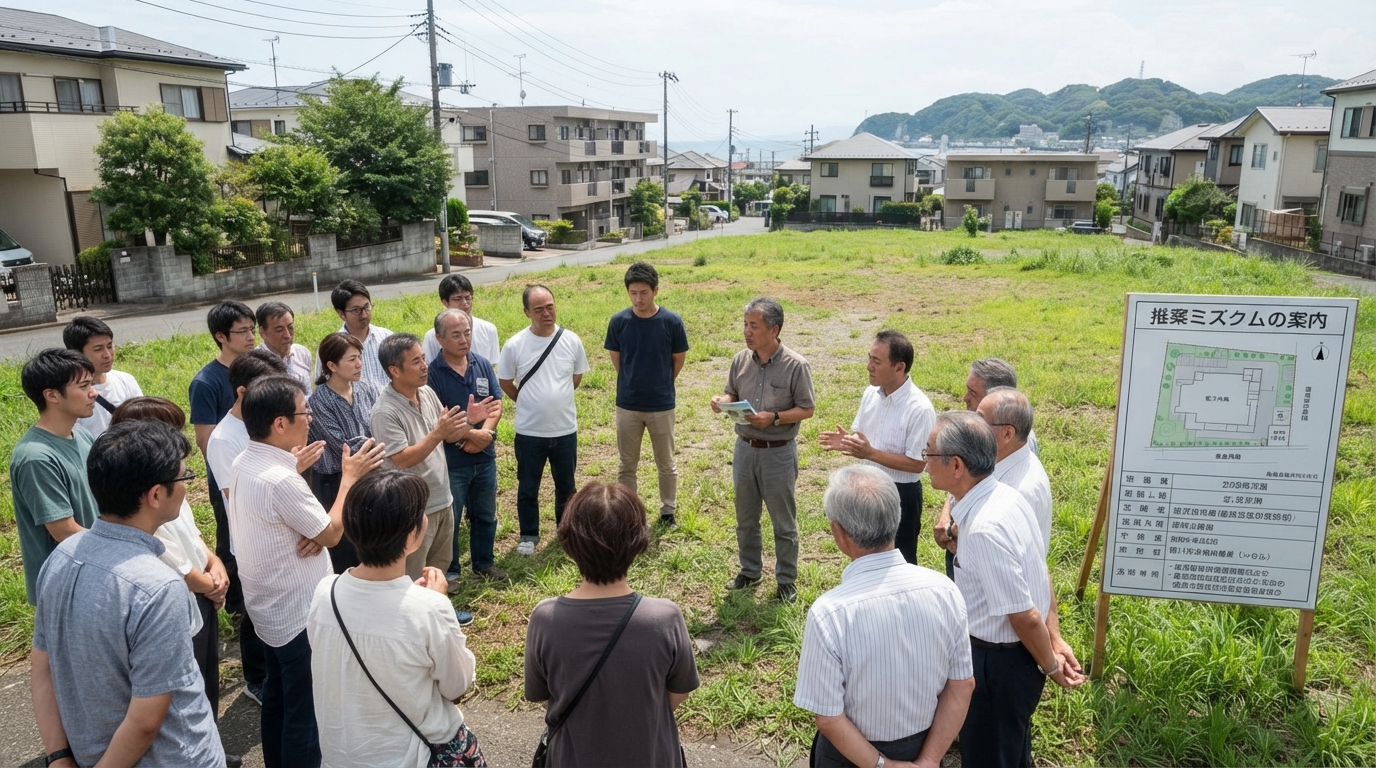
A Japanese town is grappling with its identity following public outcry over plans for its inaugural mosque.
What is currently a grassy expanse in Fujisawa is slated to become the site of the town's first mosque, a development that has stirred a wide spectrum of emotions.
"It makes me worry about how our community might change," expressed Noriko Izumizawa, a long-time resident.
The proposal to construct an Islamic religious center in Fujisawa, a tranquil coastal town approximately an hour's drive south of Tokyo, has ignited a range of sentiments, from apprehension and anger to hope and acceptance. This situation underscores the escalating concerns surrounding immigration and societal shifts as Japan contends with a labor deficit stemming from its dwindling and aging populace.
While immigration remains a politically sensitive and restricted topic, Japan is increasingly dependent on foreign workers to fill job vacancies. This influx brings with it diverse cultures, languages, religions, and lifestyles. Consequently, the discourse unfolding in towns like Fujisawa across the nation delves into the fundamental question of Japan's self-perception.
Izumizawa's sentiments are shared by others. She is part of a group of Fujisawa residents who are uneasy about the increasingly visible Muslim community. She attributes some of her discomfort to the polarizing immigration debates observed in the US and Europe.
Earlier this year, anti-mosque demonstrations erupted at the local train station, drawing thousands who protested the proposed construction. Some critics argue that a mosque significantly larger than the nearby Japanese Shinto shrine is disrespectful.
Reports of hate speech and misinformation circulating on Japanese social media have also emerged. Local media outlets indicate that mosques have been receiving abusive phone calls and emails, prompting anti-hate groups to organize counter-protests advocating for tolerance.
Hiroki Suzuka, who manages a coffee shop directly opposite the planned mosque site in Fujisawa, emphasized the need for greater understanding and dialogue.
"I'm not particularly opposed, but I wouldn't say I'm strongly in favor either," Suzuka stated. "I think the first step is to learn about them, what Islam is, what kind of people they are, and what values and perspectives they hold. It begins with having an open mind and a desire to understand each other."
Mohamed Mohideen, a businessman, has resided in Osaka for 39 years, having moved from Sri Lanka in 1987 in pursuit of better employment opportunities during Japan's economic bubble. He initially dealt in gemstones before transitioning to exporting used cars to countries such as Sri Lanka and Pakistan. He recalls a time when foreign residents were far fewer.
However, Mohideen perceives a recent shift, noting that local people have become more hostile and are making hurtful remarks towards Muslims, both online and in person.
"On social media, there are countless comments like, 'Get out of Japan' and 'Go back to your own country,'" Mohideen recounted. "People have also started coming to the mosque and shouting abuse."
Mohideen attends the Osaka mosque daily for prayers and other community duties. He asserts that he has never felt his life was in danger, despite the recent change in attitudes towards Muslims, even among neighbors with whom he previously had good relationships.
"Now, I feel that people are afraid of us."
The verbal abuse has intensified in recent years. He recalled instances where members of his Muslim community were labeled terrorists, accused of making bombs, and told to leave Japan.
"When that happens, the only thing we can do is be patient. They're trying to provoke a fight or create a confrontation. They want to see how long we'll tolerate it," Mohideen explained. "So we stay calm, speak gently, and treat them kindly, because Japanese people generally don't know much about Islam."
Nevertheless, he believes there is shared responsibility for the current divide.
"We focused only on our work and, for a long time, didn't make enough effort to help people understand who we are. We also didn't do enough to become part of the society," he admitted. "From now on, I want to work harder to increase dialogue and build better mutual understanding."
Japan's Muslim population has expanded in recent decades, and the country now hosts numerous mosques.
Shakeel Mohamed, 61, has represented the Yashio mosque in Saitama prefecture for the past decade. Having moved to Japan from Pakistan, he worked as a construction site supervisor for 26 years and is fluent in Japanese.
Mohamed emphasizes the importance of adhering to Japanese rules, including proper refuse sorting, obeying parking regulations, and wearing helmets while cycling.
"We make every effort to respect the way things are done in Japan and to follow the rules," he stated. "Courtesy is important too, even something as simple as greeting people."
He mentioned that Japanese locals in Yashio refer to the area's Pakistani community as "Yashio-stan."
"Of course, there are some Pakistanis who behave badly, but they're only a small minority. And the same is true of Japanese people."
Japan is currently grappling with its identity amidst significant demographic shifts.
According to Hirofumi Tanada, a professor emeritus at Waseda University who studies Islam in Japan, the country's Muslim population, encompassing both foreign residents and Japanese converts, reached approximately 420,000 by the end of 2024, a notable increase from 230,000 in 2019.
This growth in the Muslim population mirrors a broader national trend. The foreign resident population, primarily from China, Vietnam, South Korea, and the Philippines, exceeded four million in 2025. Government data indicates that a record 2.57 million of these individuals are employed in Japan. In the same year, Japan's overall population experienced a decline of nearly one million.
Government officials have historically refrained from labeling Japan as an immigration country, instead promoting visas perceived as temporary rather than permanent. Critics have dubbed this a "stealth" immigration system.
Despite this, Prime Minister Sanae Takaichi has adopted a highly conservative stance against large-scale immigration. In June 2026, the Japanese government decided to increase visa fees for foreign nationals fivefold, the first such increase in nearly 50 years.
Currently, the government plans to augment the staff at the Immigration Services Agency by approximately 230 individuals, aiming to bolster enforcement against foreigners who overstay their visas illegally. Officials may also introduce a limit to manage the number of foreign residents in the country.
As immigrant communities become more prominent, Japan is compelled to confront a question it has long sought to avoid: Can Japan become a more diverse country while preserving its cherished sense of identity and cohesion?
Back in Fujisawa, Izumizawa concedes that she has never personally had a negative experience with a Muslim neighbor.
"The truth is, maybe I just fear the unknown," she admitted with a shrug.
*Additional reporting by Chie Kobayashi*