

'A huge vanity project' - when Sputnik crash-landed in Scotland
Ten years after Sputnik News opened in Edinburgh, why did Scotland become a front in the global disinformation war?
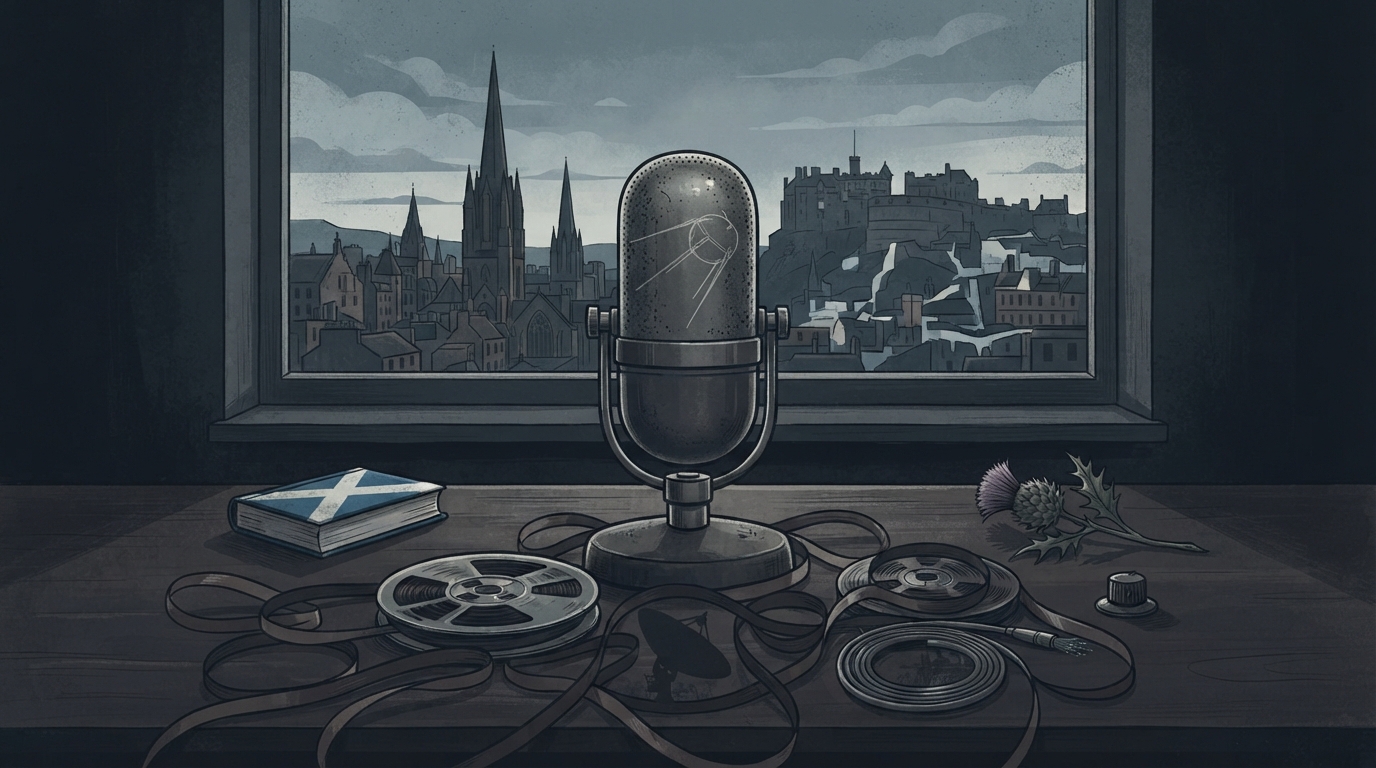
"A massive vanity endeavor" is how Sputnik's ill-fated venture in Scotland has been described.
Sputnik began broadcasting in Edinburgh in August 2016.
A decade ago, an unfamiliar entity entered Scottish airspace for the first time.
The online platform and internet radio station, Sputnik News, drew its name from the inaugural man-made satellite, launched into space in 1957.
The original Sputnik, roughly the size of a basketball, emitted a simple "beep" for three weeks before its battery failed.
However, the message it conveyed to global governments was far more profound. It signaled the Soviet Union's lead in the space race, a revelation that spurred the West into action.
Nearly six decades later, its namesake was met with comparable apprehension.
Sputnik News distinguishes itself from other media organizations. Wholly owned by the Russian government, it is widely recognized as a propaganda instrument for President Vladimir Putin.
In August 2016, it ushered in a new era of state-sponsored misinformation to Britain during a pivotal period in its recent history.
**A Scottish Platform for the Russian News Agency**
**How Russia is subtly attempting to gain influence globally, beyond the West.**
Sputnik's Edinburgh operation lasted barely five years, consistently facing accusations of fueling conspiracy theories to destabilize the UK.
A decade later, it's tempting to dismiss its time in Scotland as an odd anomaly or simply another failed media venture.
However, according to former SNP MP Stewart McDonald, that would be a misjudgment.
"Our society is ripe for hostile disinformation," he asserts. "We are deeply divided, politically and socially polarized. We are struggling economically."
"This creates the perfect environment for hostile disinformation operations. And that is precisely what Russian state media does."
"Its purpose is not to report the news."
By 2016, calls for a second independence referendum were prevalent in Scotland.
The Scotland that Sputnik entered in 2016 was experiencing a tumultuous period. In the aftermath of the 2014 referendum, a surge of new media enterprises emerged, advocating for independence.
Established online platforms like Wings over Scotland and Bella Caledonia were joined by digital news platforms such as CommonSpace and Broadcasting Scotland.
These subscription and supporter-funded services offered an alternative to what was increasingly being labeled the "mainstream media" – specifically, corporate-owned newspapers, commercial broadcasters, and the BBC.
Carolyn Scott was among the many young activist-journalists drawn to this evolving media landscape.
A folk singer and musician, she had become increasingly politically engaged during the referendum, alongside a friend from the traditional music scene, Jack Foster. The duo had run a folk music podcast for several years but had never managed to generate income from it.
Then, according to Carolyn: "The day after the referendum, Jack contacted me about establishing a new media company, and we secured some crowdfunding to explore its feasibility. We pursued that for a year."
"We launched a weekly podcast that evolved into four or five weekly podcasts, and then some YouTube TV content as well... but throughout that time, we had virtually no income."
They had an audience, but not enough to sustain themselves, leading them to dissolve the company towards the end of 2015.
A few months later, Carolyn learned that Sputnik News was coming to Edinburgh and was recruiting journalists.
Carolyn Scott joined Sputnik as a news presenter.
The Russian state-owned news agency Rossiya Segodnya established Sputnik in November 2014 as a sister service to RT – formerly Russia Today – the Kremlin's global television news service. Both broadcast the Putin government's perspective on international affairs worldwide.
Dr. Ammon Cheskin, an expert on Russian politics at the University of Glasgow, views the Sputnik of 2016 as part of a strategy to project Russian power.
"It appeared to be the kind of endeavor a great power would undertake," he states.
"In the same way that the UK might have the BBC, they would possess this network of journalists. I believe it was a facade of great power status."
"Anyone who studies Russian foreign policy knows that a key priority has been to demonstrate that Russia is indeed a great power on par with all other major global powers."
Carolyn Scott was aware of questions surrounding Sputnik's editorial independence but believed that the more established RT was not then considered beyond the pale.
"Throughout 2014 and 2015, RT had managed to cultivate a respectable reputation, a fairly decent reputation in many of the circles we were active in," she explains.
"Numerous political commentators from across Scotland and the UK hosted their own shows on RT. And it was very much presented to us as simply a radio version of that."
She and Foster signed on as presenters.
"I certainly didn't enter the job with exuberance, thinking: 'This is amazing, this is spectacular, it's going to be brilliant'," she recounts.
"It was: 'I need to pay my bills, and this will help eliminate some debt'. And we were promised virtually complete editorial freedom to run our own show."
Sputnik's Edinburgh headquarters housed both broadcast and online journalists.
Sputnik launched from Edinburgh in August 2016, and the reaction from the local media was skeptical, even hostile. It was immediately suspected of arriving in Scotland to generate and amplify tensions within the UK.
The Daily Record labeled it "Radio Gaga" and accused it of publishing stories alleging that the independence referendum had been rigged.
The Herald referred to it as "Putin's Sputnik," and an editorial in The Times declared: "Those Nationalists who welcome the arrival of Sputnik are disregarding the Russian leader's record as an autocratic ruler."
Carolyn had committed to co-presenting a daily radio program. Immediately, she sensed problems.
"It was an absolute chaotic mess. The notion that Sputnik could influence any election or referendum in this country was ludicrous. They wouldn't even influence a local dog show," she asserts.
"They had no idea what they were doing. The staff was completely inexperienced. There was a woman brought in as an executive producer whose background was as a hotel receptionist."
Nevertheless, Sputnik was perceived as relentlessly anti-Nato, pro-Russian, and pro-Donald Trump. Later, it would be accused of disseminating conspiracy theories about the Covid pandemic and the war in Ukraine.
Former MP Stewart McDonald was a persistent critic of Sputnik News.
It's crucial to recall the context in which Sputnik operated in 2016.
The UK had just voted to leave the European Union, and David Cameron had resigned as prime minister, succeeded by Theresa May.
Brexit dominated UK politics, and in Scotland, this, in turn, contributed to the SNP's dominance in the 2015 and 2016 Westminster and Holyrood elections.
Despite losing the 2014 referendum, the pro-independence movement appeared to be gaining momentum.
Sputnik heavily emphasized the pro-independence credentials of its leading journalists. In retrospect, Carolyn believes that was always the strategy.
"I now realize that I think their entire objective was to let these slightly left-wing progressive types produce the show they desired," she says.
"They gave us free rein because that might build some legitimacy so that one day, when they had an audience, they could simply pivot to their own agenda."
"And I now see in hindsight that this is what I believe their aim perhaps was."
Stewart McDonald was one of 56 SNP MPs elected in 2015. He would become his party's defense spokesman and one of Sputnik's most prominent critics.
From quite early on, he sought to establish "clear blue water" between it and the SNP.
"We very deliberately set about making RT and Sputnik as toxic as possible," he states.
"People knew that if they appeared on it, I would openly criticize them."
"I think that's partly why so few people did appear on it, because they understood this was not a good thing for us to be seen engaging with."
Alex Salmond was widely criticized for his decision to host a program on RT.
However, some were content to engage with the Russian outlets.
In 2017, former First Minister Alex Salmond faced condemnation for hosting a talk show on RT, denounced by one opponent as "Putin's puppet." His successor, Nicola Sturgeon, commented: "His choice of channel would not have been my choice."
A year later, former SSP MSP Tommy Sheridan began presenting and writing for Sputnik.
By then, Carolyn Scott and Jack Foster had long departed. They left in the spring of 2017 due to, she says, increasingly unacceptable editorial pressure.
But speaking to the BBC in 2018, Sputnik's UK editor Nikolai Gorshkov denied the company had an agenda.
"We're not attempting to influence Scottish thinking, because being based in Edinburgh, we now realize how fiercely independently minded the Scots are," he said.
"You cannot influence a Scot."
Russia's invasion of Ukraine in 2022 rendered it an international pariah.
The poisoning of former double agent Sergei Skripal and his daughter Yulia in Salisbury in 2018, followed by allegations of Russian interference in the subsequent year's UK election, led to a collapse in relations between the two countries.
This tension placed Sputnik at the heart of the disinformation war, though not for long.
The company announced the closure of its UK operation in 2021, describing the move as part of a plan to more effectively reorganize its international presence.
The following year, Russia's invasion of Ukraine made it an international pariah. Nations worldwide imposed economic and cultural sanctions.
In March 2022, the regulator Ofcom revoked RT's UK broadcasting license, and the European Union banned Sputnik and RT over their coverage of the war. Both services remain prohibited on many social media applications and websites.
Today, Sputnik's website indicates it continues to operate out of 17 countries in Africa, Asia, and the Americas.
Putin's war in Ukraine marked the end of Russia's period of soft power, according to Ammon Cheskin.
"The entire network was simply a massive vanity project that proved ineffective. It incurred significant costs and reached few people, but it presented a favorable image for those who wished to assert Russia's status as a great power," he says.
"I preferred it to what came afterward. It merely highlighted the limitations of Russian influence. Russia believed it could influence people and states through these mechanisms, and it clearly could not."
"And it therefore transitioned to a different phase, which was far more aggressive and militaristic. And that is where Russia's true influence lay."
Post-Sputnik, Carolyn has built a career in journalism education.
Stewart McDonald views Russia's disinformation program as one component of a broader conflict that now involves drones flown over European airports, attacks on sub-sea cables, and cyber-hacks on institutions.
"The ultimate warning is that you must take any form of foreign disinformation seriously," he emphasizes.
"This is a problem and a threat that is becoming more sophisticated at a rate we are simply not keeping up with."
"Consider what that means in peacetime, but what does it mean in a time of crisis? Like a pandemic, or a kinetic war, or when your sub-sea cables are severed, or if there's a cyber-attack on Network Rail that brings the central belt to a halt."
"Or during an election campaign. Have governments even considered how they would address such a situation? No, they haven't."
After her time at Sputnik, Carolyn Scott has forged a new career teaching journalism at Edinburgh Napier University. She finds discussing that period painful but understands the criticism she and her colleagues faced.
"I think if a foreign government launches a media company in your country with a rather controversial past, then it's fair game for the media to criticize it," she says.
"I feel physically ill talking about it today. I make sure to tell my students that we learn from our mistakes, and we take ownership of them; we don't shy away from them."
"But it's hard not to view it as one of the most foolish things I've ever done in my life. It is one of my biggest regrets."