

A fight between pilots, a hijack signal, and an emergency landing. What is known about the Flydubai incident
A fight between pilots, a hijack signal, and an emergency landing. What is known about the Flydubai incident
Within a few hours, the incident on board Flydubai flight Dubai–Tel Aviv became overgrown with mutually exclusive reports: first, data appeared about a possible hijacking of the aircraft, then about a fight between the pilots, an attempt to change course, and a probable terrorist attack. At the same time, information about citizenship and even the condition of the pilots themselves kept changing. We look into what is known about this episode at the moment, who was involved in it, and which versions still remain mere versions.
On September 30, flight FZ1073 was flying from Dubai to Tel Aviv on a Boeing 737 MAX 8. There were 174 passengers and eight crew members on board. During the flight, the aircraft transmitted code 7700, indicating a general emergency, and then briefly 7500, which is used in the event of unlawful interference with a flight, including the threat of hijacking. Flightradar24 data shows that after this, the aircraft abruptly changed its route and headed towards Saudi Arabia.
It was code 7500 that caused the initial version of a possible hijacking. Israeli services scrambled fighter jets, and the country's authorities held an emergency security meeting. However, it later turned out that the cause of the emergency was a conflict right inside the cockpit.
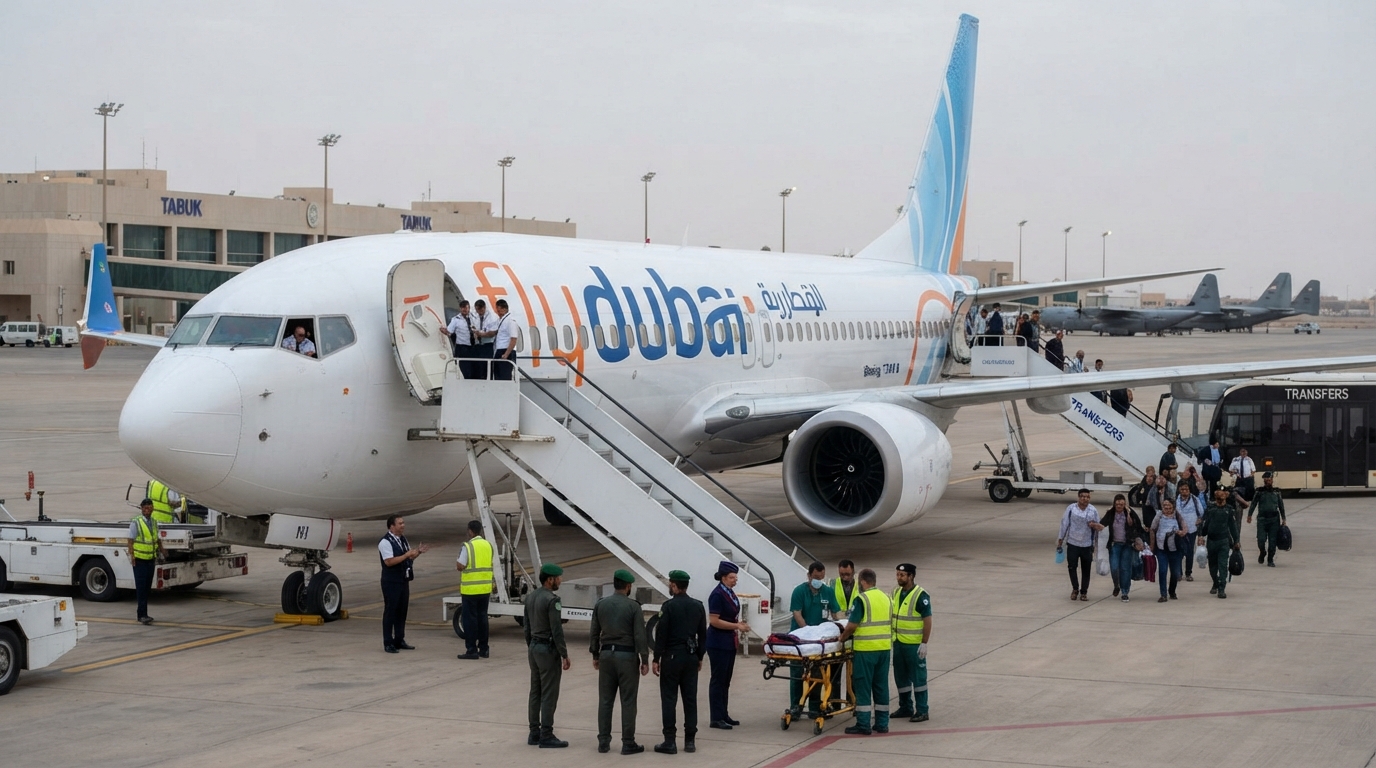
The aircraft abruptly lost altitude. According to Flightradar24, the descent was about 4.5 thousand meters in less than half a minute. At the same time, different sources cite different descent parameters, so the exact sequence of altitude changes is currently best considered a subject for further investigation. After control was regained, the aircraft headed to Tabuk Airport in northwestern Saudi Arabia and landed safely.
Who was in the cockpit
According to preliminary data from the Saudi authorities, the co-pilot attacked the captain. As a result, both sustained injuries. This is the first important established fact that allows separating what happened from the initial reports of a plane hijacking: we are talking about an attack by one crew member on another.
The captain was an Indian citizen, Smit Machchhar. After the attack, despite his injuries, he managed to open the cockpit door. This allowed passengers and other crew members to get inside and intervene in what was happening. Machchhar later told Indian Prime Minister Narendra Modi that he realized the plane was descending and was able to open the cockpit door, after which people entered.
The co-pilot was also injured after the incident. In the first hours, his citizenship was reported contradictorily: Israeli media initially called the pilots a Russian and a Ukrainian, then reports appeared about UAE and Omani citizenship. In later reports, the co-pilot was referred to as an Omani citizen, but this information should be attributed to source reports, as Flydubai has not officially disclosed the nationality of the crew members.
How passengers intervened in the situation
After the cockpit door opened, passengers and other crew members got inside. Several passengers helped subdue the co-pilot. Israeli President Isaac Herzog announced that Yaniv Hayun, Zvika Manes, and Asaf Radjuan should receive awards for their participation in this episode. Another passenger, dentist Shota Musaev, provided assistance to the injured captain.
The role of Hayun was discussed separately. According to his own account, he grabbed the attacker and then pulled the yoke towards himself when the plane began to descend sharply. This is important to separate from the established fact of the landing: the passenger's account explains one of the episodes of the struggle for control, but does not mean that he was the one piloting the aircraft.
After the attacker was subdued, control was restored. Here, too, confusion arose in the first publications. Some reports claimed that the plane was landed by an additional pilot who was among the passengers. Flydubai stated otherwise in its official announcement: according to the airline's version, the aircraft was brought back under control by a deadheading Flydubai crew on board, after which they changed route and safely landed the plane in Tabuk.
Where the terrorist attack version came from
After the landing, reports appeared that the co-pilot allegedly intended to seize control of the aircraft and crash it. This version was publicly voiced by Israeli officials, including Prime Minister Benjamin Netanyahu and Defense Minister Israel Katz. Netanyahu also spoke of a possible radical Islamist ideology of the attacker.
In its first official statement, Flydubai spoke only of a conflict in the cockpit. Following an initial investigation, the Saudi Ministry of Interior also reported only an attack by the co-pilot on the captain, without naming a motive.
Moreover, it is precisely to determine the motive and a possible connection to terrorism that the UAE authorities have launched a separate investigation. The country's Attorney General, Hamad Saif Al-Shamsi, formed a team of prosecutors to establish the circumstances of the incident, the motives of those involved, and to find out whether the incident was related to terrorist activity, pre-planned actions, or directed by anyone.
What happened to the pilots after landing
After landing in Tabuk, both pilots were taken to a hospital. The remaining crew members returned to Dubai, and the passengers were later sent to Israel on another aircraft. According to the Saudi Ministry of Interior, after their condition improved, the captain and the co-pilot were transferred from Saudi Arabia to Abu Dhabi, accompanied by UAE security officers.
The investigation has yet to establish why the conflict in the cockpit arose, what weapon exactly the attacker used, how the struggle for control of the aircraft unfolded, and whether the co-pilot had a pre-arranged plan. A possible connection of the incident to terrorism is being checked separately.
So far, only the general sequence has been established for certain: a conflict occurred in the cockpit during the flight, the co-pilot attacked the captain, the aircraft abruptly lost altitude and transmitted emergency codes, after which passengers and crew members intervened, the aircraft was brought back under control and landed in Tabuk. All other versions — from an accidental conflict to a pre-planned terrorist attack — must be verified by the investigation.