

A diploma is not a guarantee
What happens to graduates of Uzbek universities after receiving their diplomas?
## A Degree Doesn't Guarantee Employment: What Employers Look for in Graduates in Uzbekistan
A survey of 307 graduates from Uzbek universities revealed that while higher education remains important, practical experience, internships, and professional connections are increasingly required for a successful career launch. The study revealed why some students find jobs even before receiving their diploma, while others struggle to find employment for months.
**Employment Problems: From Courier to Geologist**
One respondent, who holds a degree in geology, currently works as a courier, earning less than 3 million soums per month and rates his job satisfaction at 1 out of 10. Despite completing his master's degree, he was unable to find work in his field, even offering to work for free. This case, while one of the most striking, reflects common problems raised by other participants: a shortage of job openings, employers' demand for experience, and a mismatch between university training and real-world challenges.
Of the 307 respondents, 146 are currently employed, running a business, completing an internship, or self-employed. Another 89 are currently looking for work. It's important to note that the survey does not claim to be representative of the unemployment rate among all graduates, as participation was voluntary, and those with employment difficulties may have been more active. However, the results do reveal key discrepancies between academic preparation and labor market demands.
**University provides a degree, but does not always prepare for work**
Just over half of the participants rated the quality of preparation for real-world work at university negatively, while 42% gave a positive rating. A degree remains one of the main factors in launching a career, but the problem is that the university validates qualifications without always providing the experience and skills expected by employers in their first job.
In their open-ended responses, graduates mentioned the importance of proficiency in Russian and English, Excel, 1C, Power BI, and SQL, as well as communication, sales, document management, and negotiation skills. Many acquired these skills independently, through courses, internships, or after employment.
**First Job Often Starts Before Graduation**
The most significant difference was observed between those who began working in their field while still studying and those who did not. Among graduates with relevant work experience, approximately two-thirds were employed during their studies, while among those who did not, the figure was just over a third. Students with experience may have studied in more in-demand fields, possessed better language skills, or developed more professional contacts.
Nevertheless, the results underscore the importance of entering the profession before graduation. One participant reported that he began volunteering in his third year, which subsequently led to a permanent position offer. He also landed his next job thanks to his accumulated experience and connections.
**First Job Requires Experience: A Vicious Cycle**
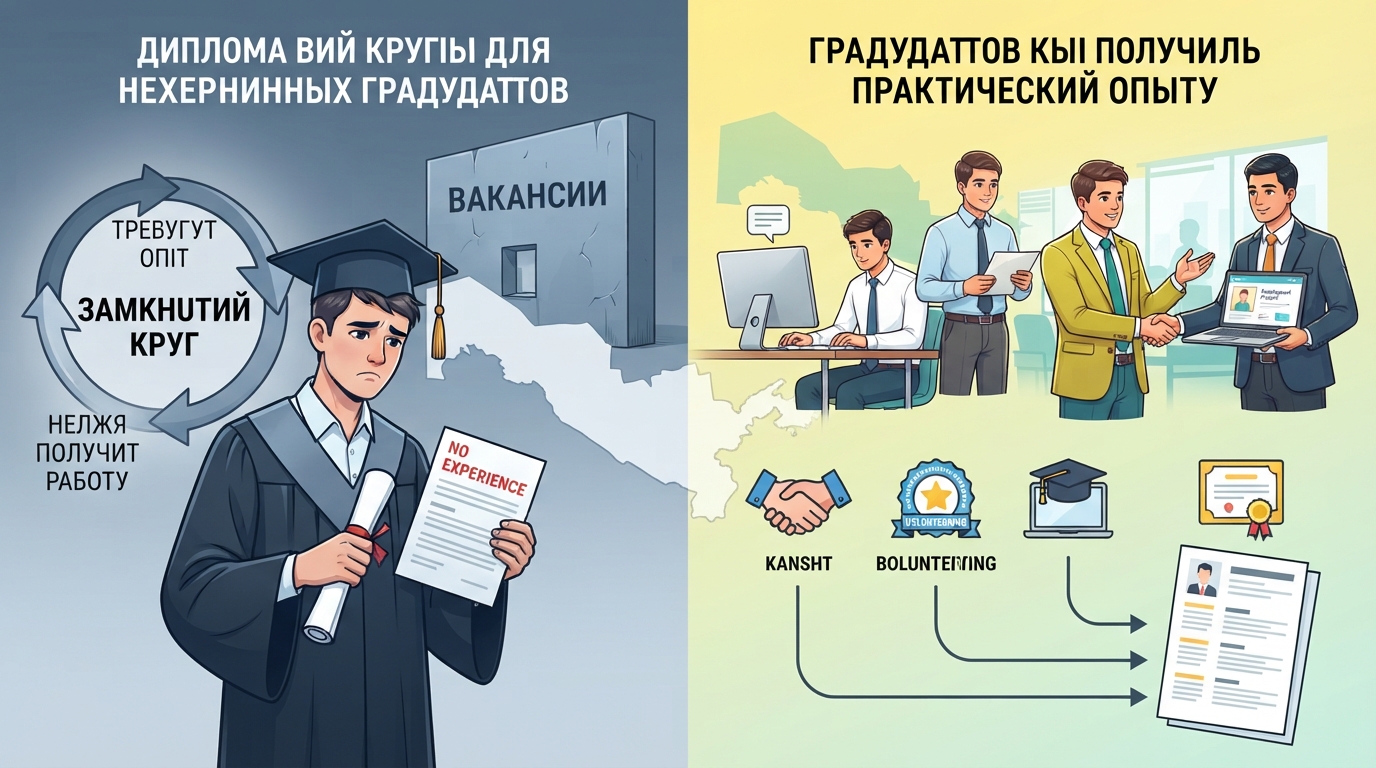
The main obstacle for job seekers was the small number of vacancies in their field. Almost half also faced the experience requirement. A graduate majoring in economics aptly summarized the problem: someone who just graduated from university is already being asked to demonstrate their experience. Another participant, who graduated in road construction, has been unable to find official employment for almost a year, as organizations reject them due to lack of experience, even when there are vacancies.
This creates a vicious cycle: experience is required for the first job, but it can only be obtained after someone agrees to offer that first job. More than half of those searching for work spend at least seven months searching, and 37 people have been searching for more than a year. A lengthy search does not always mean a complete lack of offers; graduates may turn down low salaries, informal employment, inconvenient locations, or jobs unrelated to their field.
**Networks Help More Than University**
The most common way to find a first job was through connections and family – almost one in three employed participants found a job through this channel. Twelve participants found their first job through a university or career center. The same number of participants reported that an employer contacted them directly. Personal connections do not necessarily mean employment through influence; they can include professional recommendations, connections from internships, volunteer projects, and first jobs. However, the results show that university career mechanisms are still less likely to lead to employment than personal contacts. Only four out of 307 participants mentioned the career center as a factor in helping them launch their career, indicating its role remains insignificant.
**Not Everyone Leaves Their Career**
Only 42% of employed participants reported that their current job is completely related to their degree. However, a complete change in career was not the experience of most. Combining the full and partial correlations, approximately 71% of employed participants maintained their attitude toward their education. Thus, the problem lies not only in graduates choosing a different profession, but also in the difficulties of landing their first job and transforming their university knowledge into experience recognized by employers.
**Work Doesn't Always Mean High Income**
Among the 144 employed participants who reported an income, the most common range was 5 to 8 million soums per month, which also served as the median. Participants' incomes varied significantly: about half earned less than 8 million soums, while approximately one in five reported incomes above 12 million. These results cannot be used to estimate the average salary of all graduates, as the survey included people of different professions, regions, ages, and graduation years.
**Graduates Earn Their Own First Line on Their CV**
The story of a geology graduate working as a courier doesn't reflect the situation of all young professionals, but it does illustrate the key gap identified by the survey. A diploma remains important, and most working participants have fully or partially retained a connection to their education. However, a diploma alone is often insufficient for landing a first job.
Some enter the profession through an internship, others through work during their studies, teaching, volunteer projects, or connections. Those entering the market without experience can search for months. Until universities and employers create a clear transition from studies to their first position, graduates will have to independently resolve the main contradiction of the labor market: to gain experience, they first need to prove they already have it.
**What do employers look for in students without experience?**
A lack of years of experience doesn't always bar a first job. Comments from TBC Uzbekistan and CLICK show that when selecting students and junior specialists, companies look beyond a diploma and the number of lines on their resume. Fundamental knowledge, a desire to apply it in practice, an ability to learn, motivation, and a work ethic are important to them.
**Experience isn't just about official employment**
When hiring for junior positions, TBC Uzbekistan looks not so much at a candidate's previous work history as at their efforts and acquired knowledge. This could include an internship, part-time job, freelancing, volunteering, university internship, student project, or personal project. According to Daria Shabanova, Head of Talent Acquisition at TBC Uzbekistan, such experience helps determine whether a candidate can set goals, achieve results, collaborate with others, and take responsibility.
"When hiring students, we don't expect them to have the experience of an adult professional. We look at their potential: learning ability, motivation, responsibility, initiative, and ability to work with people. A good signal for us is any real experience while still studying: an internship, part-time job, project, or volunteer work."
Therefore, the absence of an official job doesn't necessarily mean a blank resume. A small project can sometimes tell an employer more than just a list of familiar programs and tools.
**Fundamental knowledge is necessary, but being a fully-fledged specialist is not required**
Employers don't expect students to be able to independently complete all tasks from day one. TBC believes that a theoretical foundation is important for junior specialists, but the ability to quickly master new processes, tools, and information is equally crucial. If a candidate can grasp a new task, ask the right questions, and apply their acquired knowledge, a lack of specific experience isn't always a decisive disadvantage.
CLICK takes a similar approach. The company notes that when recruiting interns, it doesn't try to find the candidate who knows the most. What's more important is whether the candidate can think, is interested in the work, and is willing to put in the effort. Fundamental knowledge remains a prerequisite, but the employer then wants to see what the candidate can do with that knowledge.
**Motivation must be specific**
TBC also emphasizes the importance of making informed choices. The interview reveals whether the candidate has researched the company and the position, understands the upcoming challenges, asks insightful questions, and can explain why they want to develop in this specific field. Therefore, the phrase "I want to develop" alone doesn't convey much. Specifics are more effective: what the candidate studied independently, what projects they worked on, what problems they tried to solve, and why they chose this particular field.
**Employers care about how the candidate thinks**
At CLICK, the intern selection process consists of three stages: resume review, a test assignment, and a final interview with a mentor. This allows us to assess not only knowledge but also how the candidate understands the task, reasons, and comes to a solution.
"We understand perfectly well that a student is not a ready-made specialist. Lack of experience and gaps in knowledge are normal, and we accept that. We will impart practical experience and knowledge ourselves. But there are things that can't be taught: dedication to work and hard work. That's what we look for first and foremost."
CLICK notes that some of the company's current employees started with internships and then stayed on.
Some skills are easier to teach than others.
According to TBC's observations, the main gaps among graduates can be divided into two groups:
* **Practical skills:** A strong theoretical foundation can be combined with a lack of day-to-day work experience: prioritizing, managing a task from start to finish, interacting with managers and colleagues, working with clients, and analyzing information. Some positions may also require basic digital skills, such as Excel, CRM, and document management.
* **Soft skills:** Independence, responsibility, initiative, communication, and teamwork.
TBC emphasizes that Excel or CRM skills can be taught internally. It is much more difficult to develop responsibility, initiative, and the habit of independently solving problems. In this regard, TBC and CLICK's assessments largely coincide: gaps in technical knowledge can be gradually filled, but a person's attitude toward work, willingness to learn, and taking responsibility are important from the start.
**How to gain experience before graduation?**
The survey also reveals a noticeable difference: among participants who worked in their field while studying, the proportion of those currently employed is significantly higher than among those who did not. First experience does not necessarily have to be a full-time job. It can be: an internship; a part-time job; freelancing; volunteering; a university project; an in-house project; a hackathon or competition. Some employers create such opportunities themselves.
Therefore, it is more useful for students to not dwell on the thought "I have no experience" but to ask a different question: what real result can I create while still studying and then demonstrate to an employer?
**Research Methodology**
307 university graduates participated in the online survey. The questions depended on the participant's current status. A total of 146 employed respondents answered questions about their work and employment options. Eighty-nine currently seeking employment discussed the length of their search and obstacles. Participants participated voluntarily. The sample was not weighted by age, region, major, or year of graduation, so the results cannot be considered representative of all graduates. The survey reveals correlations between responses but does not establish causation. For example, higher employment rates among participants with relevant experience does not prove that working during their studies determined their subsequent careers.