

A "carbon credit" mechanism will be established in Karakalpakstan
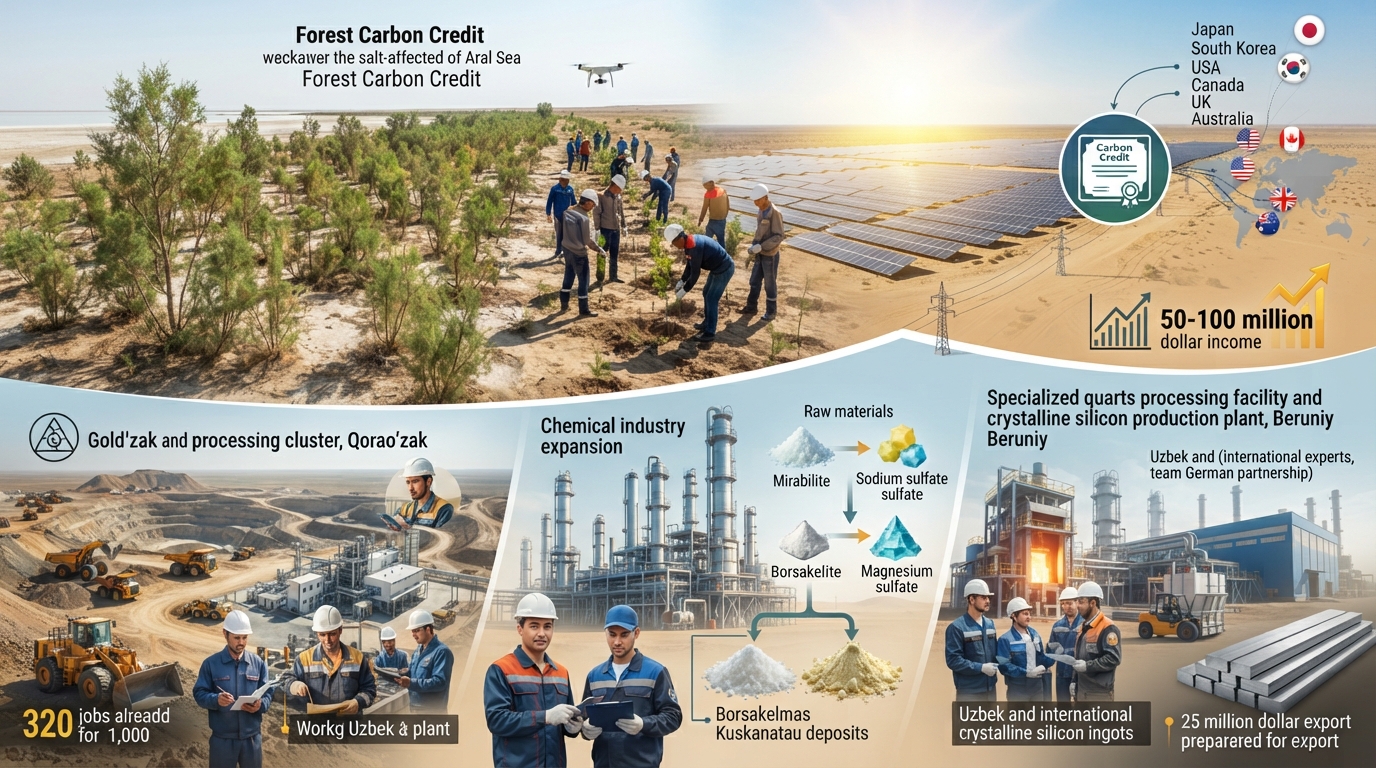
A "carbon credit" mechanism will be introduced in Karakalpakstan
A meeting dedicated to the socio-economic development of Karakalpakstan is being held in the city of Nukus under the chairmanship of Shavkat Mirziyoyev.
It was noted that reducing greenhouse gas emissions into the atmosphere is an urgent issue in the context of climate change.
Converting "green" energy into "carbon credits" could bring Karakalpakstan at least $50-100 million in revenue annually.
Officials were instructed to launch the "carbon credit" mechanism in Karakalpakstan within a month and to hold negotiations with major importing countries such as Japan, Korea, the USA, Canada, the UK, and Australia.
The funds obtained from the export of "carbon credits" will be in addition to the funds allocated for infrastructure and will remain in Karakalpakstan itself.
Large foreign companies are making proposals to finance tree planting in ecologically difficult areas through the "forest carbon credit" system.
The task was set to launch the "forest carbon credit" program on 50,000 hectares of the Aral Sea region by the end of the year.
Geological work has been carried out on only 20 percent of the territory of Karakalpakstan. It was emphasized that at a time when major investors are coming, information on raw material reserves is insufficient.
A Chinese investor brought $33 million in investment and technology to the "Urusoy" deposit in Karauzak and identified 4 tons of gold reserves on 200 hectares. 320 jobs have been created here.
Instructions were given to resolve the issues raised by investors within a month, establish a gold mining and processing cluster with 1,000 jobs, develop a comprehensive geological exploration program, and re-evaluate deposit reserves.
Every year, 1 million tons of industrial salt from the "Borsa Kelmas" deposit in Kungrad is sold without being processed. By processing mirabilite at the "Kuskanatau" deposit in Bozatau, it is possible to obtain 45,000 tons of sodium sulfate annually, and magnesium sulfate from astrakhanite.
A German company planned to invest $30 million in the quartzite deposit in Beruniy to produce crystalline silicon and establish exports worth $25 million annually. In the world market, one ton of crystalline silicon costs $5.5 thousand.
Chemical industry officials were tasked with implementing additional projects worth $200 million in addition to the initial $400 million plan and creating 5,000 jobs.