

A 200-year-old mystery solved: artificial intelligence helped read a military letter
Researcher Carter Church announced that he succeeded in reading an encrypted military message sent to General Auguste de Marmont during the Napoleonic era. He stated that the GPT-6 Astra model spent nearly six hours of computing time analyzing and decrypting the old scan. The researcher himself dedicated several of his evenings to the work.
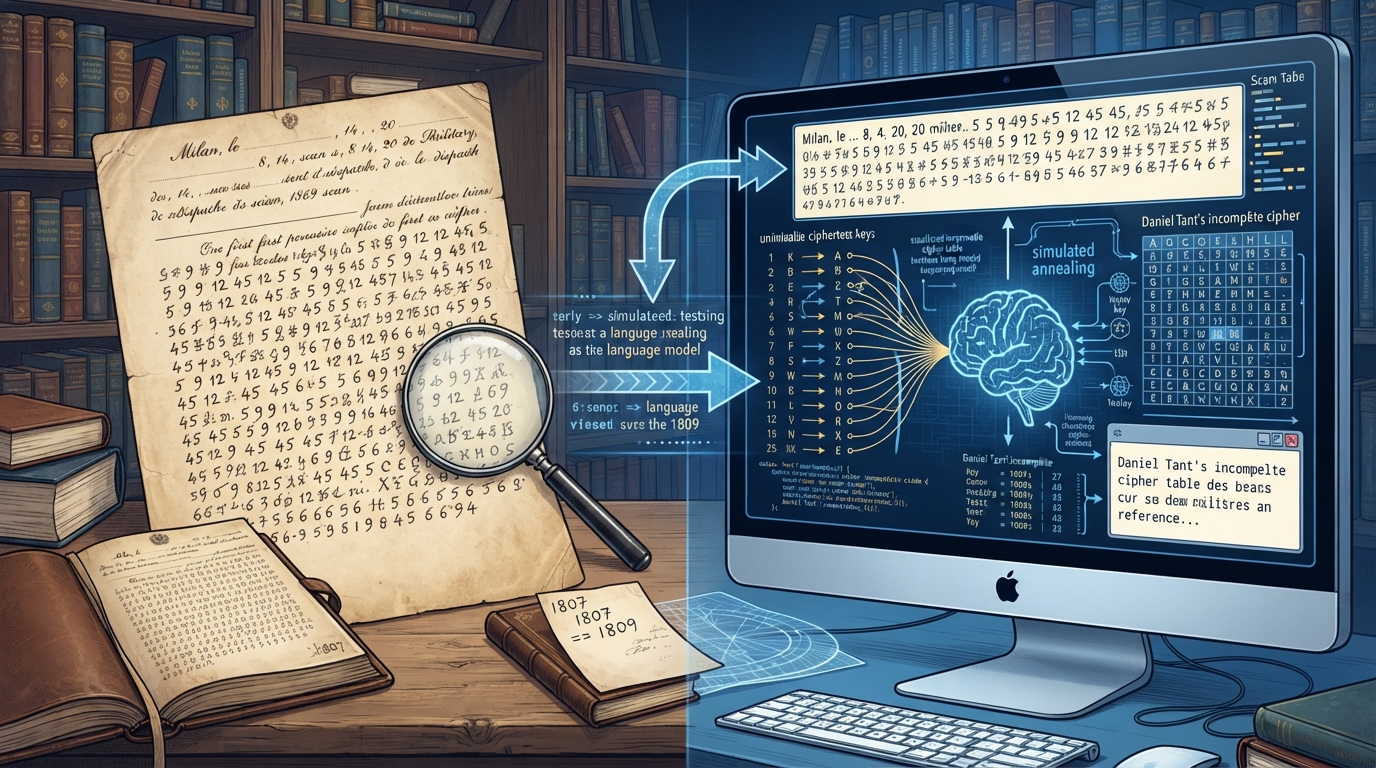
A 200-year-old mystery solved: artificial intelligence helped read a military letter
The subject is a dispatch sent in the spring of 1809 from the headquarters of the Viceroy of Italy, Eugène de Beauharnais, to General Marmont. The document is related to Napoleon's instruction to inform the commander in Dalmatia about the situation of the French and allied troops.
This is not a letter written by Napoleon's own hand, but a military message prepared based on his instructions.
24 lines of cipher followed simple sentences
A scan of a reproduction published in a French military-historical journal in 1969 was used for the research.
The first line of the letter is written in plain French. It reminds the addressee of the letters from the 8th, 14th, and 20th of the current month. After that, 24 lines of cipher consisting of numbers, letters, and handwritten symbols followed.
According to Church's calculations, the final transcript contains 1,300 cipher units and 155 different symbols.
In the encryption system, a single letter was represented by several different symbols, and some symbols replaced entire words. For this reason, simply identifying the most frequently repeated symbol was not enough to read the letter.
How did the artificial intelligence work?
In the research, an existing but incomplete cipher table by cryptography historian Daniel Taunt was used as a starting point.
To find the remaining matches, the model compared probable readings with the French language. To check controversial symbols, it referred back to the image of the manuscript.
An optimization method called "simulated annealing" was used in the search for cipher key variants. It helps to try different keys and evaluate how correctly the resulting text is read.
Such methods existed even before modern language models. The unique aspect of this work is that manuscript recognition, historical source searching, and programming tasks were combined into a single process.
The date of the letter was also clarified
In the Cryptiana catalog of historical ciphers, the document was listed for a long time as belonging to 1807. Church, however, proposed dating it to 1809.