

OpenAI announced that it has solved one of the "millennium prize problems." Two mathematicians suspect that their results were used
OpenAI has announced that its AI agents have solved one of the 7 'Millennium Prize Problems'. Two mathematicians suspect that the OpenAI model may have been trained on their data and misappropriated their ideas. They also claim that OpenAI employees have threatened them.
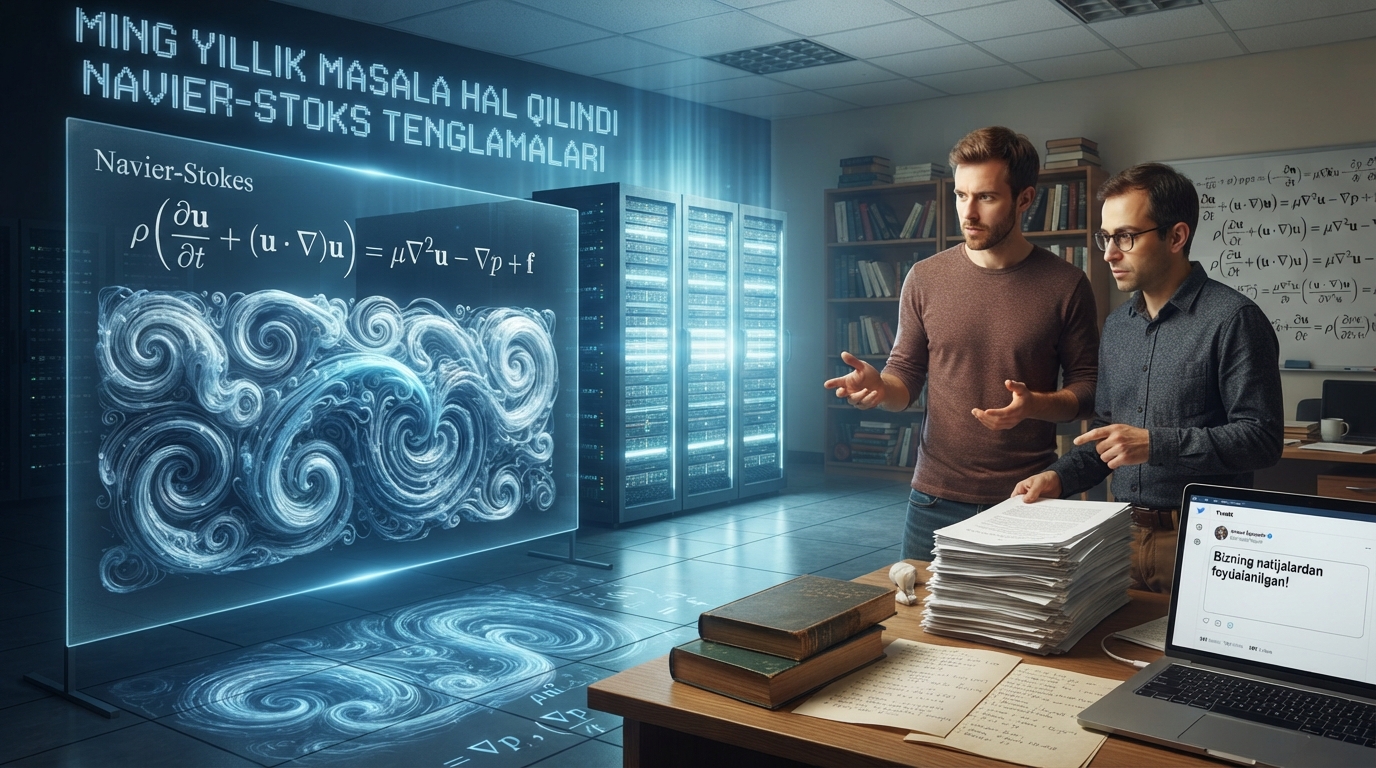
OpenAI announced that it has solved one of the "Millennium Prize Problems." Meanwhile, two mathematicians suspect that their results may have been used.
In the first week of September, OpenAI announced that its artificial intelligence agents, using the company's unreleased internal model, had solved one of the seven mathematical problems known as the "Millennium Prize Problems" — the problem concerning the Navier-Stokes equations.
Just hours before this announcement, Tristan Buckmaster — one of the two mathematicians working in the same field — posted a message on social media accusing the company of using their results and putting pressure on him. Both sides are presenting their own version of events. As a result, this situation has sparked intense debate in the mathematical world, turning into an ethical controversy.
The issue is that whether a general and smooth solution in three-dimensional space (3D case) exists for these equations has remained a mathematically open question for 90 years.
The question is posed as follows: if a flow in three-dimensional space starts from a completely smooth and quiet state, will the equation always describe its subsequent motion correctly and continuously? Or can the flow jump to infinite velocity at some point? If the latter occurs, mathematicians call this a "blow-up of the solution" — meaning the equation ceases to describe anything from that moment on.
Solving the problem could lead to positive breakthroughs in engineering, turbulence problems, medicine, and other fields. Most importantly, according to mathematicians, the path leading to the solution and the concepts introduced to science during the process of solving the problem hold more value than the solution itself.
According to OpenAI's version, on September 1, rumors reached the company that solutions to two of the seven "Millennium Prize Problems" might have been found. Following this, the company decided to test a newly developed internal model, which has not yet been released for public use, on all unsolved mathematical problems on the list.
It is worth noting that there are also speculations that the company became "interested" in the "Millennium Prize Problems" after learning that one of these problems might have been solved by its main competitor, Anthropic.
The company formed several groups of AI agents of various sizes, allowing them to use a cached version of the internet, as well as run code and communicate within the group. In addition to the "Millennium Prize Problems," the AI agents were also given several simpler related problems. These included the problem of the regularity of solutions to the Euler equations — equations similar to the Navier-Stokes equations, except they do not take into account the viscosity of the medium, making them much easier to work with. A group of 100 agents managed to solve it within 50 hours.
After reviewing the solution, researchers considered the Navier-Stokes problem to be the most promising for further work. Following this, a group of nearly ten thousand agents was directed to the main area — the Navier-Stokes problem — and a solution was found in approximately 88 hours on September 5. It took another 17 hours to formalize and verify the results in the Lean interactive theorem proving system. This task was assigned to the recently released GPT-6 Astra model. For the Navier-Stokes problem alone, according to the company's statement, 2.7 million messages were exchanged and about 130 billion tokens were consumed.
At the end of its statement, OpenAI noted that the rumors that prompted the company to start the research were related to the work of Tristan Buckmaster, a mathematics professor at New York University, and Levent Alpoge, a mathematician working at Anthropic. The text states that on September 6, after the verification of the results in the Lean system was completed, OpenAI representatives contacted the scientists, proposing a joint publication of the work.
The company twice emphasized that it recognizes the scientists' priority in solving the Euler problem, and also stated that it does not claim the "Millennium Prize." Furthermore, OpenAI claims that neither the researchers themselves nor their AI agents had access to Buckmaster and Alpoge's work, and did not use any specific user data.
At the same time, the company's statement also noted that anonymized data from Buckmaster and Alpoge, obtained during their use of OpenAI models, might have contributed to improving their work results.
"We had no access to their work in any way before it was made public; in particular, no specific user data was used to solve this problem. Although it is highly unlikely, we cannot rule out that anonymized data obtained from their use of our products helped improve our models. However, our proofs differ significantly, and even the results clearly proven in the Euler case differ from each other," the company says.
Rumors that one of the "Millennium Prize Problems" had been solved began to spread in early September. On September 3, Levent Alpoge learned that this information had reached OpenAI, and Buckmaster decided to write to them himself to confirm the rumors.
On that day, OpenAI representatives replied to him, offering to share details and stating that they were ready to provide additional computing power for the research. The scientist suggested discussing this the following week, but as early as September 4, company employees asked to schedule a meeting. After receiving a refusal, they repeated the request on September 6. Soon, the reason for such persistence became clear — OpenAI announced that its internal model had generated a proof for the Navier-Stokes problem.
The scientist claims that he was shown the corresponding prompt, but they refused to tell him for a long time when it was first sent to the AI system. According to him, OpenAI representatives did not answer a direct question about whether Codex had been trained on the scientists' sessions.
The Clay Mathematics Institute, which has promised a reward for solving the "Millennium Prize Problems," is in no hurry to evaluate the solution. Nevertheless, on September 11, the institute released a statement suggesting the problem "appears to be solved" and changed the status of the problem on the website from "unsolved" to "active" ("solved") — however, this does not mean that the prize will be awarded or that the proof has been verified.
Of the seven problems, only one — the Poincaré conjecture — has been officially recognized as solved so far.
Moreover, no one has yet independently verified the 166-page proof.