

9/11: What happened and how many people died in September 11 attacks?
The 2001 attacks killed thousands of Americans, and had profound consequences across the globe.
9/11: What happened and how many people died in September 11 attacks?
A series of commemorative events will be held on Friday in the United States to mark the 25th anniversary of the 9/11 attacks.
On Tuesday 11 September 2001, hijackers took control of US passenger planes and flew them into two New York skyscrapers, killing thousands of people.
The attacks had far-reaching consequences around the world.
Four aircraft over the eastern US were seized at the same time by small groups of hijackers.
They were then turned into giant guided missiles and flown into landmark buildings in New York and Washington.
Two planes struck the Twin Towers of the World Trade Center in New York, with the second impact coming 17 minutes after the first.
The towers caught fire, trapping people on the upper floors and shrouding the city in smoke. In under two hours, both 110-storey towers collapsed in enormous clouds of dust.
A third plane hit the western side of the Pentagon - the huge headquarters of the US military just outside Washington DC.
The fourth plane went down in a field in Pennsylvania after passengers fought back. It is believed the hijackers had intended to target Washington's Capitol Building.
In all, 2,977 people died, not including the 19 hijackers, most of them in New York:
All 246 passengers and crew on the four planes were killed
At the Twin Towers, 2,606 people died - either at the time or later from injuries suffered in the attack
At the Pentagon, 125 people were killed
The youngest victim was two-year-old Christine Lee Hanson and the oldest was 82-year-old Robert Norton, both of whom were passengers on planes.
When the first plane hit, an estimated 17,400 people were inside the two towers. No one survived above the impact zone in the North Tower, but 18 people escaped from floors above the impact zone in the South Tower.
Victims came from 77 different countries. New York City lost 441 first responders.
Thousands were injured, or later developed illnesses linked to the attacks, including firefighters who had worked in toxic debris.
Health conditions tied to the dust and smoke from the towers' collapse have since killed more than three times as many people as died in the attacks.
An Islamist extremist network called al-Qaeda planned the attacks from Afghanistan.
Led by Osama Bin Laden, al-Qaeda blamed the US and its allies for conflicts in the Muslim world.
The group's Khalid Sheikh Mohammad allegedly came up with the plot and helped recruit the pilots, some of whom trained in the US.
Nineteen people carried out the hijackings, split into three teams of five and one team of four on the plane that crashed in Pennsylvania.
Fifteen of the hijackers were Saudis like Bin Laden. Two were from the United Arab Emirates, one from Egypt and one from Lebanon.
Less than a month after the attacks, then-US President George W Bush led an invasion of Afghanistan - backed by an international coalition - to destroy al-Qaeda and track down Bin Laden.
But it was not until 2011 that US troops finally found and killed Bin Laden in neighbouring Pakistan.
Khalid Sheikh Mohammad had been arrested eight years earlier in Pakistan in 2003.
Al-Qaeda still exists. It is strongest in Sub-Saharan Africa, but even now has members inside Afghanistan.
US troops withdrew from Afghanistan in 2022 after nearly 20 years, raising fears among many that the Islamist network could stage a comeback.
Born in Kuwait, Khalid Sheikh Mohammed studied engineering in the US before fighting in Afghanistan in the 1980s.
He was already wanted by the FBI before 9/11 because of his role in other bombings and foiled attacks.
After his arrest in 2003, Mohammed spent three years in secret CIA prisons where he was subjected to "brutal" interrogation methods, according to US Senate Intelligence Committee findings.
He was eventually transferred to the US Navy base at Guantanamo Bay in Cuba, where he has remained.
A military court at the base has spent more than a decade considering whether and how he can be tried for his role in 9/11, amid concerns that his treatment while in US custody could weaken the evidence against him.
In January 2025, he and two other defendants - Walid Muhammad Salih Mubarak Bin Attash and Mustafa Ahmed Adam al-Hawsawi - were expected to plead guilty for their part in the attacks.
In exchange, they would avoid the death penalty and instead serve life sentences without parole.
But the plea deal was dropped in July 2025 after the US government objected.
The trial for Mohammed and three co-accused is set for June 2028.
Flight security was tightened worldwide in the years after the 9/11 attacks.
In the US, the Department of Homeland Security was created to prevent further terrorist attacks, Bush said. The Transportation Security Administration was also established to strengthen security at airports and on planes.
It took more than eight months to clear "Ground Zero" - the site of the fallen Twin Towers.
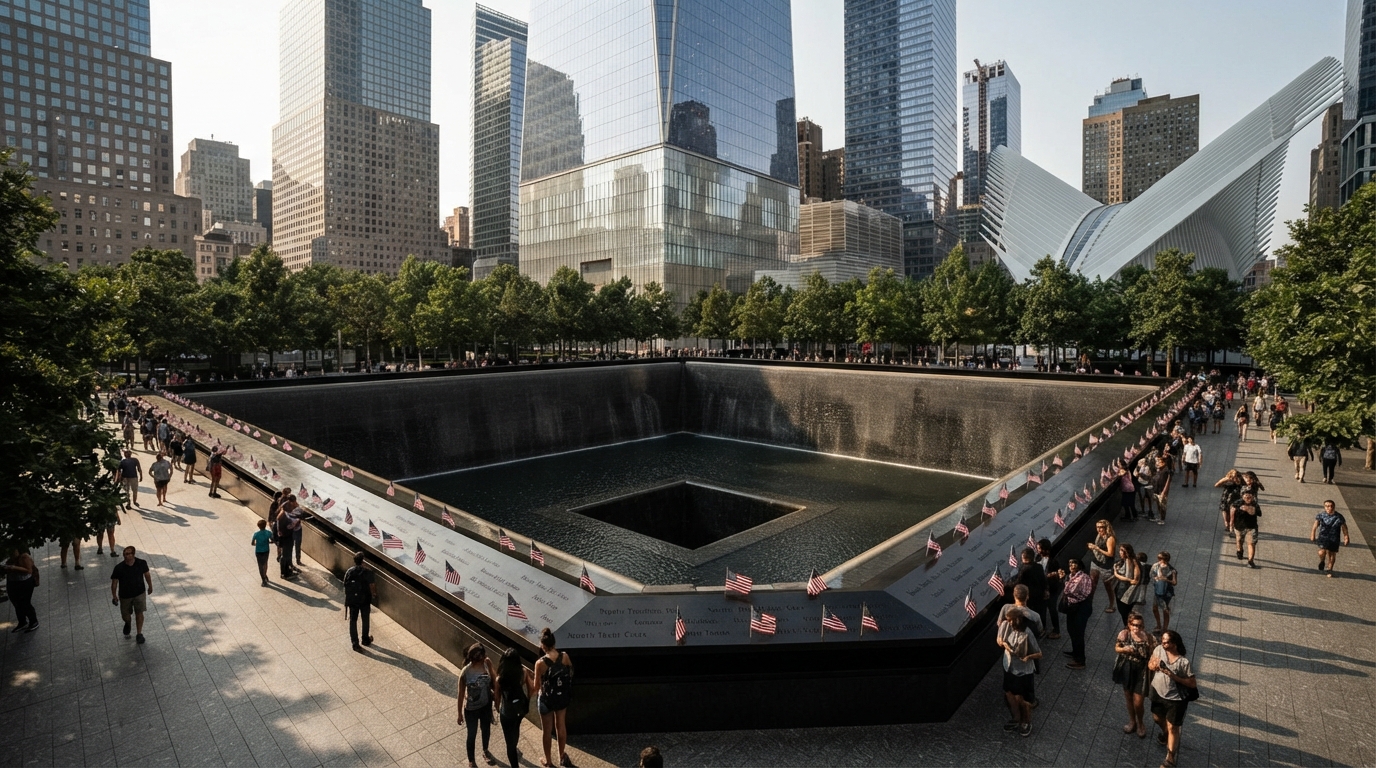
A memorial and a museum now stand on the site, and new buildings have risen there in a different design.
At 1,776ft (541m), the completed centrepiece - the One World Trade Center, or "Freedom Tower" - stands even taller than the original North Tower it replaced, which was 1,368ft (417m).
Rebuilding at the Pentagon took just under a year, with staff back in their offices by August 2002.