

400 km/h trains and a smart ticketing service - China wants to modernize its railways
China has presented a plan for the technological modernization of its railway sector by 2030. It envisages the development of an operation system for trains traveling at a speed of 400 kilometers per hour, the continuation of research on maglev trains reaching 600 km/h, and the provision of passenger services using artificial intelligence.
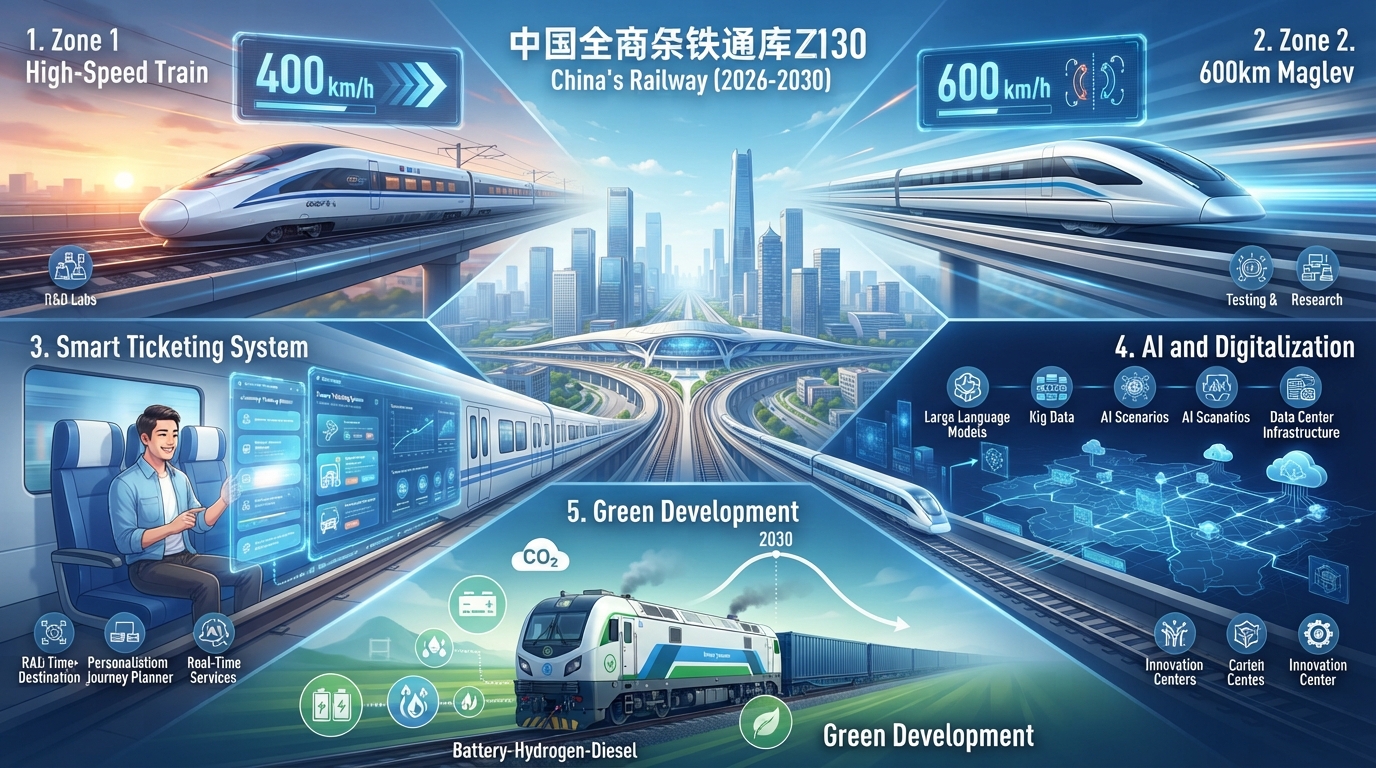
Trains at speeds of 400 km/h and a smart ticketing service — China's railways are planned to be upgraded
The document published by the National Railway Administration of China covers the years 2026–2030. According to the Global Times, this plan combines infrastructure construction, new technical equipment, digitalization, safety, and emission reduction efforts.
Within five years, the sector aims to establish nearly 30 new scientific and technological innovation centers, achieve breakthroughs in at least 100 key technologies, and obtain no fewer than 500 significant scientific and technical results.
In addition, at least 20 model solutions or demonstration projects for implementing technologies into practice will be developed. Among them is an operation system for high-speed trains designed for speeds of 400 km/h.
Meanwhile, research on maglev trains designed for speeds of 600 km/h will be carried out step by step. It is planned to test key technologies necessary for manufacturing the relevant systems in China.
The official 12306 ticketing platform for passengers will also undergo changes. It is intended to transform it from a website that mainly serves for ticket purchasing into an intelligent system that accompanies the passenger throughout the entire journey. The platform should offer travel options combining various modes of transport and better accommodate personal needs.
Large language models, datasets, and computing infrastructure for the railway sector will also be developed. It is planned to create at least 20 high-quality sectoral datasets and introduce more than 20 model scenarios for the use of artificial intelligence.
In the environmental direction, the demonstration use of low-fuel-consumption diesel locomotives, as well as rolling stock combining energy sources such as batteries and hydrogen, is envisaged. The goal is to bring the volume of carbon dioxide emissions from railway transport to its peak by 2030 and create conditions for a subsequent reduction.