

Winemakers prosper but veg farms wilt in the drought
Growers in the West of England search for new crops to grow in a changing climate.
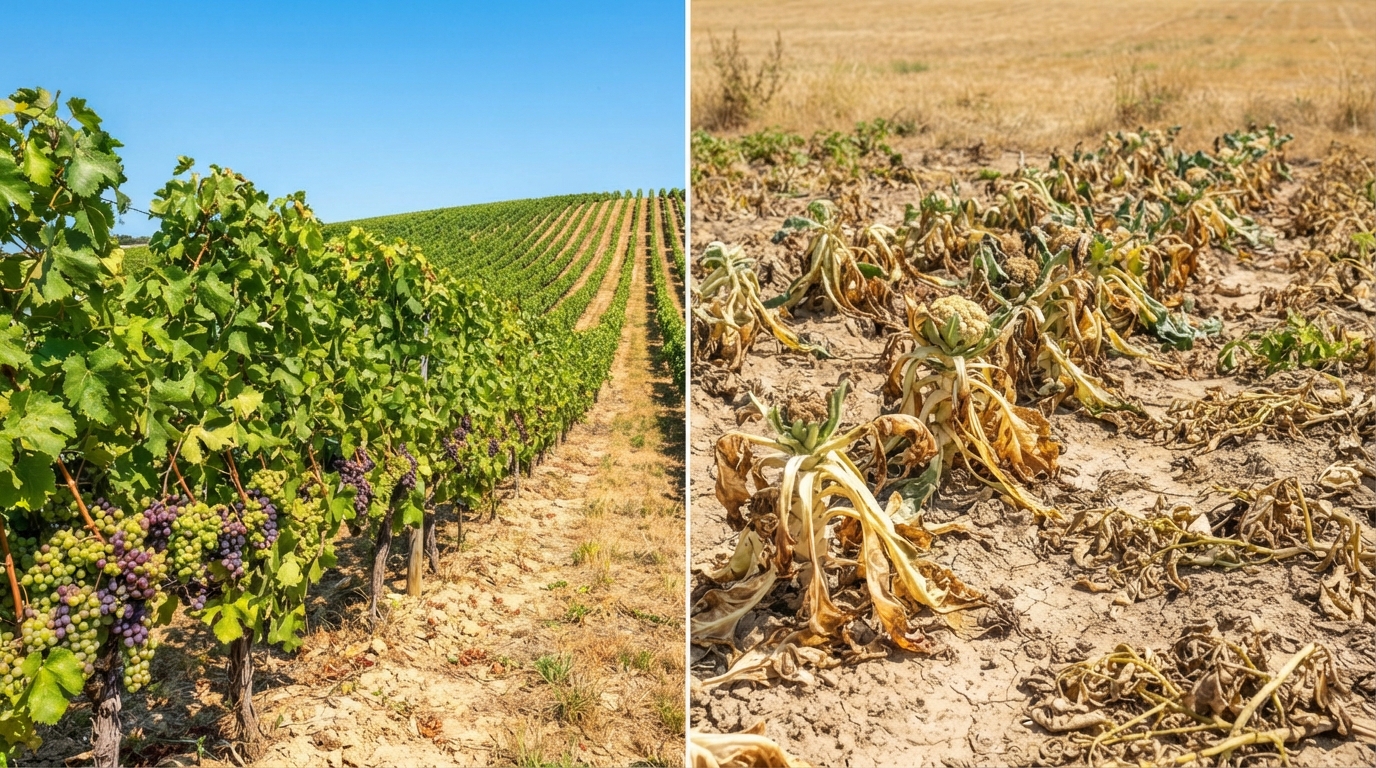
**Grape Growers Thrive Amidst Drought, While Vegetable Farms Wither**
While vineyards in Somerset are flourishing under the current sunny and dry conditions, Wiltshire vegetable farmer Phil Collins faces significant losses. For the first time in his career, Collins has an overdraft, a direct consequence of six weeks without rain that has devastated his cauliflower and potato crops.
"Six thousand cauliflowers at £1.25 each," Collins lamented, highlighting the financial impact. "You do the maths."
Across the nation, vegetable farmers are sounding alarms about potential produce shortages following the driest July in 190 years. However, winemakers are experiencing a boom.
"The vines love the warm, dry days," stated Somerset winemaker Sandy Luck.
As heatwaves and drought persist, a clear divide emerges between those thriving and those struggling, prompting questions about the future of farming in a warming climate.
**A Tale of Two Farms: Thriving Vines vs. Shriveled Spuds**
At Sandy Luck's Aldwick Estate vineyard, located just south of Bristol, the landscape could easily be mistaken for Southern France. The sun shines relentlessly, and the grapes are notably plump and abundant.
"We're getting nice 'veraison' here, look at that," Luck pointed out, showcasing a bunch where young green grapes are beginning to turn purple with a grey tint. "We're ahead of the game this year."
Winemakers are celebrating this summer's conditions. The extended period of hot, dry weather has accelerated fruit ripening and, as Luck noted, "keep disease at bay." An additional benefit is the increased sugar content in the grapes due to more sun, which translates to higher alcohol levels in the wine. This development is enabling English winemakers to produce still red wines, a departure from their traditional focus on drier sparkling varieties dictated by cooler climates.
A similarly hot and dry summer in 2025 allowed Aldwick to produce "very good looking still reds" from their Pinot Noir grapes, rather than using them for sparkling wine. "It makes a more rounded wine," Luck explained. "The quality is higher, and we have more variety we can make."
Essentially, the South and South West of England are now experiencing summers akin to those in central France two decades ago, making French-style wine production feasible. Aldwick's Somerset vintages frequently receive awards.
Hot summers also lead to increased wine production. In 2025, English wine output saw a 55% increase compared to the previous year. Despite this, English wine remains more expensive than its continental counterparts.
"Sadly not," Luck responded with a smile when asked if French weather would lead to French wine prices. "We are a small team, our vineyard is just over 12 acres, and we are going for quality not quantity."
Just 50 miles from Luck's flourishing vineyard, near Devizes, Phil Collins presented a starkly different scene.
"Six and a half thousand cauliflowers here, which have just basically cooked," he explained, gesturing towards fields of brown, crispy leaves and tiny, dried-up cauliflowers. In a potato field, the plants had shriveled to nothing, lying brown on the soil.
"This is Marfona, which is meant to be a drought resistant variety," Collins stated. "But this year has just been so dry, it couldn't cope with it. The plants should be two foot high and green - there's nothing left there."
Collins sells his produce at farmers' markets but still competes with supermarket prices. Irrigating all his crops to save them would incur costs so high that his cauliflowers, potatoes, and carrots would be significantly more expensive than supermarket alternatives. His runner bean harvest is currently "about a third of the normal crop."
"I've never had an overdraft in thirty years," he revealed. "This year has been so bad, we've no choice. We will get over it, but it'll take a while."
**Adapting to a Changing Climate**
Southern England's climate is increasingly becoming more suitable for grape cultivation than for many traditional crops. Met Office climate scientists confirm that the 2026 heatwaves are exacerbated by climate change, and the UK can expect more frequent hot, dry summers.
"We are seeing the emergence of new warmer climates," explained Mike Kendon, a climate scientist at the Met Office.
Both Sandy Luck and Phil Collins are aware of these changes and are attempting to plan accordingly. For vineyards, the outlook is largely positive. Well-maintained vines develop deep roots, and the heat stress "is actually good for them, making them go deeper, and put out more grapes," Luck elaborated.
However, Phil Collins is grappling with decisions about next year's crops. "Pumpkins are a Mediterranean crop, they should do OK, but even they have struggled this year with the dry," he said, surveying his fields of scorched plants.
"I really just don't know what to grow if it carries on like this."