

How cow showers and fans help farmers keep cattle cool
Dairy farmers are using cow showers and fans to protect cattle as hotter summers hit milk production.
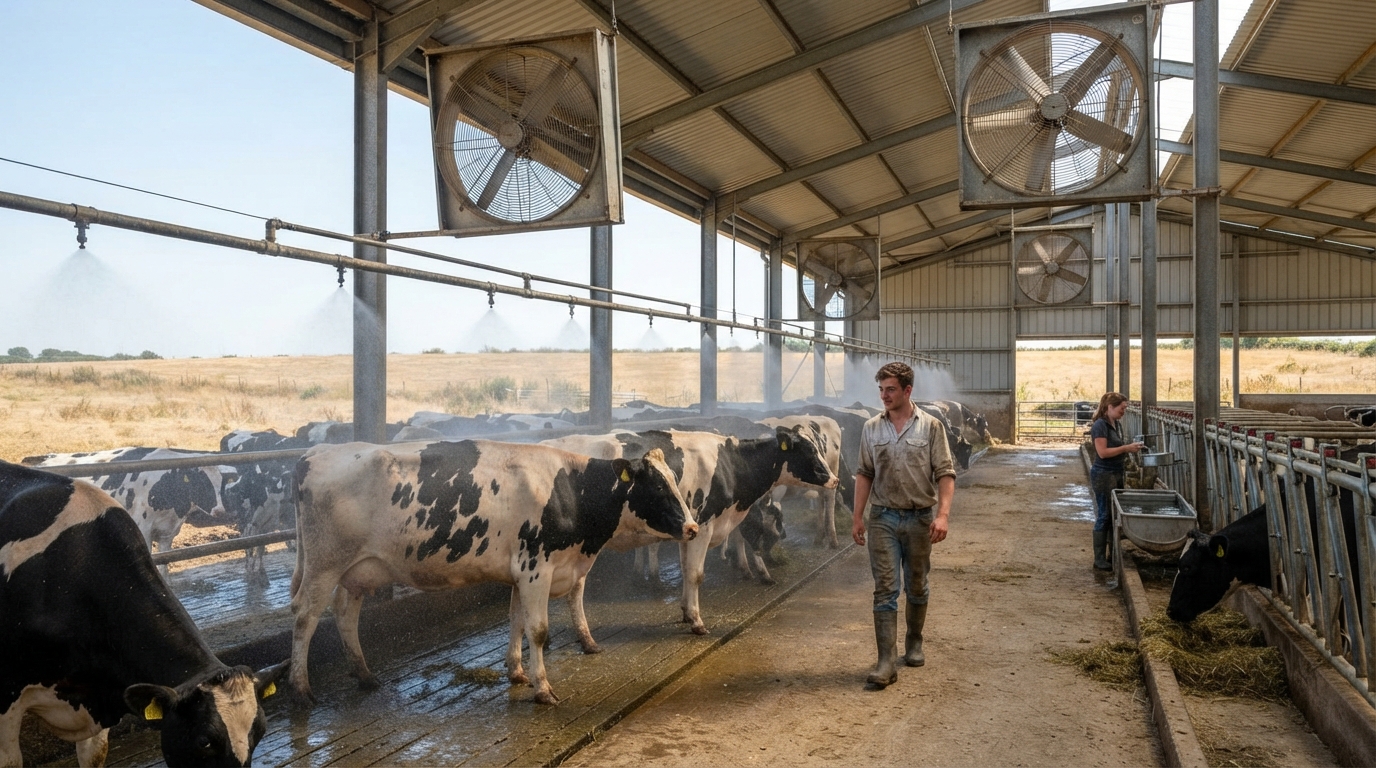
Dairy farmers are implementing "cow showers" and large cooling fans to combat increasingly frequent hot, dry summers. Extreme heat has led to a milk production decrease of up to 20%, prompting farmers to invest thousands in cooling systems to safeguard milk yields.
Sarah Godwin, a farmer near Chippenham, Wiltshire, has spent £15,000 on a ventilation and sprinkler system to help her cattle cope with the "nearly continuous heatwave we are living through." Professor Nicola Cannon from the Royal Agricultural University (RAU) in Cirencester notes that drought-stricken pastures are also forcing many farmers to use winter feed earlier than anticipated.
At a dairy farm near Swindon, Sam Woolford activates a switch in the milking parlor, bringing 10 industrial-sized fans to life. "It's like a wind tunnel in here," he describes, noting the powerful airflow. The cows appear to enjoy the cooling effect, lingering in the parlor, visibly relaxed. While these systems aid in keeping cattle comfortable, farmers acknowledge they cannot entirely mitigate the effects of prolonged heat.
Professor Cannon explains that "cows feel stressed just as humans feel stressed when it's really hot and, as a response to that, their milk productivity goes down." She adds, "So farmers are trying to help their cows, by putting in big fans, or sprinkler systems, to just try and cool animals down."
Experts warn that extended dry weather is becoming a regular challenge for dairy farms, resulting in scorched grass, heat-stressed cattle, and farmers relying on winter feed months ahead of schedule. Mike Kendon, a climate scientist at the Met Office, states, "What we used to think of as extreme weather, we increasingly consider as normal." Farmers in Somerset have described the current conditions as the worst drought in 50 years, severely impacting crops.
Woolford points to a bunch of thin grass, remarking, "Look at this stemmy nonsense. There's no leaf to it, they don't get any nutritional quality from this rubbish." His family has farmed dairy cows outside Swindon for five generations, witnessing both hot and wet summers. However, Woolford, 20, along with his father and grandfather, has observed a permanent shift in the weather patterns. "We're praying it's not going to become the new norm," he says, "But it looks like it will recur. It's really tough. The cows don't enjoy it, we're down on milk production by 20%, we just need some rain for the grass."
Professor Cannon elaborates on the parched conditions: "Basically, soils are parched. There's people quoting 38, 39 days without rainfall now. We call that 'permanent wilting point'. Grass can't rebound after grazing, or after cutting for hay or silage."
Woolford's cows still graze in the fields in the mornings, but by midday, they return to the barns to escape the sun and consume feedstocks intended for winter. This practice, which was newsworthy last year, is now standard across West Country dairy farming.
Near Chippenham, Godwin's family has installed a system of 'cow showers' – sprinklers that douse the cattle with cool water. "Farming has got very hard recently," Godwin states, describing the summer as "one long heatwave." The entire system cost £15,000 and required significant effort to install, but it is not unique.
Even ice cream producers are facing difficulties. Marshfield Farm, north of Bath, uses milk from its own herd to produce well-known ice creams. Rory Hawkins, who helps manage the herd, explains, "The summers are getting hotter, which is great for the ice cream sales. But it affects the cows with heat stress, and we lose a lot of milk through the hotter summers now."
Hawkins, 27, and Woolford, 20, are among young farmers committing to dairy farming despite the challenges. Met Office experts agree that hotter summers will become more common, making grass harder to grow and necessitating cow cooling.
"You just have to get on with it," say Lara Browne and Sam Woolford, two young dairy farmers from Wiltshire. Hawkins expresses his love for "working outside, helping look after the animals," adding, "Weather is changing, but we just have to crack on with it." Woolford is drawn to the "variety" of farm work.
Lara Browne, whose family farms near Trowbridge, emphasizes the need to "make the best of the situation, and make your farm as resilient as you can." While many in their 20s are concerned about climate change, these young farmers are focused on adapting their farming methods. "I've not got any kids," Browne says, "but I feel like I'm already farming for the next generation."