

Which countries have become richer in the last 30 years?
A new infographic based on World Bank data shows how the world's income levels have changed over the past 30 years. It shows that dozens of countries in Asia and Eastern Europe have joined the ranks of high-income countries, while Guyana in South America has been one of the countries with the most rapid economic growth.
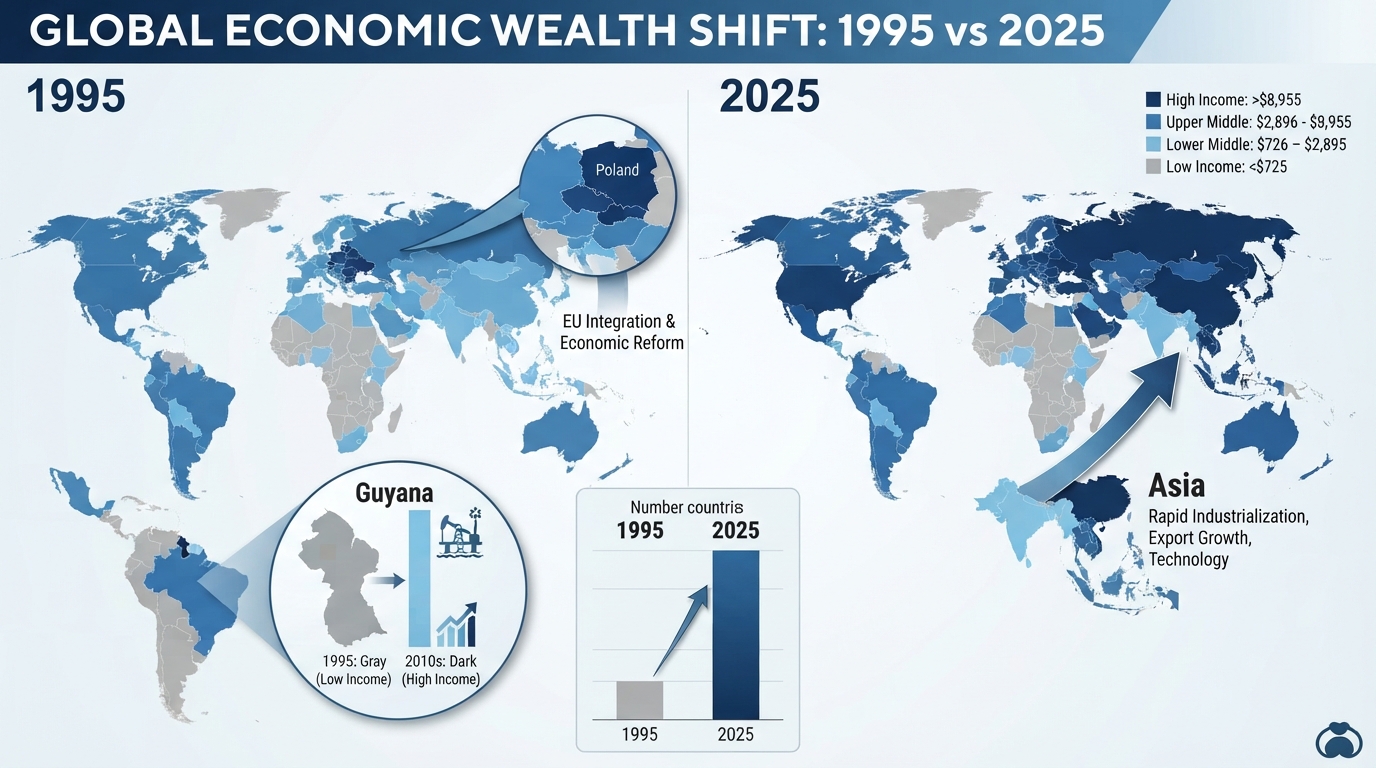
Which countries have gained wealth in the last 30 years?
This infographic by Visual Capitalist, based on World Bank data, compares the distribution of countries by national income level in 1995 and 2025, showing how the global economic map has changed significantly over the past three decades.
The World Bank divides countries into four categories based on their gross national income (GNI) per capita. For 2025, low-income countries are those with a per capita income of up to $1,175. Lower-middle-income countries are defined as those with a per capita income of $1,176–4,635, upper-middle-income countries are defined as those with a per capita income of $4,636–14,375, and high-income countries are defined as those with a per capita income of more than $14,375.
In comparison, in 1995, these thresholds were much lower. At that time, low-income countries were classified as countries with a per capita income of up to $725, lower-middle income countries were classified as countries with a per capita income of $726–2,895, upper-middle income countries were classified as countries with a per capita income of $2,896–8,955, and high-income countries were classified as countries with a per capita income of more than $8,955.
According to the analysis, one of the biggest changes has been observed in Eastern Europe. As a result of market reforms, integration into the European Union, the flow of foreign investment and the modernization of the economy, many countries in the region have risen to the ranks of high-income countries.
The largest economic growth has been recorded in Asia. Over the past 30 years, 30 countries on the continent have moved up at least one place in the World Bank classification. This process was driven by an export-oriented economic policy, the rapid development of industrial production and the growth of high-tech industries. At the same time, a large gap in the level of well-being between Asian countries still remains.
One of the most striking examples is Guyana in South America. The country managed to move from the category of low-income countries to the group of high-income countries in 30 years. Experts point to the development of large offshore oil fields as the main reason for this. The commissioning of new oil reserves has dramatically increased production volumes, export revenues and state budget revenues. As a result, Guyana has become one of the fastest growing economies in the world in recent years, demonstrating one of the largest jumps in world statistics on per capita income.