

What's causing record high US beef prices?
The meat has never been more expensive, due to supply shortages, but no-one is making more money.
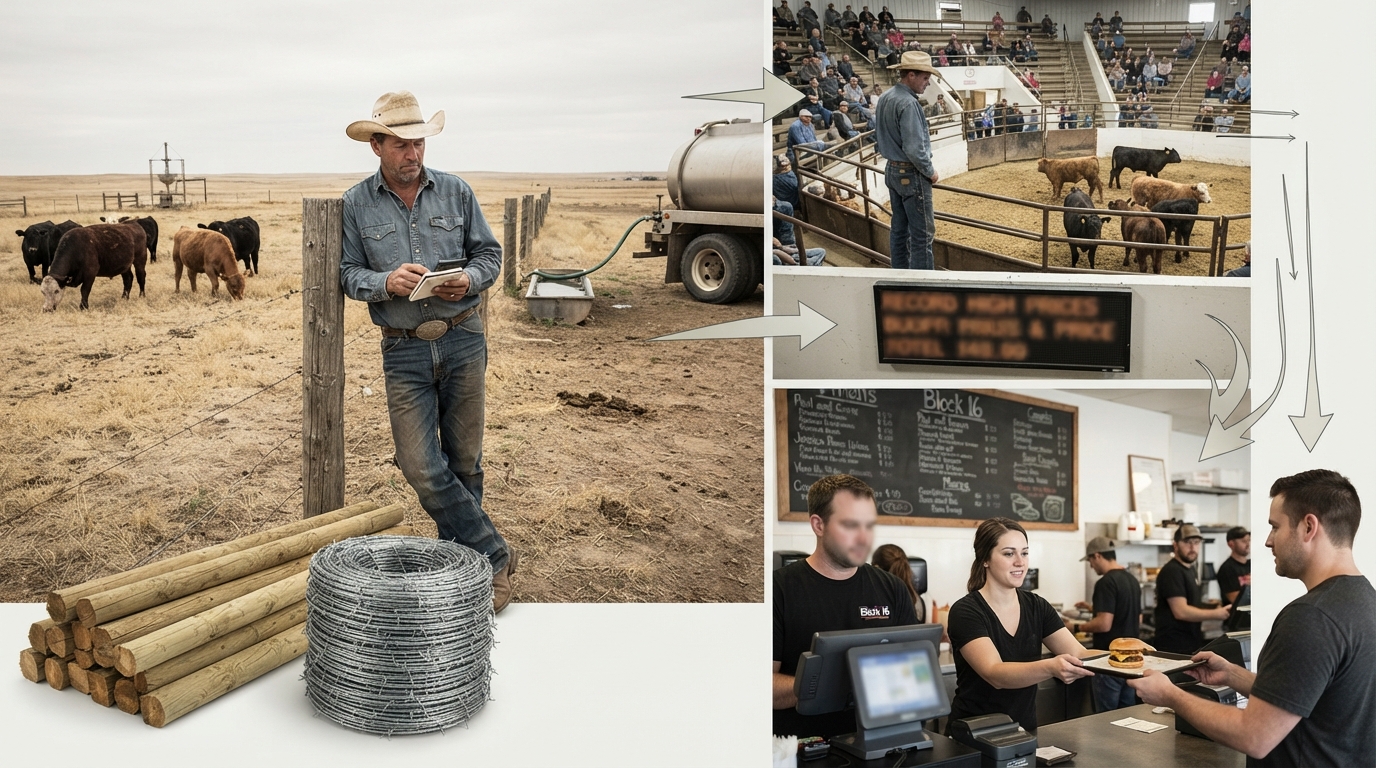
Despite record-high beef prices in the US, South Dakota cattle rancher Eric Gropper isn't seeing increased profits. While supermarket beef costs have surged by 12% over the past year—more than triple the general inflation rate—Gropper and other beef farmers report no significant change in their earnings. The BBC World Service's "Follow the Money" series investigated the American beef supply chain to uncover the reasons behind this price jump and where the money is actually going.
Eric Gropper, who manages approximately 350 breeding cows on about 8,000 acres of leased grassland in southwest South Dakota, is selling his animals at unprecedented prices. However, his operational costs have also skyrocketed. Gropper's ranch is remote, located seven miles from the nearest paved road and a two-and-a-half-hour drive from the closest sizable town. He sells his calves annually at a livestock auction, where bids currently stand at a record high of around $2,500 for a 600lb calf, up from $2,000 two years ago.
This surge in prices is primarily due to a cattle shortage. A combination of widespread drought and disease has led to the lowest US cattle population since 1951. Gropper himself is experiencing the drought, with all 13 of his natural wells dry, forcing him to use a water tanker for his cattle.
While Gropper benefits from record prices for his cattle due to the national shortage, his expenses have climbed to new highs. A new pickup truck, once $40,000, now costs $100,000. Wooden fence posts have risen from about $6 to $19, and a quarter-mile roll of barbed wire has doubled from $60 to $130. He notes that prices for all his daily necessities have increased significantly since the Covid pandemic. With over 60% of US cattle grazing on drought-affected land, farms like his are compelled to purchase hay, silage, and other feed. Gropper states, "I'm able to pay my bills, but my input costs are so drastically high that if we didn't have these record prices we'd all be broke. I sit down to do my taxes, and it feels like I made a lot of money. But in the end I really didn't make any more."
Gropper's calves, at about six months old, are sold to feedlots, where they are fattened on corn and grains for three to six months before slaughter. Around 95% of US cattle are finished this way, with some large feedlots housing over 100,000 cattle. Brenda Boetel, a professor of agricultural economics at the University of Wisconsin–River Falls, observes that while feedlot companies are selling cattle at record prices, they are also acquiring them at all-time high costs, preventing them from realizing larger profits.
Meatpacking companies, which slaughter animals and process carcasses into cuts for shops and restaurants, are also facing challenges. Four major companies—Tyson, JBS, Cargill, and National Beef—dominate about 85% of American beef processing. Despite accusations of price-fixing, even from former President Trump, these firms are not experiencing huge profits. Tyson, the largest, reported a loss of over $500 million on beef in the first half of its financial year, as it too is buying cattle at peak prices.
Jamie Crumley, owner of Harpley's Meatpacking in central North Carolina, a smaller operation, notes that the price her company pays for live animals has increased by as much as 60% in the last three years. While meatpacking companies have raised their beef prices, there's a limit, as supermarkets, restaurants, and consumers can opt for chicken or cheaper imported beef. Furthermore, meatpacking plants are operating below capacity. Harpley's, designed to handle 425-450 cattle daily, is currently processing only 350 due to a lack of available animals. Fixed costs for the facility, production line, and staff remain constant, meaning these costs are spread across fewer animals. Crumley estimates daily losses of $100 to $400 per head of cattle, which helps explain Tyson's substantial losses.
At the end of the supply chain, Paul and Jessica Urban, owners of Block 16, a burger restaurant in Omaha, Nebraska, also face profit limitations. They use about 300lb of ground beef weekly, making 2,800 burgers monthly. While a burger cost $8.95 when Block 16 opened in 2010, it's now $11.95. Paul explains, "To maximise our profit, maybe we'd have to charge $13 for a burger. Well, we don't feel comfortable doing that. I wouldn't want to walk in here and have to pay $13 for a cheeseburger. So we don't make the profit that we'd like — but you're still getting people through the door, and it's not always about the money."
In summary, ranchers are selling calves for record sums but are not better off due to higher costs. Feedlot companies sell at all-time high prices but also incur high purchasing costs. Packers are losing money because there's a ceiling on what they can charge, and restaurants and supermarkets can only raise prices so much. Everyone in the chain is handling more money but retaining no additional profit. This situation will persist until significantly more US cattle enter the market. However, as Eric Gropper points out, increasing the cattle supply is a lengthy process: a heifer needs two years to produce a calf, and that calf requires another year to reach slaughter weight, meaning it takes three years for additional beef to become available.