

What can scientists learn from a stray SpaceX rocket hitting the Moon?
While the collision was an accident, it is a unique scientific gift for planetary geologists that could provide important data for future space missions.
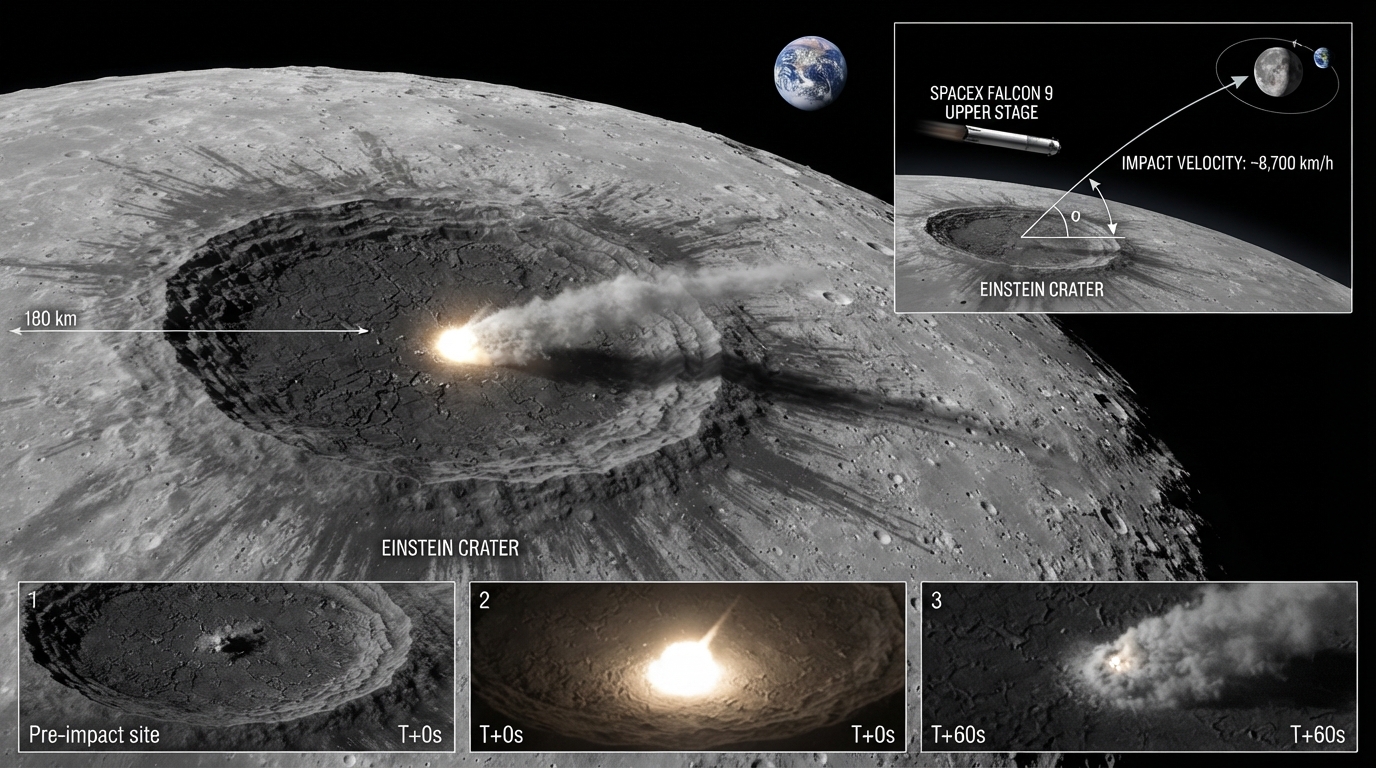
Scientists are presented with a unique research opportunity following the presumed collision of a stray SpaceX rocket with the Moon. This incident, which is thought to have created a new crater near a prominent lunar landmark, could offer valuable insights for future space missions.
The empty upper stage of a Falcon 9 rocket was projected to impact the Moon at approximately 5,400mph (8,700km/h) on Wednesday, near the Einstein crater. While the brief, intense flash generated by the impact would have been challenging for even advanced amateur telescopes to capture, larger observatories in the Americas are currently analyzing the data.
It may take days or even weeks to fully comprehend the event and its implications. However, for planetary geologists, this unintentional collision is considered a significant scientific boon.
The Falcon 9 rocket, a reusable model from SpaceX, has been deployed on multiple missions. While parts of its design allow for return to Earth, other sections are jettisoned in space. This particular rocket launched from Florida in January of last year, carrying two lunar landers. Its primary objective was to propel the upper stage with sufficient force to send both landers out of Earth's orbit and onto a trajectory toward the Moon, a mission that was successfully accomplished.
The spent stage, roughly the size of a five-story building and weighing at least 4,000kg, was subsequently left in a long, looping orbit that extended towards the Moon and back. Over the subsequent 18 months, the subtle gravitational forces of the Earth, Moon, and Sun, along with even sunlight, provided a gentle propulsion. Astronomers tracking the rocket component eventually determined that these minor nudges had set it on a collision course with the Moon, with its speed increasing daily.
The impact, occurring around 07:35 BST (06:35 GMT) on Wednesday, took place during daylight hours for many parts of the world. The resulting flash would have been too faint to observe, even with a telescope. Amateur astronomers observing in darkness would also have had minimal chance of witnessing the flash, given its fleeting duration. However, they might have observed a dust plume extending up to 100km (62 miles) that persisted for several minutes.
Even spacecraft orbiting the Moon were not ideally positioned to observe the impact live. South Korea's Danuri orbiter had the best chance, having passed near the crash site shortly before. Its team has informed Korean media that any footage will only be released after researchers complete their analysis. In the coming days, NASA's Lunar Reconnaissance Orbiter will be in position to photograph the site, enabling a comparison of images from before and after the crash.
The Einstein crater, exceeding 180km (112 miles) in width, is large enough to encompass a smaller crater within it. The initial scientific findings and likely the first images will originate from powerful telescopes in the Americas, where the sky was still dark. Even then, detecting a 14m object striking the lunar surface 385,000km away will be a complex task. Image processing to refine the visuals could take hours, days, or even weeks as scientists verify and process the data.
Because researchers already possess precise information regarding the rocket's size, speed, and impact point, this collision transcends a random accident, becoming a rare, controlled experiment. This is a pivotal moment for planetary scientists, allowing them to test their models concerning how impacts create craters, scatter debris across the surface, and generate tremors within the Moon's interior.
This research holds significant practical value. Understanding the volume of rock and dust ejected by an impact will aid engineers in designing safer landers and future Moon bases, by determining the potential travel distance of flying debris and the intensity of ground shaking in the vicinity. Furthermore, material unearthed from beneath the surface offers new insights into the Moon's geology, augmenting existing knowledge about the formation of the Earth-Moon system approximately 4.5 billion years ago.
This is not the first instance of a human-made object striking the Moon. Since 1959, dozens of spacecraft have impacted the lunar surface, some accidentally and many intentionally for scientific purposes. The Soviet probe Luna 2 was the first, followed over the decades by NASA's Ranger probes in the 1960s, several Apollo-era rocket stages, and more recently the LCROSS mission in 2009, which was deliberately crashed to search for water ice. The last confirmed accidental impact, in 2022, was believed to be the leftover booster from a Chinese lunar mission launched in 2014, serving as a reminder of the accumulating space debris above us for over half a century.