

SpaceX's first-ever earnings show higher revenues and huge spending
Elon Musk said during a call with financial analysts that people were "underestimating" his company.
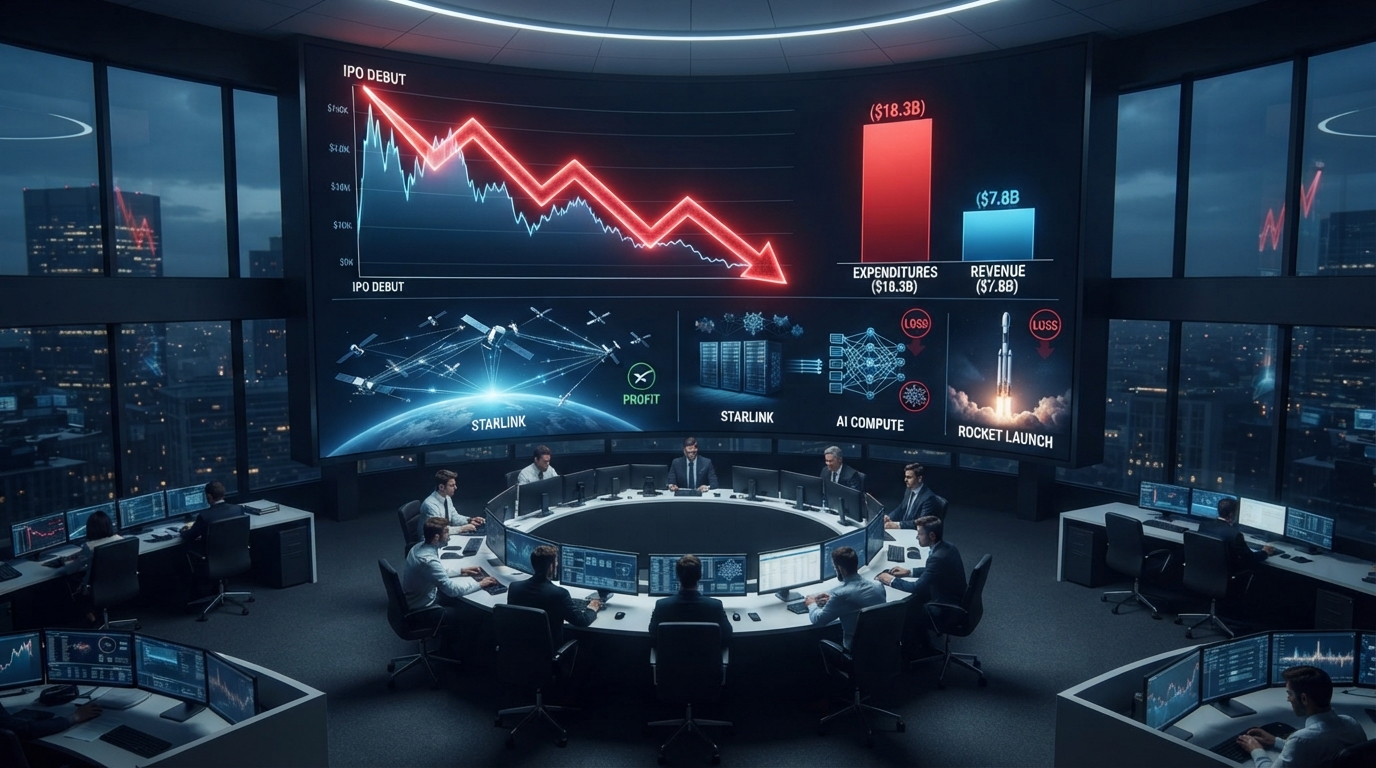
SpaceX, led by Elon Musk, has released its inaugural quarterly financial report as a publicly traded entity, revealing a near-doubling of revenue alongside a dramatic surge in expenditures. The company, which manufactures space rockets, Starlink internet satellites, and owns the social media platform X, commenced trading on the U.S. stock market in June.
The report indicated a 92% increase in revenue, reaching $7.8 billion (£5.8 billion) compared to the previous year. However, spending escalated by over 550% to $18.3 billion, contributing to a net loss of $2 billion during the first half of the year. Following the announcement, SpaceX's stock experienced a nearly 9% decline in after-hours trading.
During a subsequent call with financial analysts and investors, Musk suggested that people might be "underestimating" SpaceX. He highlighted Starlink, the only profitable segment of the company, which generated $1.6 billion in the second quarter. Musk expressed confidence that this business would expand exponentially in the coming years, even stating, "It's not out of the question that, at some point, Starlink will operate most of the world's internet."
Musk also discussed the anticipated rapid growth of SpaceX's nascent business line: selling compute power for artificial intelligence (AI) projects to other companies, including current clients Google and Anthropic. While SpaceX currently possesses 1.4 gigawatts of ready-to-use compute power, Musk projected that this capacity would reach at least 10 gigawatts by sometime next year through ongoing data center development. He remarked, "Data centres are a trivial problem compared to making reusable rockets."
Despite rockets being SpaceX's core business, its space segment recorded a $542 million net loss against $962 million in revenue for the second quarter. The company's AI business also incurred a $1.2 billion loss during the quarter on revenues of $2.5 billion.
Bret Johnson, SpaceX's head of finance, stated during the call that the company's capital spending would remain at a "very similar" level for the remainder of the year. Nevertheless, Musk optimistically predicted that SpaceX would likely achieve $1 trillion in revenue by 2030, a year earlier than his projection just six weeks prior.
Despite Musk's optimism, SpaceX shares fell by over 7% in after-hours trading on Tuesday, erasing gains made earlier in the day. Tech analyst David Nicholson viewed SpaceX's expenses as unsurprising and considers the stock a long-term investment rather than something that can be "rationalised on the fundamentals in the near-term." He expressed his intention to invest in the company soon, citing its long-term vision and growing confidence in the technology being developed at Musk's electric car firm, Tesla. Nicholson, from The Futurum Group, a market research firm, described it as "an emotional investment in something I want to be part of."
Responding to Musk's comment about investors "underestimating" the firm, Brady Wang from Counterpoint Research acknowledged that Starlink's subscription numbers are "strong," but emphasized that it is the sole SpaceX business unit generating an operating profit. Fabien Yip, an analyst from investment platform IG, noted that the firm's AI business is still losing money as spending increases, making it "a stretch" to claim the entire company is being underestimated. Yip also added that controversies surrounding Musk's politics have previously influenced some investors and remain a "live risk" for SpaceX.
SpaceX has struggled to maintain investor enthusiasm despite achieving a historic public listing, which briefly saw its market valuation surpass established giants like Microsoft and Amazon. Since reaching an intraday high of $176 in June, shares of the space technology company have steadily declined and have been trading below their original $135 per share debut price for several weeks.