

Amazon and Apple just told us more about their AI plans - here are three things we learned
Billions of dollars are being poured into a new wave of AI technology. But will it pay off?
Amazon and Apple recently provided further details regarding their artificial intelligence (AI) strategies, offering three key insights.
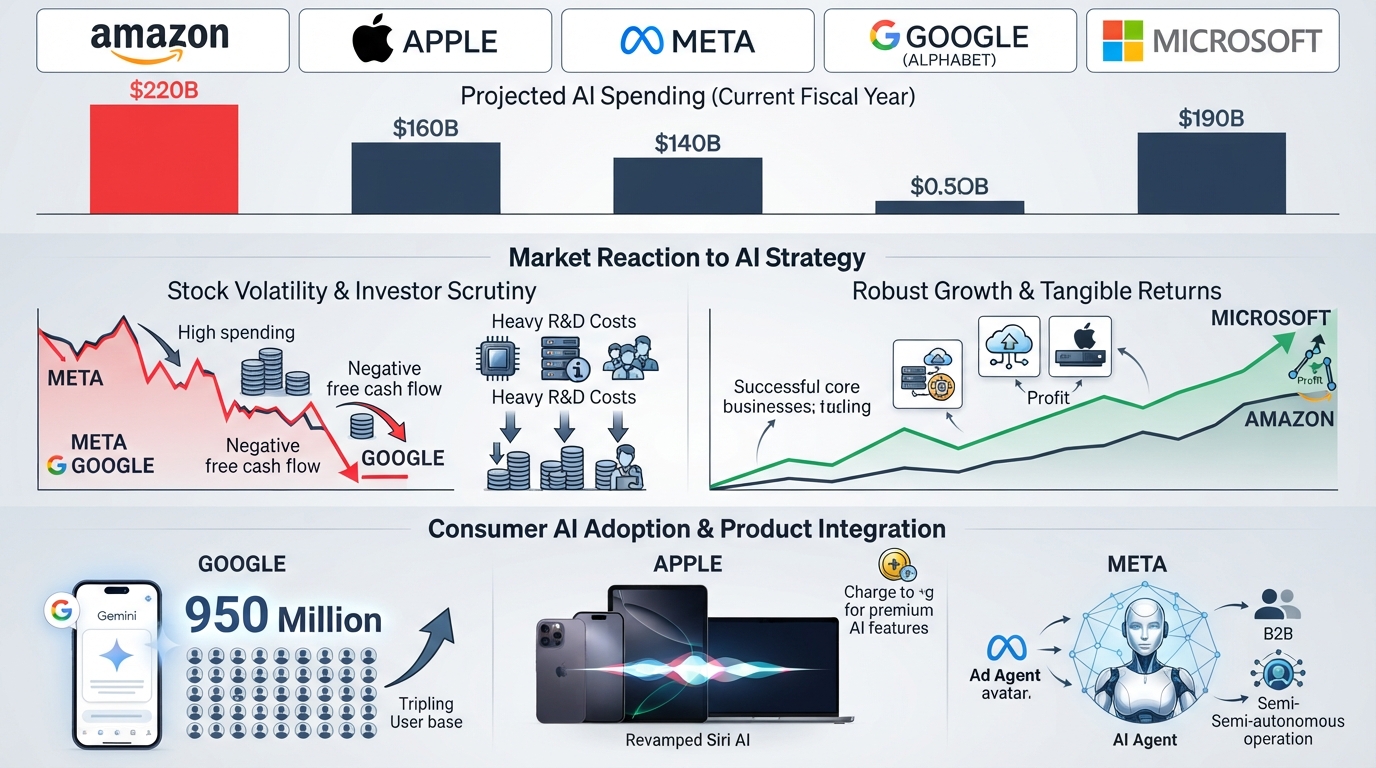
In recent days, the leaders of major technology companies, including Meta, Amazon, and Google, have released their quarterly financial results. This week, the world's largest tech firms—Microsoft, Meta, Google, Apple, and Amazon—updated Wall Street on their financial performance. A consistent theme emerged: all are committed to continuing substantial investments in AI.
Investors, however, are seeking more tangible returns on the growing external investment of $1 trillion (£743 billion) in areas such as computer chips, data centers, and technical personnel. This sentiment has led to significant fluctuations in some tech stocks recently. While these companies operate in diverse sectors, their AI spending and plans reveal several shared characteristics.
The release of OpenAI's ChatGPT in late 2022 initiated the ongoing AI investment race, prompting every major tech company to launch its own consumer-facing AI chatbot. Meta offers Meta AI, Google has Gemini, and Amazon introduced Rufus. Apple even relaunched Siri.
Despite the considerable costs associated with their creation, none of these chatbots or related tools have, in themselves, generated significant revenue for the companies. Instead, the latest earnings reports clearly indicate that companies like Google (owned by Alphabet) and Meta are currently spending considerably more on AI tools than they are earning from them.
Both companies reported some of their lowest-ever free cash flow, a metric representing the money a business retains after covering operations and investments. Google's extensive AI spending resulted in Alphabet's free cash flow being negative on revenue of $118 billion, marking the first time in the company's history as a public entity that it spent more than it earned. Meta's free cash flow was only $784 million on $61 billion of revenue, indicating that it spent nearly as much as it generated during the quarter. Meta's Reality Labs, responsible for its AI initiatives, incurred losses of almost $9 billion in the first half of this year.
Wall Street's reaction to Meta's quarterly results underscores that investors are no longer satisfied with executives' assurances that AI investments will eventually pay off at an unspecified future date. Shares of the social media giant plummeted to their second-lowest level in a year after CEO Mark Zuckerberg announced Meta's development of its own AI agent—an AI chatbot capable of semi-autonomous operation—and plans to establish an operation to sell an AI tool directly to other firms.
Neither this operation nor the AI tool currently exists in a revenue-generating capacity for Meta, and Zuckerberg did not provide a timeline for their materialization. Nevertheless, Meta increased the lower end of its projected AI spending, likely investing over $140 billion in AI this year alone.
Conversely, Microsoft's shares surged to a six-month high. Despite the company's intention to match the $190 billion it spent on AI over the past 12 months in the current financial year, it demonstrated robust revenue growth and increased adoption of its core AI tool. Tracy Woo, an analyst at Forrester, noted that Microsoft is a tech company whose substantial AI investments are "beginning to deliver returns."
The market's response to Amazon was almost identical. Despite negative cash flow and plans to spend $220 billion on AI this year, the success of its other businesses propelled its stock to its highest price in two months.
While AI tools may not yet have sparked a consumer tech revolution on the scale of the internet or even electricity, as many tech executives have promised for years, there remains significant public demand for new technology. Google reported last week that 950 million people use its Gemini chatbot at least once a month, tripling its user base from a year ago.
Apple announced on Thursday that new versions of its flagship products—the Mac computer, iPhone, and iPad—have sold better this year than the company had anticipated or planned. This strong demand led Apple to warn investors that sales of these products would slow due to its inability to secure enough microchips to meet buyer demand.
However, the company expects considerable excitement from Apple users for the upcoming update to Siri, its AI voice assistant integrated into its products, which is undergoing an overhaul with assistance from Google's Gemini chatbot. Outgoing CEO Tim Cook stated that Apple already plans to charge users who wish to make more extensive use of the new Siri, based on feedback from user testing. Cook expressed immense enthusiasm, saying, "We're off-the-charts excited about Siri AI. We do believe there will be people who want to use it – a lot."