

Uzbekistan unveils Shunkor-88 interceptor drone - but the price tag raises questions
Tashkent Times is an English language online-newspaper that brings all latest Uzbekistan news
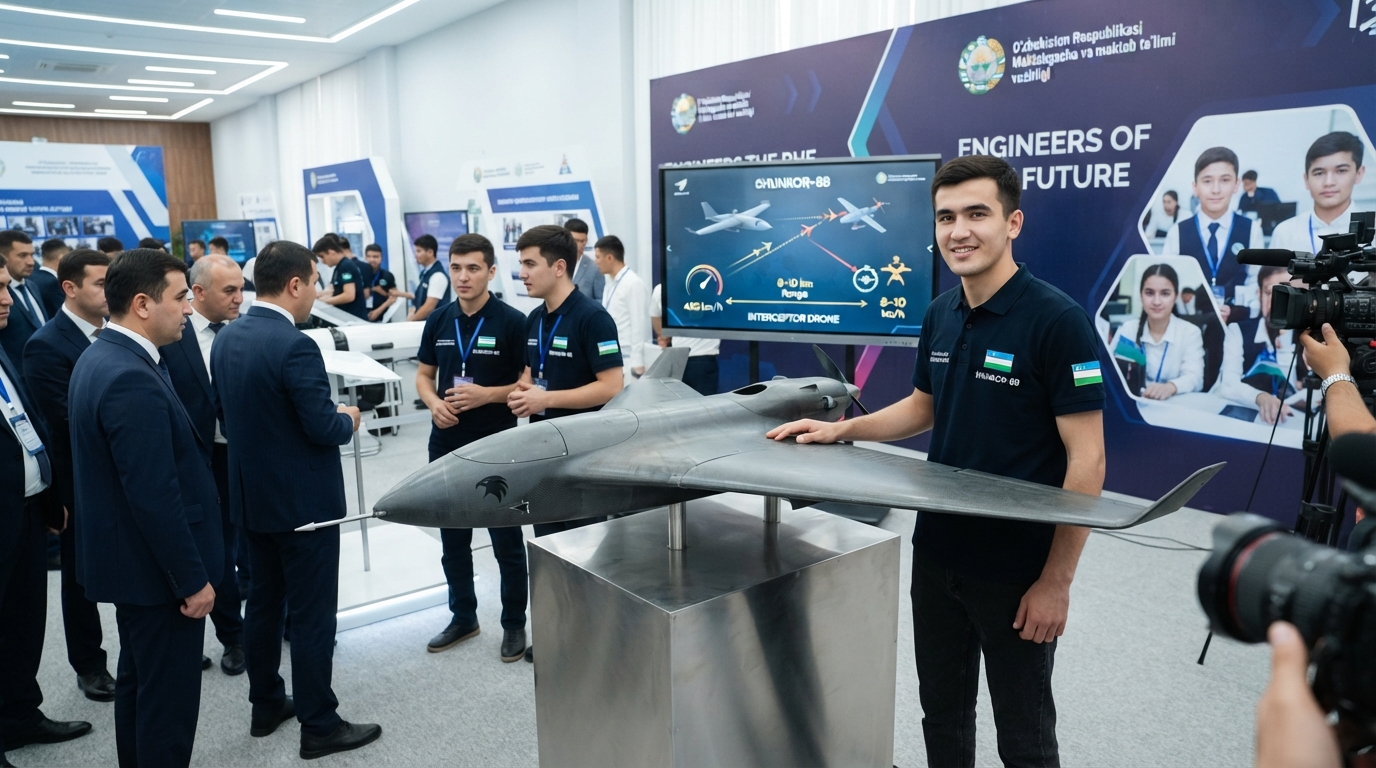
Uzbekistan has unveiled an interceptor drone, the "Shunkor-88," developed by a team of young Uzbek engineers to neutralize hostile unmanned aerial vehicles, as announced by the Ministry of Education's press service. Lead developer Ismail Bilolkhanov and his team presented the system at the national "Engineers of the Future" competition, positioning it as a domestically developed, economical solution to the increasing threat of drone attacks.
The ministry states that the Shunkor-88 can achieve speeds of up to 450 km/h and engage targets within an 8 to 10-kilometer range. Officials estimate the manufacturing cost per unit to be between $20,000 and $50,000. They highlight this figure as a significant saving compared to conventional anti-aircraft missiles, which typically cost $2 million to $5 million each.
While this comparison is technically accurate, it contrasts the Shunkor-88 with a different class of weaponry—missiles designed for aircraft and ballistic threats, which have distinct purposes and cost structures. A more pertinent comparison, omitted from the ministry's announcement, would be with the rapidly expanding global market for drone-on-drone interceptors, an area where Ukraine has become a leader in cost-efficiency due to wartime demands.
**Shunkor-88's Market Position**
Ukraine's Skyfall P1-SUN, one of the most affordable interceptors currently in use, costs approximately $1,000 per unit for Ukrainian forces. It features a lightweight, 3D-printed airframe and uses computer vision and thermal imaging for target tracking. Another mass-produced Ukrainian interceptor, Wild Hornets' Sting, has a unit cost of about $2,100. MaXon Systems' newer autonomous interceptor, designed to hunt Shahed drones, costs around $3,500, reaches speeds of up to 300 km/h, and has a 30-kilometer operational radius. Even the more expensive, new fixed-wing interceptors being introduced into the Ukrainian Air Force cost approximately $5,000 per unit, according to Ukrainian military expert Taras Chmut.
In essence, the Shunkor-88, priced at $20,000 to $50,000 per unit, is between four and fifty times more expensive than comparable Ukrainian interceptors that are already in mass production and have undergone combat testing.
This price disparity is difficult to justify based solely on performance. The Shunkor-88's top speed of 450 km/h is impressive but not unique; some Ukrainian interceptors already operate at speeds between 195 and 280 miles per hour (approximately 315 to 450 km/h), depending on the model. Furthermore, the Shunkor-88's stated engagement range of 8 to 10 km is actually less than some cheaper alternatives. For instance, Ukraine's Octopus interceptor, designed for night operations and resistant to jamming, boasts a combat radius of roughly 30 kilometers, which is three to four times greater than the Shunkor-88's range.
**Production Volume as a Potential Factor**
One plausible explanation for the cost difference could be production volume. Ukraine's low prices are a result of wartime mass manufacturing; Wild Hornets reportedly produces 10,000 Sting units monthly, and Skyfall has indicated it could scale up to 50,000 interceptor drones per month. A prototype developed by a university engineering team for a competition is unlikely to achieve such low per-unit costs. Economies of scale are crucial in drone manufacturing, and it would be unreasonable to expect a first-generation design to match prices set by companies with years of wartime production experience.
However, the ministry's announcement lacks this crucial context. Is the $20,000–$50,000 figure a projected cost for mass production, or does it represent the cost of building a single, hand-assembled prototype for a competition? Are the components sourced domestically, or does the price reflect imported parts that could be significantly reduced with scaled-up production? Given the commercial availability of comparably fast and farther-reaching interceptors at a fraction of the price, what specific factors, beyond its novelty, justify the Shunkor-88's cost?
These questions do not diminish the accomplishment of young engineers in developing a functional interceptor drone from scratch. However, if the Shunkor-88 is intended to be presented as a serious, cost-effective solution for national airspace defense—rather than merely a promising student project—a more transparent breakdown of costs, production plans, and a comparison to battle-tested systems already on the market would provide a far more compelling argument than a comparison to multimillion-dollar missiles.