

Uzbekistan, Kazakhstan Eye Joint Expansion Into New Markets
Uzbek and Kazakh businesses discussed joint expansion into Syria, Iraq and Afghanistan, with business missions planned for Aleppo and Erbil.
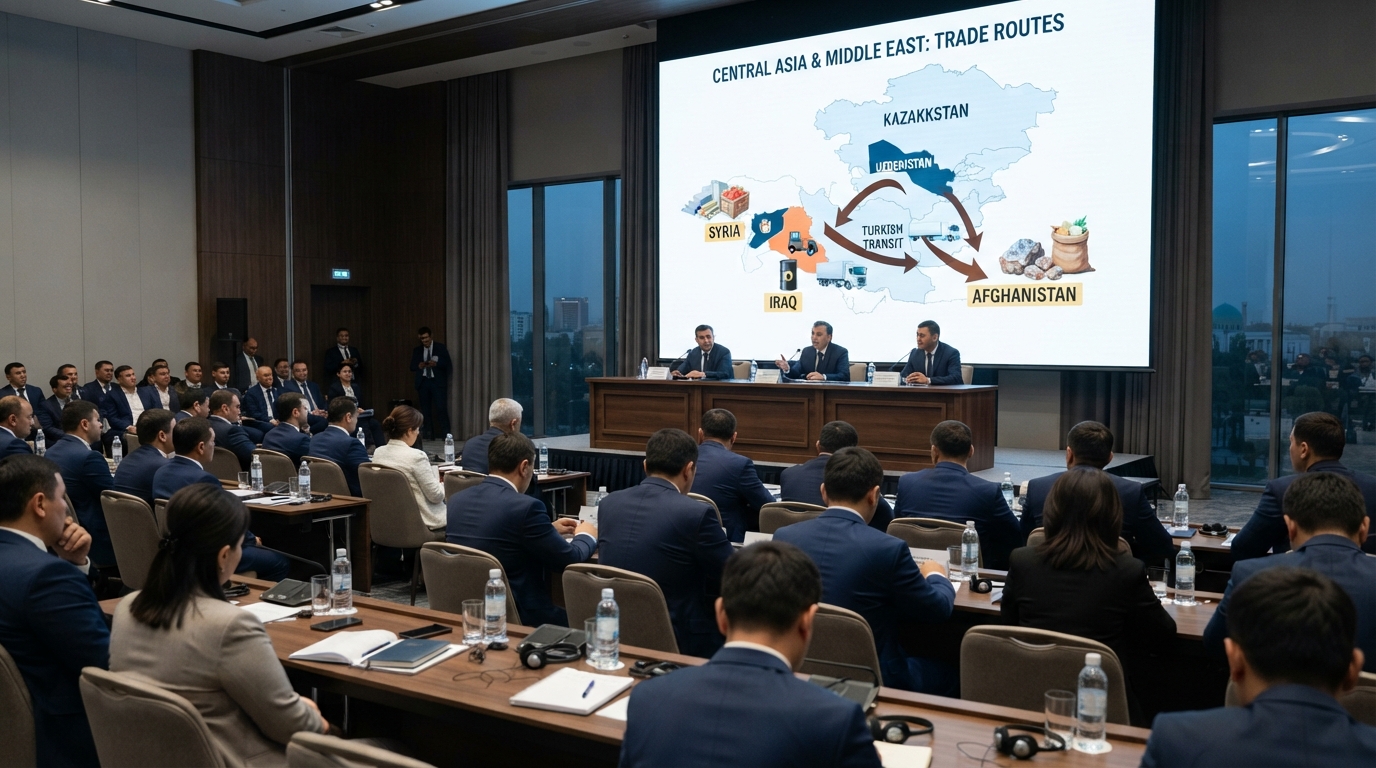
Entrepreneurs and business associations from Uzbekistan and Kazakhstan convened at the Uzbek-Kazakh Business Forum in Tashkent to explore avenues for collaborative expansion into new international markets, including Syria, Iraq, and Afghanistan. This topic was a significant focus of the forum, alongside discussions on bilateral trade.
**Syria: Demand for Construction Materials and Food**
An Uzbek trade house, established in Syria in March, reported substantial demand for construction materials and food products. Nail, a representative of the trade house, indicated that Syria is undergoing a reconstruction phase approximately 18 months after the conclusion of the war. He stated, "Syria currently needs food products and construction materials from different countries because there is already a plan to build about 6 million apartments."
Specifically, he identified high demand for construction materials, sunflower oil, meat products, and Kazakh-made galvanized and steel products, noting that Uzbekistan does not produce the latter. While Uzbekistan has a 25-year history of exporting dried fruit to Russia, Belarus, and Arab nations, exports to Kazakhstan have been sporadic and through intermediaries. The company now aims to secure direct contracts.
Kanat Sharlapayev, Chairman of the Presidium of Kazakhstan's National Chamber of Entrepreneurs Atameken, directed participants to prioritize the Syrian market, citing existing connections with the Qatari holding PH, which is involved in Syrian construction projects. He emphasized, "This is an extremely important direction for both Uzbekistan and Kazakhstan."
**Iraq and the Kurdistan Region**
Sharlapayev also mentioned that approximately 180 entrepreneurs from Iraq's autonomous Kurdistan Region, headquartered in Erbil, visited Kazakhstan about 20 days prior. He noted that a considerable portion of imports into the Kurdistan Region is subsequently distributed throughout the rest of Iraq and neighboring countries, including re-exports to Turkey and Iran.
He highlighted Iraq's import volume of US$95 billion and exports of US$109 billion, with oil accounting for US$108 billion. This indicates that nearly all other goods consumed in Iraq are imported.
Forum participants observed that Iraqi business partners frequently require full prepayment for monthly shipments of seven to eight truckloads. They also pointed out that logistical challenges make it more practical to supply semi-finished goods, such as unpackaged household chemicals or polyethylene granules, rather than energy-intensive finished products.
**Afghanistan: Growing Exports and Mineral Supplies**
Kazakhstan's exports to Afghanistan in the first seven months of 2025 nearly matched the total for all of 2024, reaching approximately US$500 million. The objective is to increase these exports to US$3 billion.
In addition to export growth, participants noted an increase in mineral raw material supplies from Afghanistan. Discussions included a contract for the supply of zinc ore to Uzbekistan's Almalyk Mining and Metallurgical Complex.
**Logistics: Spare Capacity on Turkish Trucks**
Logistics were also a key discussion point, specifically utilizing the spare capacity of Turkish trucks transiting Uzbekistan. Davron Vakhabov, Chairman of the Chamber of Commerce and Industry of Uzbekistan, stated that around 350,000 Turkish trucks pass through Uzbekistan annually and return empty. Turkish drivers do not require visas for transit through Turkmenistan.
According to Vakhabov, transporting cargo via this route costs between US$2,900 and US$3,500 and takes eight to ten days, significantly less than the US$6,000 to US$8,000 for direct transport.
**Participants' Views**
Vakhabov also drew a distinction between the stringent requirements of European markets and the needs of recovering Middle Eastern economies. He explained, "No one in Germany needs your products because the standards are very strict. But in countries where domestic production was absent for a long time, such as Syria and Iraq, the situation is now stabilising, and this creates a major opportunity," citing the growth of Kazakhstan's exports to Afghanistan over the past two years as an example.
He further highlighted the potential for export diversification in Uzbekistan's confectionery and furniture industries, where production volumes are doubling annually, with some output already being exported to Moscow.
**Business Missions Planned**
The parties agreed to organize joint business missions to third countries. These include a mission to Aleppo, Syria, at the end of September, coinciding with the official opening of the trade house, and another to Erbil, Iraq, in early October.
Regional chambers of entrepreneurs in Kazakhstan were tasked with compiling lists of sector-specific interests within 24 hours for submission to the Uzbek side, to facilitate the formation of business delegations.