

Uzbek Industrial Reform Delivers US$3.8 Billion Import Substitution
Uzbekistan's new industrial cooperation and public procurement system generated US$3.8 billion in import substitution in the first half of 2026.
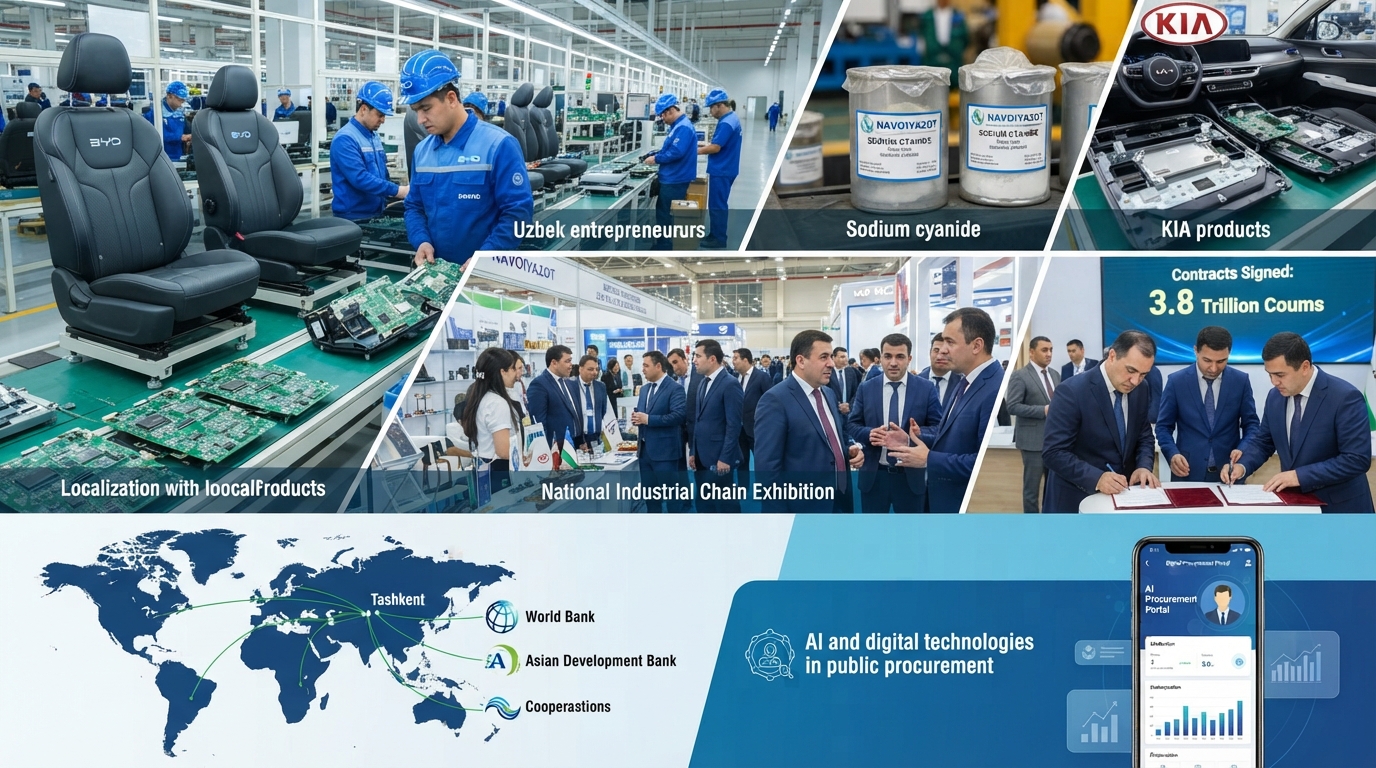
Uzbekistan's new industrial reform program has generated US$3.8 billion in import substitution, according to the first half-year results announced by the nation. The initiative, established by Presidential Decree No. PF-17 on February 4, 2026, created the Industrial Cooperation and Public Procurement Agency to centralize production localization, industrial cooperation, public procurement, and value chain development.
The reform aims to forge an integrated "order-production-technology-science-public procurement" framework. This model is designed to boost the manufacturing of goods that replace imports, increase the involvement of domestic companies in public procurement, and foster stronger collaboration among enterprises.
**Over 1,700 Localization Projects Implemented**
In the first six months of the year, 1,746 projects were completed under the Localization Programme. This led to the domestic production of numerous items previously imported. Notable examples include sodium cyanide at Navoiyazot, BYD car seats at O‘z-Tong Hong Kompani, interior trim components for KIA Sonet vehicles at O‘z-Hanwoo in Andijan Region, and electronic printed circuit boards at Vodiy Circuits in Namangan Region. In total, 83 new product types have been introduced, contributing to the US$3.8 billion in import substitution.
**Direct Engagement with Businesses**
Ahead of the sixth Open Dialogue between the President and entrepreneurs, the Agency conducted meetings in 208 districts and cities nationwide. These sessions involved over 2,700 entrepreneurs, who raised 447 concerns spanning manufacturing, localization, public procurement, certification, and industrial cooperation. Of these, 155 issues were resolved during the meetings, 75 received official clarifications, and 214 issues were assigned specific follow-up actions, which are now under monitoring.
**National Industrial Chain Exhibition Secures New Contracts**
This year's National Industrial Chain exhibitions, held in Akhangaran and Samarkand Region, brought together major buyers, local manufacturers, research institutions, and technology providers. These events resulted in agreements and contracts totaling 3.8 trillion soums. They also showcased 856 new products with an estimated localization potential of US$1.5 billion. The majority of these agreements pertained to public procurement, industrial cooperation projects, and plans for new production launches.
**Increased Domestic Participation in Investment Projects**
A core focus of the new system is to enhance the share of value added within Uzbekistan. Out of this year's US$53 billion investment portfolio, the potential for domestic value creation is estimated at US$21.1 billion. For investment projects worth US$27.6 billion implemented in the first half of the year, the national economy's share of value added reached 36%.
**Enhanced Efficiency in Public Procurement**
Total public procurement for the first six months amounted to 188.4 trillion soums, comprising 72.9 trillion soums in budget procurement and 115.5 trillion soums in corporate procurement. Competitive procurement constituted 60% of the total, leading to savings of 7.8 trillion soums in budget funds.
To boost procurement transparency, digital technologies are being implemented. Currently, 90% of offers on the Uzbek Republican Commodity Exchange and 75% of orders on the Cooperation portal undergo automated moderation using artificial intelligence.
Additionally, a new preferential loan product of up to 100 million soums has been introduced on the Cooperation portal to cover deposits and commissions. This financing is interest-free for up to 30 days. To date, 48 enterprises have received loans totaling 5.9 billion soums.
**Expanding International Cooperation**
During the reporting period, the Agency held over 30 meetings with international financial institutions and organizations. It established partnerships with the World Bank, the Asian Development Bank, the Islamic Development Bank, Ernst & Young, and other international entities to improve public procurement, develop local content, and strengthen institutional capacity. The Agency also signed several cooperation memorandums and studied the practices of more than 40 countries.
**Priorities for the Second Half of the Year**
In the latter half of 2026, the Agency plans to continue developing the industrial cooperation and public procurement system. Key objectives include organizing new National Industrial Chain exhibitions focused on the energy, chemical, and petrochemical sectors, increasing domestic producers' involvement in public procurement, launching an AI-powered module for determining average market prices, and further digitizing procurement processes.
Additional plans include organizing the "Make in Uzbekistan" exhibition, the Regulators Forum, launching a modern training and certification platform for public procurement officers, and preparing for the PRIMO-19 international forum, scheduled to take place in Tashkent in 2027.