

Uzbek Industrial Output Rises 8% in First Half of 2026
Uzbekistan's industrial production reached 637.2 trillion soums in the first half of 2026, up 8 percent year-on-year, official statistics show.
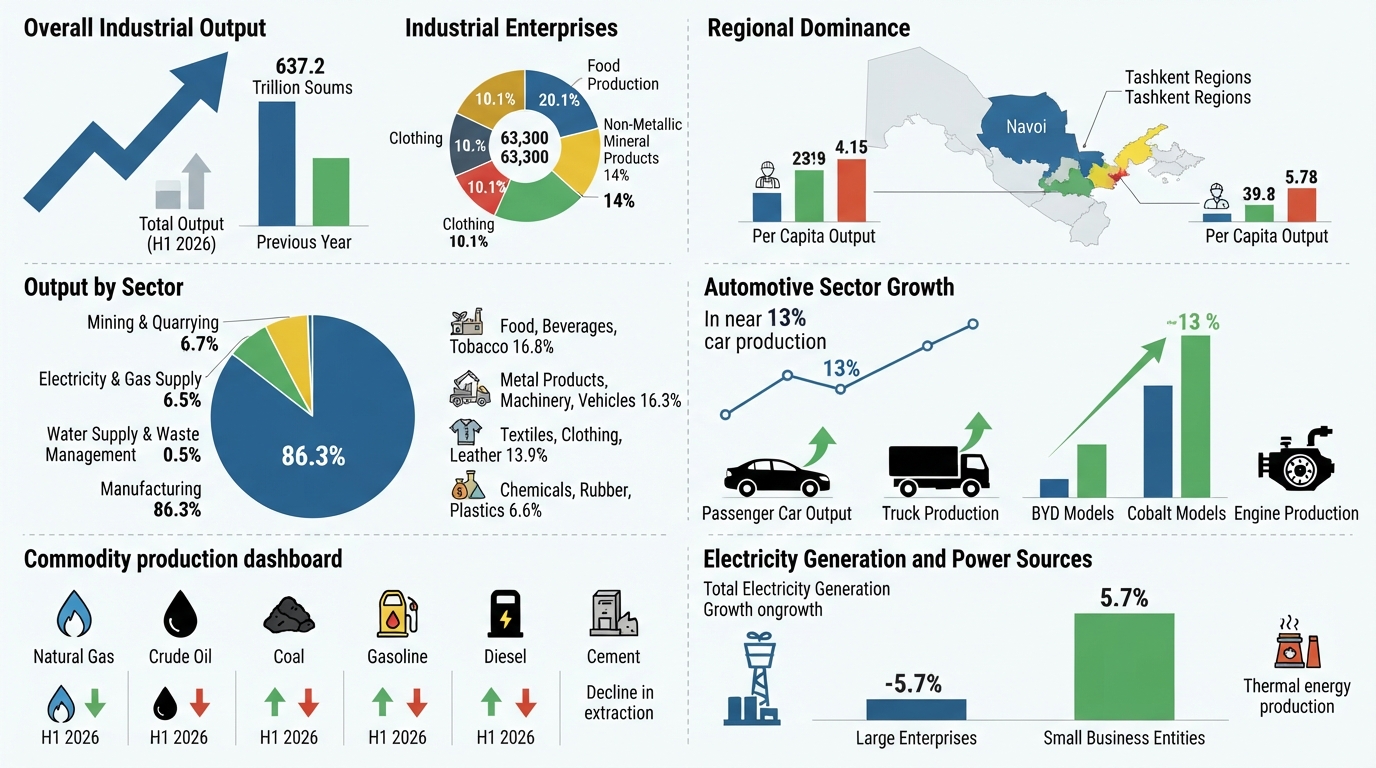
Uzbekistan's industrial output saw an 8% increase in the first half of 2026, reaching 637.2 trillion soums, according to a press release issued by the National Committee of the Republic of Uzbekistan on Statistics on July 28. This figure represents a rise compared to the same period last year.
As of July 1, 2026, the nation hosted 63,300 industrial enterprises. Food production led the sectors with 12,700 enterprises (20.1%), followed by other non-metallic mineral products with 8,900 (14%), and clothing with 6,400 (10.1%).
**Navoi and Tashkent Regions Dominate Production**
A significant portion of the country's industrial output, nearly 42%, originated from just two regions: Navoi Region, contributing 155 trillion soums, and the city of Tashkent, with 109.6 trillion soums. Tashkent Region followed with 100 trillion soums. These three regions also reported the highest per capita output: Navoi Region at 139 million soums, Tashkent at 34.3 million soums, and Tashkent Region at 31.5 million soums. This contrasts with the national average of 16.6 million soums per capita.
However, per capita production growth rates exceeding the national average of 106.1% were observed in Jizzakh (110.3%), Samarkand (107.8%), and Andijan (107.4%) regions. This suggests that regions with smaller industrial foundations are experiencing faster growth than the established market leaders.
**Manufacturing Sector Accounts for 86% of Output**
The manufacturing sector was the primary driver of industrial activity, generating 549.7 trillion soums, or 86.3% of the total output. Mining and quarrying contributed 42.4 trillion soums (6.7%), electricity and gas supply accounted for 41.7 trillion soums (6.5%), and water supply and waste management totaled 3.3 trillion soums (0.5%).
Within manufacturing, the production of food, beverages, and tobacco products held the largest share at 16.8%. This was followed by metal products, machinery, equipment, and motor vehicles (16.3%), textiles, clothing, and leather goods (13.9%), and chemical products, rubber, and plastic goods (6.6%).
**Automotive Sector Sees Nearly 13% Growth**
Automobile production experienced substantial growth. Passenger car output increased to 235,800 units from 209,000 in the previous year, while truck production rose to 2,750 units from 2,300. BYD models recorded the most significant growth, almost doubling to 13,400 units, and Cobalt models increased to 83,000 units. The production of car engines also saw an increase, reaching 126,700 units.
Other key commodities produced during the six-month period included 18.3 billion cubic meters of natural gas, 313,800 tonnes of crude oil, 2.5 million tonnes of coal, 614,200 tonnes of motor gasoline, 568,000 tonnes of diesel fuel, 10.1 million tonnes of Portland cement, 433,600 tonnes of yarn, and 724,100 tonnes of flour made from soft wheat and spelt. Conversely, natural gas production declined from 21.9 billion to 18.3 billion cubic meters, and the extraction of crude oil and gas condensate also decreased.
**Electricity Generation Rises, Thermal Power Output Drops**
Electricity generation reached 44.1 billion kWh in January–June 2026, marking a 5.7% increase from the previous year. While output from large enterprises decreased to 29.8 billion kWh, generation by small business entities surged by nearly 37% to 14.3 billion kWh, indicating an expansion in distributed generation.
In contrast, thermal energy production by large enterprises saw an 18.1% decline, totaling 9.3 million Gcal. There was no production of gas from underground coal gasification during January–June 2026.
Within the water supply and waste disposal sector, the volume of textile waste increased by 12.7% to 13,400 tonnes, and wastewater treatment services rose by 12.3% to 371.7 billion soums.