

UN warns of high seismic risk across Central Asia
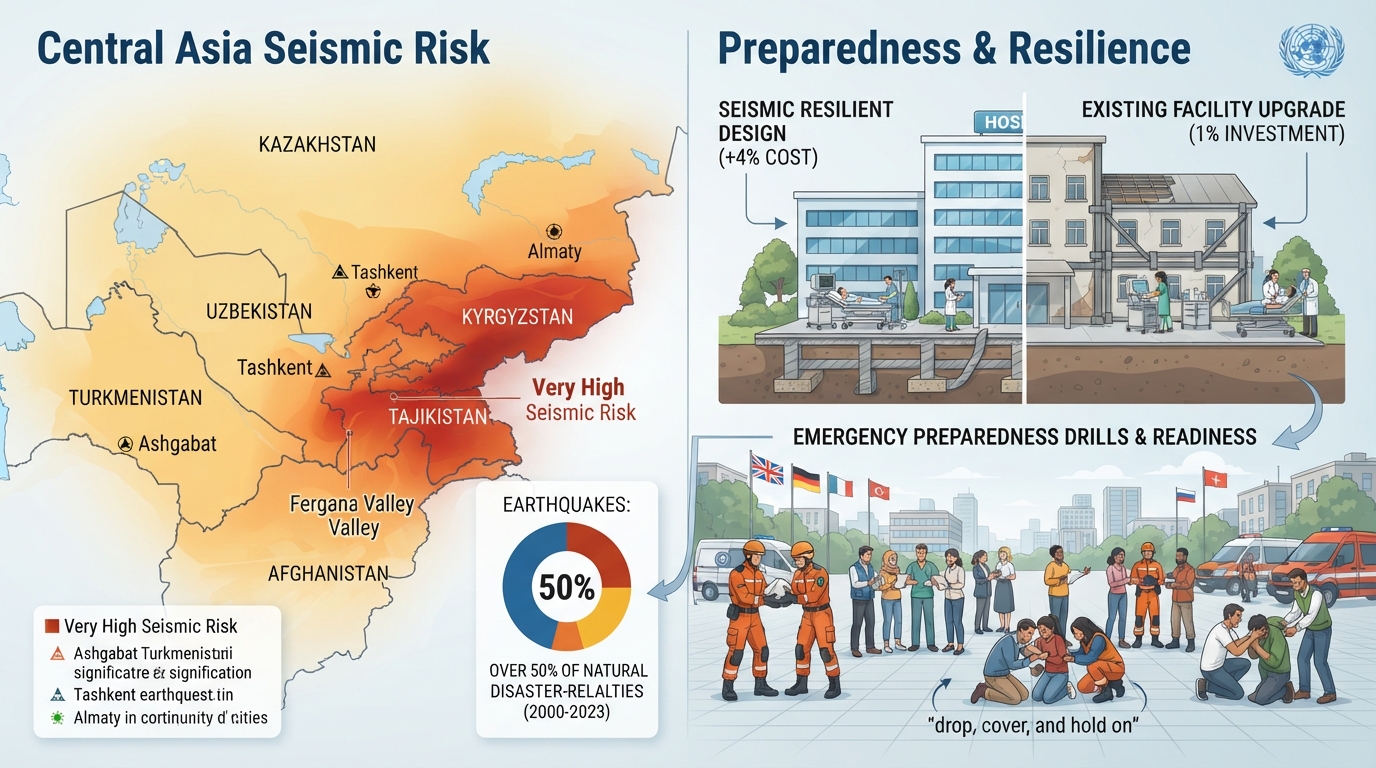
UN Issues Warning on High Seismic Risk in Central Asia
The United Nations has urged countries in Central Asia to enhance their earthquake preparedness, noting that earthquakes were responsible for over half of all natural disaster-related fatalities globally from 2000 to 2023, with several areas in the region classified as high seismic-risk zones.
The UN reports that Kyrgyzstan and Tajikistan are predominantly situated in regions of very high seismic risk, while parts of Kazakhstan, Turkmenistan, and Uzbekistan are also at risk of significant earthquakes.
The organization identified the Fergana Valley as one of the most susceptible areas in the region, home to nearly 11 million people across the borders of Kyrgyzstan, Tajikistan, and Uzbekistan.
Additionally, the UN pointed out Istanbul as one of the world's most alarming seismic hotspots. The Turkish metropolis, which has a population exceeding 15 million, is located near the North Anatolian Fault, one of the most active fault systems on Earth.
A study conducted in 2025 projected that the Marmara Sea segment of the fault could produce an earthquake of approximately magnitude 7, with a 40–60% likelihood of such an occurrence in the coming decades.
The UN emphasized that the catastrophic earthquakes that impacted Turkey and Syria in 2023 underscored the necessity of keeping hospitals functional during emergencies, as failures in medical infrastructure can leave thousands without critical care in the immediate aftermath of a disaster.
The organization highlighted that investing in preparedness is far more cost-effective than recovery efforts after a disaster.
According to the UN, designing new hospitals to comply with seismic resilience standards only increases project costs by about 4%, while upgrading existing facilities demands investments of around 1% of their total value.
The UN also advised maintaining emergency medical teams in a state of constant readiness, conducting regular disaster drills, enhancing international collaboration, and prioritizing assistance for vulnerable populations, including the elderly and individuals with disabilities.
Seismic History of Central Asia
Central Asia has a significant history of devastating earthquakes, with many of the region's largest cities having faced catastrophic seismic events. The 1948 Ashgabat earthquake in Turkmenistan obliterated much of the city and resulted in an estimated 110,000 fatalities, while the 1966 Tashkent earthquake displaced over 300,000 residents and transformed Uzbekistan's capital during its reconstruction.
Kazakhstan's largest city, Almaty, experienced major earthquakes in 1887 and 1911, both of which caused extensive damage. The UN Development Program notes that earthquakes have influenced Central Asia's history, with nearly all major cities situated in areas of heightened seismic risk.
Recent seismic activity has further emphasized these concerns. In April 2025, a strong earthquake in eastern Tajikistan resulted in fatalities and damaged homes near the Chinese border, while earthquakes originating in Tajikistan and Afghanistan have continued to produce tremors felt in neighboring countries, including Uzbekistan, underscoring the region's persistent vulnerability to seismic threats.