

UN Report: Uzbekistan Recognized Among Countries with Accelerated Progress in Water Sector
A special country case study by UN-Water highlights Uzbekistan's successful institutional reforms, digitalization, and modern irrigation technologies that have significantly reduced water stress.
UN Report: Uzbekistan Recognized for Rapid Advancements in Water Sector
Tashkent, Uzbekistan (UzDaily.uz) — Uzbekistan has been acknowledged as one of the countries making rapid strides towards achieving the United Nations Sustainable Development Goal 6 (SDG 6): Clean Water and Sanitation. This finding was released in a special report by the UN inter-agency coordination body UN-Water, titled "SDG 6 Country Acceleration Case Study: Uzbekistan," which evaluates the nation's extensive reforms in water resource management.
The report highlights that Uzbekistan has significantly enhanced water-use efficiency in recent years through comprehensive institutional reforms, digital advancements, the introduction of modern irrigation technologies, increased international collaboration, and the mobilization of both public and private investments. The authors assert that these initiatives have enabled the country to make tangible progress despite experiencing considerable water stress.
The UN-Water report places particular emphasis on the advancement of water-saving technologies. Experts point out that the increased adoption of drip irrigation and other modern irrigation techniques has been a key factor in reducing agricultural water consumption. Uzbekistan's approach is showcased as a practical model for other nations dealing with water scarcity.
The study includes specific statistics that illustrate the success of the current policies. Freshwater withdrawals in Uzbekistan fell from 58.9 billion cubic meters in 2017 to 42.5 billion cubic meters in 2021. Concurrently, the national water stress indicator decreased from 169% to 122%, which the report identifies as a significant enhancement in global water resource management under SDG 6.
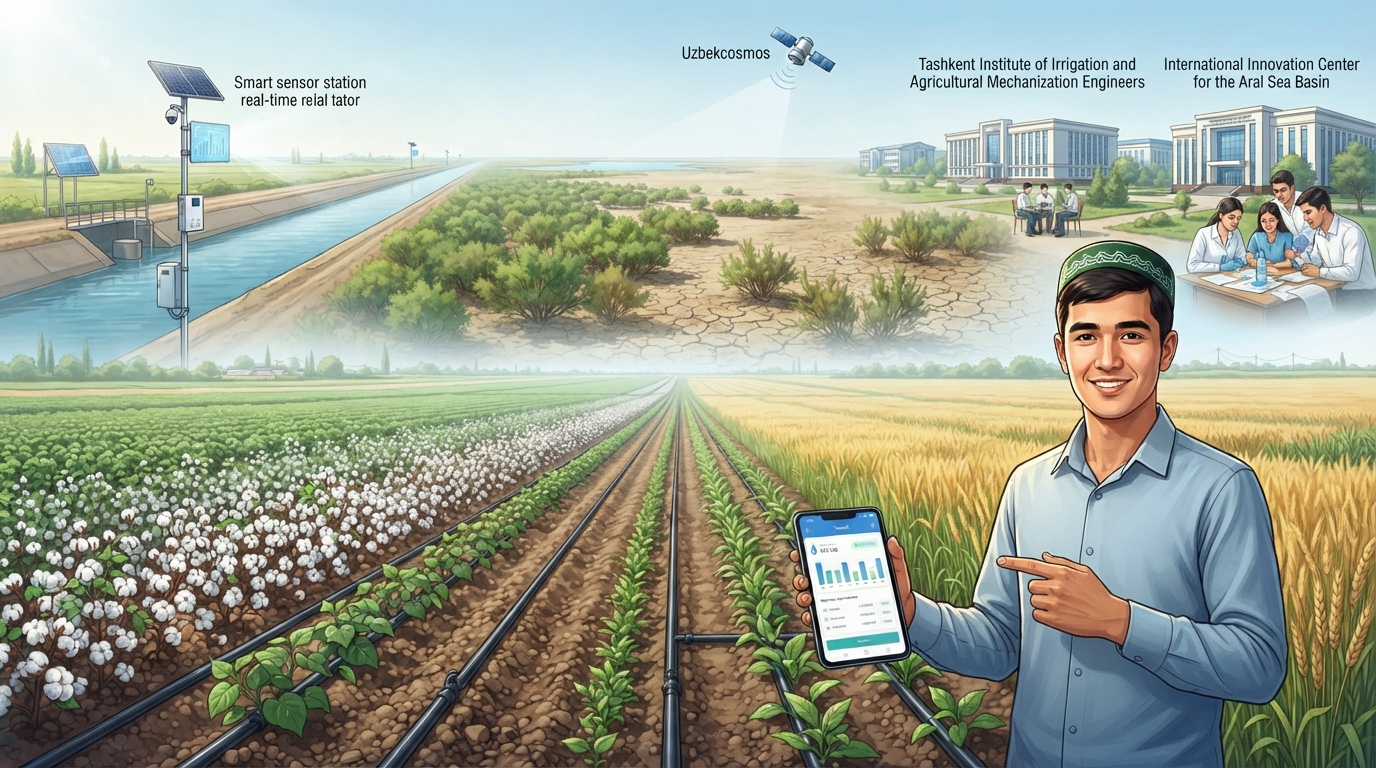
As a notable example of digital transformation, UN-Water highlights the "Tomchi" mobile application, which offers farmers real-time information on water-saving technologies, irrigation schedules, government subsidies, preferential loans, and equipment suppliers. This initiative was developed with the assistance of the Swiss Agency for Development and Cooperation.
The report also outlines advancements in digital monitoring systems, including the installation of a network of smart sensors across key reservoirs to monitor water levels and hydraulic infrastructure in real time. Furthermore, the national space agency, Uzbekcosmos, performs satellite monitoring of all national reservoirs to enhance drought and flood forecasting.
UN-Water specifically commends the efforts of the Scientific Information Center of the Interstate Commission for Water Coordination (SIC ICWC), located in Tashkent. Since 2007, the center has produced biannual analytical assessments for the Amu Darya and Syr Darya river basins, offering data on river flows, reservoir capacities, and water withdrawals. UN experts note that this system fosters regional trust and promotes transboundary water cooperation.
The restoration program for the Aral Sea was also highlighted as a vital aspect of the country's ecological reforms. The report underscores that Uzbekistan’s extensive afforestation initiative on the desiccated bed of the Aral Sea—primarily through the planting of drought-resistant saxaul—represents one of the largest nature restoration projects globally, aiding in the reduction of dust storms and the revival of local ecosystems.
UN-Water experts also acknowledged the country's expanding academic and scientific capabilities, citing the International Innovation Center for the Aral Sea Basin and the National Research University "Tashkent Institute of Irrigation and Agricultural Mechanization Engineers" as leading innovation hubs.
The case study emphasizes that these achievements were realized by implementing the five fundamental pillars of the SDG 6 Global Acceleration Framework: governance, financing, capacity development, data and information, and innovation. Strong political backing and ongoing institutional reforms were identified as crucial to this success.
Nonetheless, the report indicates that challenges persist. Uzbekistan must continue its efforts to lower water withdrawals to ecologically sustainable levels, enhance the protection of groundwater resources, adopt technologies to reduce water loss, and strengthen cooperative transboundary water management with neighboring countries.
According to UN-Water, Uzbekistan's strategic approach can serve as a model for other Central Asian nations and water-stressed countries worldwide. The outcomes of the country's reforms are set to be presented to the international community at the UN Water Conference in Abu Dhabi in December 2026, as well as during the World Water Forum scheduled to take place in Samarkand.