

Turkmenistan, EU explore new opportunities for economic cooperation
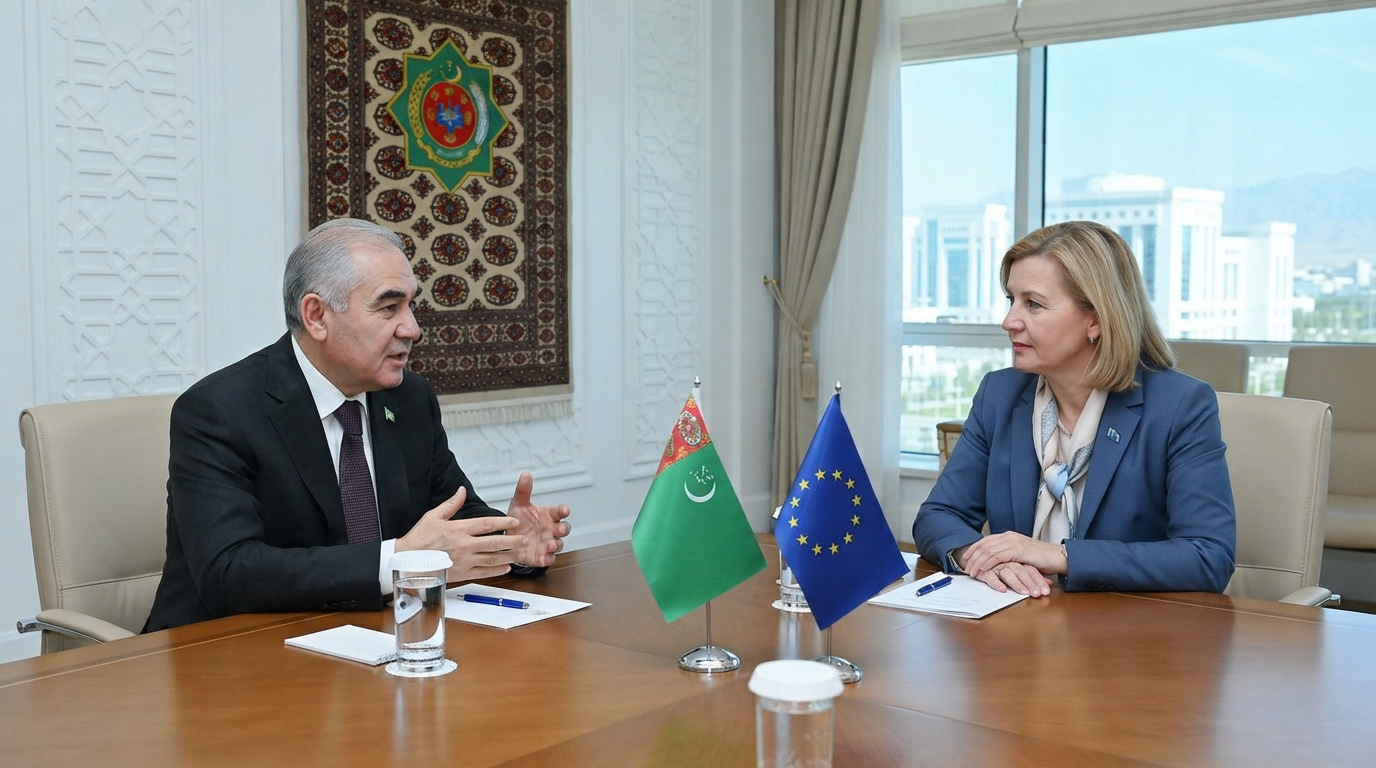
Turkmenistan and the European Union are exploring new avenues for economic collaboration, as discussed in a meeting between Turkmen Trade Minister Nazar Agakhanov and EU Ambassador Beata Peksa.
A statement released by the Turkmen government on August 3 indicated that the officials assessed their existing bilateral cooperation and considered potential future developments, as reported by Trend. The discussions specifically emphasized enhancing cooperation in commerce, economic advancement, and business interactions.
The statement highlighted that "The participants paid particular attention to strengthening partnership in the areas of trade, economic development and expanding business contacts." Both parties reiterated their shared desire to deepen cooperation and identify new prospects for future joint endeavors.
Currently, the relationship between Turkmenistan and the European Union is guided by the Interim Agreement on Trade and Trade-related Matters, which became effective in 2010. A more comprehensive Partnership and Cooperation Agreement, signed in 1998, has not yet received full ratification from the European Parliament. Consequently, Turkmenistan remains the sole Central Asian nation without a fully enacted partnership agreement with the EU.
In recent years, the collaboration between the EU and Turkmenistan has increasingly concentrated on areas such as transport connectivity, trade facilitation, energy, education, climate policy, and economic diversification. The EU's involvement with Turkmenistan operates within the framework of the 2019 EU Strategy for Central Asia and the Global Gateway initiative. For its 2021–2027 program, the EU has designated €18 million ($20.9 million) for bilateral cooperation with Turkmenistan.
Transport and logistics have also emerged as crucial areas of cooperation, with Brussels recognizing Turkmenistan as a significant participant in the Trans-Caspian Transport Corridor, which connects Central Asia with Europe. During a visit to Ashgabat in March 2025, European Commissioner for International Partnerships Jozef Síkela reiterated the EU's commitment to developing this corridor under the Global Gateway strategy.