

The deal favoring Iran and the drone blown up in Germany - the daily news
We will introduce you to the most important events and news that happened in the world over the past day in our daily newsletter.
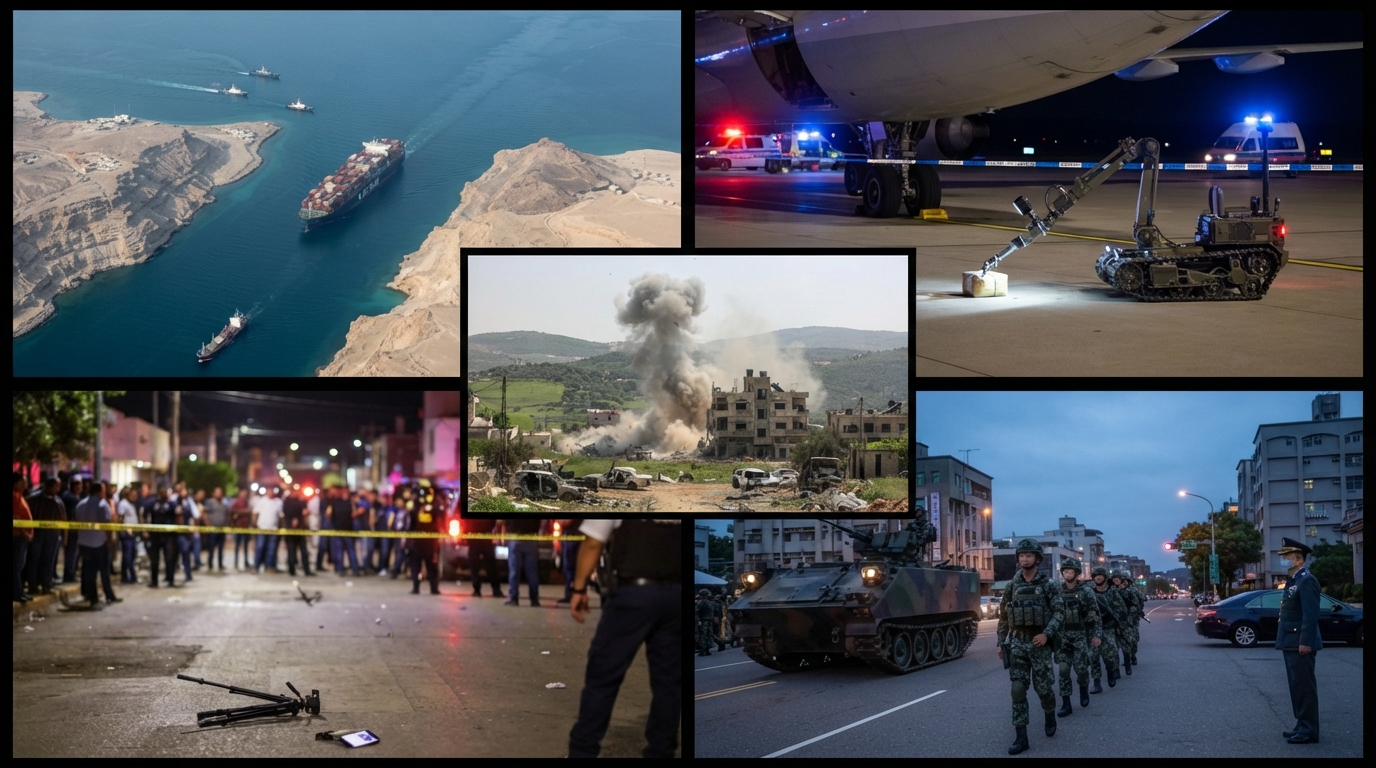
**Iran deal and drone explosion in Germany – daily news digest**
Here is a roundup of the most important events and news from the past day around the world.
**Strait of Hormuz deal**
A proposed deal between Iran and Oman could give Tehran control over ships passing through the Strait of Hormuz, a senior Iranian source and two regional officials told Reuters on Wednesday. It is said to be one of the biggest concessions ever made to Iran.
According to an Iranian official, ships entering and leaving the strait will pass through Iranian territorial waters. Another regional source said that details on how "control" will be determined are yet to be determined.
Iran is demanding that ships using the strait pay a fee of 5% to 7% of the cost of their cargo. Oman is negotiating a fee of around 3%, while Washington wants none at all. Gulf negotiators insist that any levies be voluntary.
At the same time, Iran has warned that any new US attack would trigger a strong response. “Iran’s warning was firm: if America targets Iranian infrastructure, they will respond by hitting Gulf energy facilities and other regional targets,” one Gulf source said.
The US has not yet commented on the Hormuz proposal. President Donald Trump has said a deal to reopen the strait is close, although US officials have said they would never allow Iran to control access to Hormuz.
A deal that would give Iran such authority would represent a major shift in the regional balance of power in Tehran’s favor since the US and Israel launched a war in February. Before the war, the strait was free and open to all ships, free of charge.
**Explosive device found at German airport**
A drone with an explosive device was found at an airport in Germany last night. According to Saxony police, the object was found near parked Antonov aircraft. The detonator of the explosive device was removed by a robot. Police later carried out a controlled explosion.
Leipzig/Halle airport is used by the German military and NATO allies to transport military cargo. It also serves as a base for Ukraine's Antonov Airlines.
A second unidentified object collided with a cargo plane near the same airport. The plane landed in Hanover with minor damage.
Germany's interior minister said the incidents represented a "new level of threat." He did not name any suspects, but said the investigation could indicate "possible involvement by foreign forces."
In recent months, there have been a number of unauthorized drone flights over military bases, airports, energy terminals, seaports and logistics companies. German airports have been put on alert. Police have warned of possible Russian involvement in the attacks, which Moscow denies.
**Israel strikes southern Lebanon again**
The Israeli military announced on Wednesday afternoon that it had begun "precise strikes" in southern Lebanon. Half an hour before the attacks, an IDF spokesman in Arabic warned Lebanese residents to evacuate.
Both Israeli statements blamed Hezbollah for violating the ceasefire, but gave no further details.
Lebanese media reported that one man was killed and 12 others were wounded when a building in the cemetery of the city of Tibnin was hit. The western city of Mansouri was also hit, where the Israeli military ordered the first evacuation in more than a month.
Mansouri Mayor Haider Madihli said Israeli warplanes had struck four buildings and villas in the Ghazaleh neighborhood on the outskirts of the city.
Madihli said the strikes had sparked a wave of displacement, with families loading their belongings into cars and heading towards the largest city in the south, Sur.
The incidents came as Israeli and Lebanese officials were in Rome for US-brokered talks aimed at preserving a ceasefire.
A deal brokered by the three countries in late June called for an Israeli withdrawal from southern Lebanon in exchange for Hezbollah disarmament. But Hezbollah rejected the deal, saying the terms crossed "all red lines."
**Blogger shot dead on live broadcast**
Mexican social media influencer Cesar Gastelum was shot dead while live streaming with friends outside a restaurant in the city of Culiacan.
According to local media, Gastelum, who has nearly 600,000 subscribers on TikTok, was dressed as a courier for the video.
During the broadcast, two men on a motorcycle pulled up next to them. Footage of the live broadcast showed the motorcyclist shooting Gastelum directly in the head. It was at this point that the broadcast was cut off.
Although the video was later deleted by the platform, parts of it continued to circulate online.
A security official confirmed Gastelum's death and said a major security operation was underway.
Culiacan, the capital of Sinaloa state, has been the scene of a power struggle within the region's dominant drug cartel. Local media reports have reported that several influential figures, including those with alleged links to criminal gangs, have been killed in the city in recent years.
**Military drills in Taiwan**
Taiwanese President Lai Chin-te has taken part in a drill designed to demonstrate how the government would operate in the event of war. The president rushed to the command center in an armored personnel carrier at night.
The 10-day drills in Taiwan are designed to bolster preparations in case China follows through on its pledge to take the island by force.
On Thursday, photos emerged of the president climbing into an armored personnel carrier wearing a bulletproof vest and helmet.
Taiwan will deliberately slow down mobile internet speeds for the first time next week, testing how citizens can communicate in situations ranging from disasters to Chinese invasion.
China’s military, which has yet to comment on Taiwan’s military exercises, has been moving around the island almost daily.
The idea of evacuating Taiwan’s leader to safety in times of war or other crisis dates back to the height of the Cold War. Then-President Chiang Kai-shek lived in constant fear of an attack by his arch-rival Mao Zedong.
One of the scenarios they practiced during Chinese military exercises around Taiwan in 2023 was to deliver precision strikes for the mission of “decapitation” (eliminating the leadership).