

Tashkent transport could face fare adjustments and route cuts
Tashkent Times is an English language online-newspaper that brings all latest Uzbekistan news
Tashkent's public transportation system may undergo significant changes, including potential fare increases and route reductions, according to a proposal from the Institute for Reducing the Shadow Economy, Improving Tax and Customs Administration, and Fiscal Analysis, an entity operating under the Ministry of Economy and Finance. These recommendations were formally introduced on July 30 at a "Fiscal Dialogue" policy session.
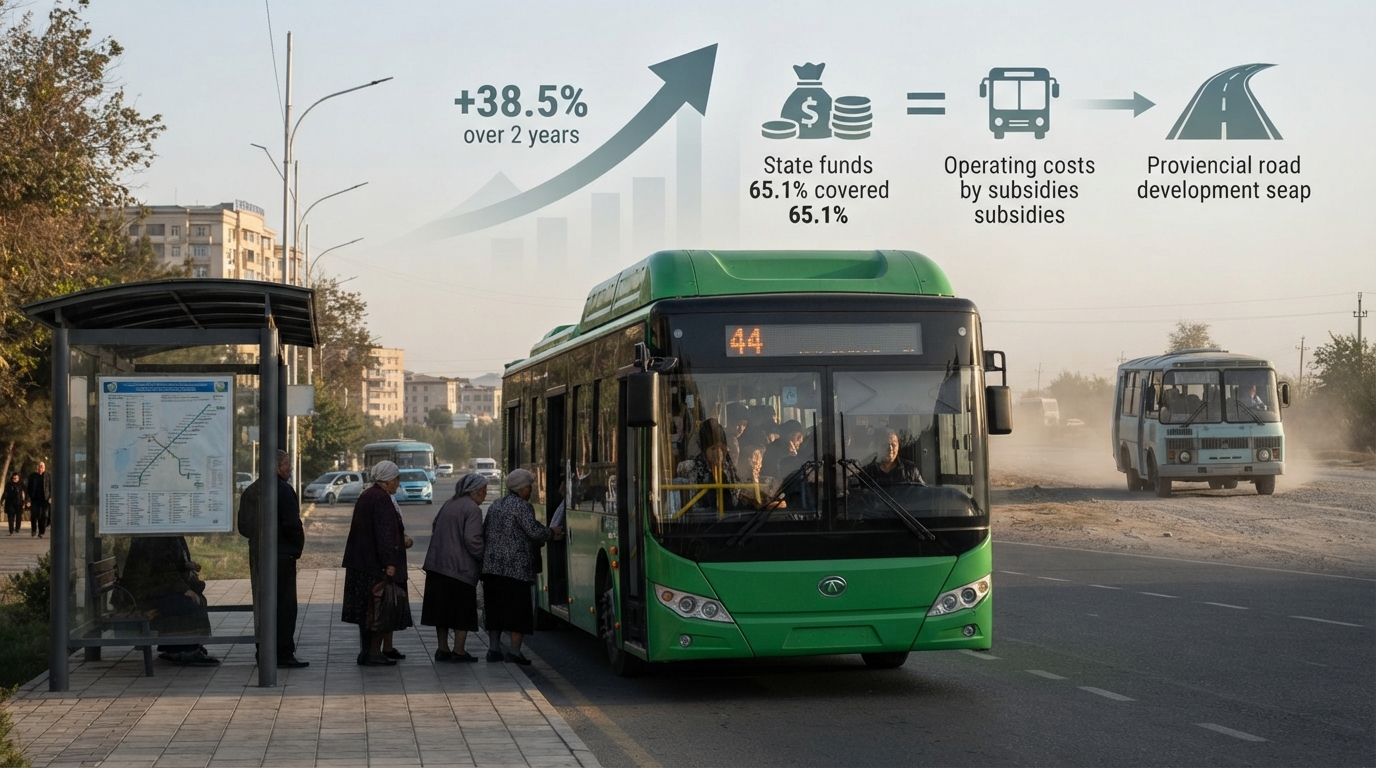
The institute's presentation highlighted that the state budget allocates 1.9 trillion UZS annually to gross contracts for public transit operators. A substantial 1.3 trillion UZS of this funding is specifically directed to support Tashkent's public transportation infrastructure. Overall, government subsidies now cover 65.1% of all public transit operating expenses.
The total amount of these subsidies has been on a sharp upward trend, rising from 1 trillion UZS in 2024 to 1.2 trillion UZS in 2025, and projected to reach 1.385 trillion UZS in 2026. This signifies a considerable 38.5% increase in state expenditure over just two years.
The institute pointed out a stark disparity in public transit capabilities and service availability between the capital city and the country's rural regions. Analysts cautioned that despite the aggressive escalation of state subsidies, the tangible results of this financial support remain unclear and challenging to quantify.
Moreover, the presentation noted that a recent surge in passenger traffic has not led to a corresponding increase in revenue or eased the financial burden on the state budget.
**Proposed Reform**
To tackle these inefficiencies, the institute suggests "optimizing" routes with low passenger traffic, progressively adjusting passenger fares to reflect actual economic costs, and broadening transit coverage in rural provinces.
Under the proposed new framework, payments to both private and state transport operators via gross contracts would be directly tied to key performance indicators (KPIs) that assess service quality. Simultaneously, the proposal recommends maintaining targeted, subsidized transit fares for vulnerable citizens and those with official travel privileges.
The institute's projections indicate that adopting this model of targeted assistance would release a significant portion of the substantial subsidies currently consumed by Tashkent’s public transit network. These freed-up funds could then be reallocated to develop essential transport infrastructure in the provinces.