

Fiscal Policy Institute proposes overhaul of heating subsidy system
A fiscal policy institute in Uzbekistan has proposed replacing universal heating subsidies with targeted social assistance for low-income households.
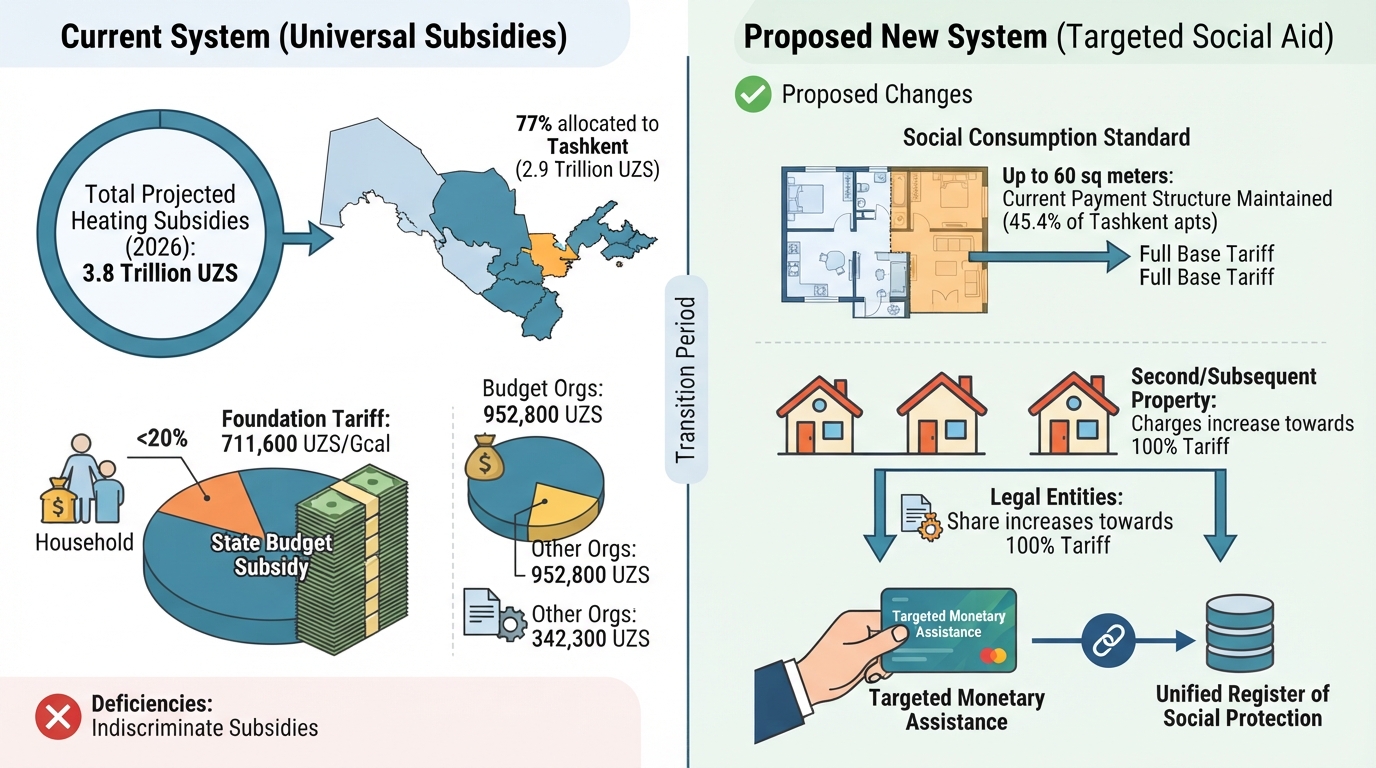
The Institute for Reducing the Shadow Economy, Improving Tax and Customs Administration and Fiscal Analysis, operating under Uzbekistan's Ministry of Economy and Finance, put forth a proposition on July 30 during a fiscal dialogue: to substitute the existing system of universal heating tariff subsidies with focused social aid for households with limited incomes.
As per the presentation, the aggregate heating subsidies in Uzbekistan are projected to reach 3.8 trillion soums by 2026. A significant portion of this, 2.9 trillion soums or 77%, is allocated to Tashkent. Presently, households contribute less than 20% of the foundational tariff, which is 711,600 soums per gigacalorie, with the state budget covering the remainder.
The proposal's creators pointed out that Tashkent's centralized heating infrastructure largely relies on budget subsidies, while in most other regions of the nation, consumers primarily bear the cost of heating.
The institute identified several deficiencies in the current framework, such as the indiscriminate provision of subsidies irrespective of a household's income or property holdings. The presentation also drew attention to the varying tariffs for legal entities, where organizations funded by the budget pay 952,800 soums per gigacalorie, and other organizations are charged 342,300 soums.
In lieu of the present system, the institute advocates for the incremental implementation of a social consumption standard. The suggested baseline would be 60 square meters of living space per household or 16 square meters per registered occupant. Any area surpassing this limit would be billed at the complete base tariff.
Furthermore, the institute suggests progressively increasing the charges for second and subsequent residential properties from 40% of the base tariff to 100%. For legal entities, it proposes elevating their share of the base tariff payment from 60% to 80%, and subsequently to 100%.
In the intermediate future, the authors recommend substituting universal subsidies with targeted monetary assistance for eligible citizens, facilitated by the Unified Register of Social Protection.
According to the presentation, the current payment structure would remain unaltered for 45.4% of apartments in Tashkent that have a floor area of up to 60 square meters.