

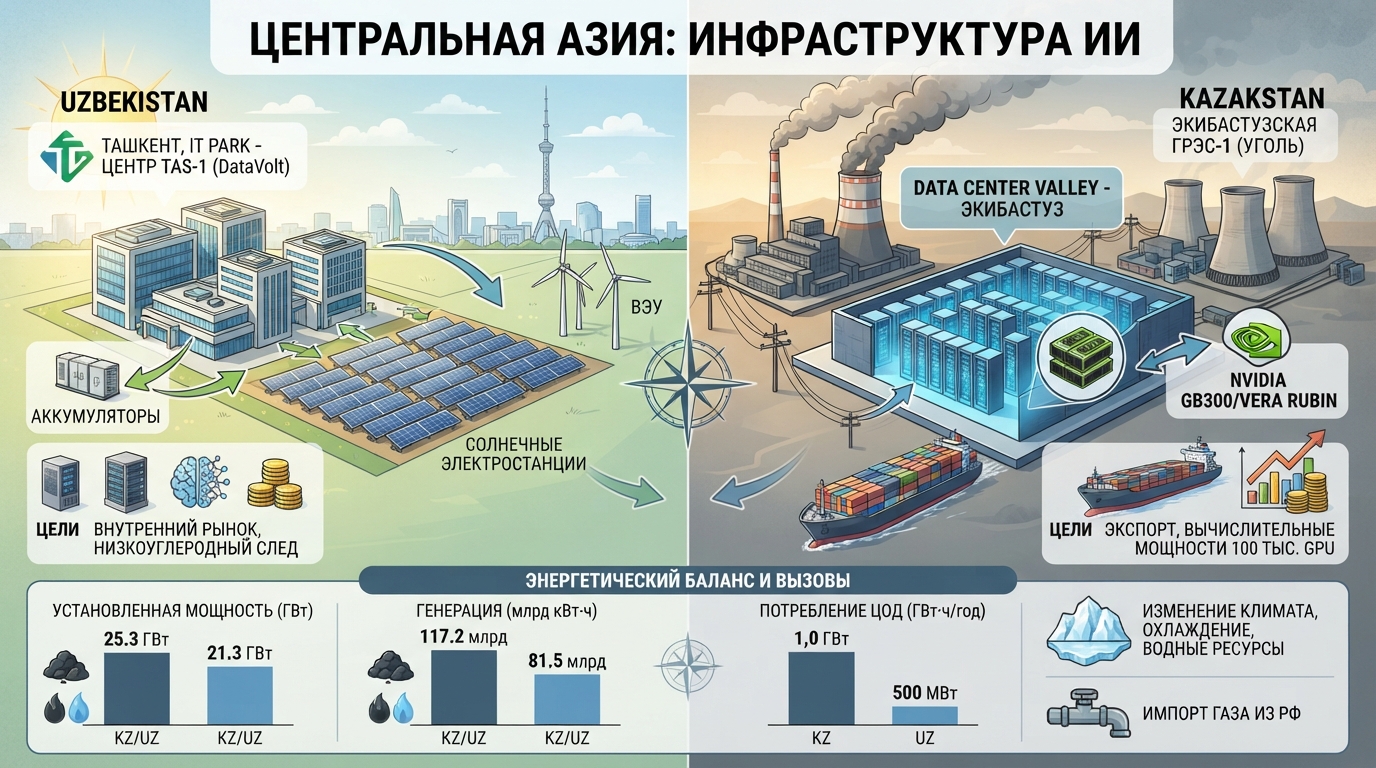
A competition for digital hub status is unfolding in Central Asia: Uzbekistan and Kazakhstan are actively developing artificial intelligence infrastructure, seeking to transform computing power into a new export industry. However, the countries are pursuing this goal in different ways: Kazakhstan is attracting investment through the availability of affordable energy from large power plants, while Uzbekistan is focusing on reducing its carbon footprint, developing renewable energy sources, and the potential of its domestic market.
Uzbekistan is actively laying the foundation for its future digital economy. The first significant project will be the TAS-1 data center, which is being built by the Saudi company DataVolt in Tashkent's IT Park. Construction began in May 2024, and its launch is scheduled for late 2026. The center's total capacity will be 12 MW, 10 MW of which will be used directly for server equipment.
To implement TAS-1, DataVolt has secured up to $150 million in project financing from international institutions, including the European Bank for Reconstruction and Development. The data center is positioned as ready to host AI systems and primarily uses renewable energy sources, supplemented by a battery storage system for increased reliability.
TAS-1 is only the first stage of a large-scale program. DataVolt, in collaboration with the Uzbek government, plans to build several data centers with a total capacity of up to 500 MW by 2032, with an estimated investment of approximately $3 billion. These initiatives are closely aligned with the state AI development strategy, which aims to reach $1.5 billion in sales of AI-based software products and services by 2030.
A project of a different scale is being implemented in Kazakhstan. The Data Center Valley cluster is being built near Ekibastuz State District Power Plant No. 1, one of the largest coal-fired power plants in the region. It will house 300 MW of infrastructure, with the potential to expand to 1 GW, covering up to 1,500 hectares. The project includes the construction of 15 km of transmission lines and new substations. The launch of the first phase (125 MW) is scheduled for 2027, with full development planned by 2033.
In June 2026, the Kazakh government, American company Firebird, and Nvidia announced a $10 billion package of agreements. Data Center Valley is planned to house a computing cluster of approximately 100,000 graphics processors, including Nvidia GB300 and advanced Vera Rubin chips. Kazakh authorities predict annual export revenues of at least $3 billion once the complex reaches full capacity.
According to Nikkei Asia analysts, Kazakhstan's energy base remains an advantage. At the beginning of 2025, the installed capacity of its power plants was approximately 25.3 GW, compared to 21.3 GW in Uzbekistan. Kazakhstan generated 117.2 billion kWh of electricity, while Uzbekistan generated approximately 81.5 billion. More than 63% of Kazakhstan's output came from coal, while Uzbekistan obtained almost three-quarters of its electricity from natural gas.
Ekibastuz is attractive for large data centers due to its 24/7 access to inexpensive coal-fired electricity, a well-developed industrial network, and a cold climate that reduces cooling costs. Kazakhstan is seeking to convert local coal into export computing services. However, the high carbon footprint of coal-fired power is a key drawback, discouraging international companies with environmentally conscious goals, despite low tariffs. Furthermore, aging plants require modernization, and their price advantage is partly due to equipment depreciation.
Uzbekistan offers investors an alternative: its gas-fired generation has a lower carbon footprint than coal, and it is actively developing renewable energy. By 2030, the country plans to increase the share of renewable energy to 40%, and all low-carbon generation to 54%. A larger domestic market is also a significant advantage. New computing capacity can be used not only for export but also for the development of local digital services, from banking to the creation of Uzbek language models.
However, energy could be the main constraint on the digital ambitions of both republics. A 500 MW data center, when operating continuously, could consume up to 4.38 billion kWh per year. This corresponds to more than 5% of Uzbekistan's current annual generation. A 1 GW cluster in Kazakhstan would require up to 8.76 billion kWh – approximately 7.5% of the country's current generation.
The situation in Uzbekistan is complicated by declining domestic gas production. The republic is increasing its imports of Russian gas through Kazakhstan, reaching 6.5 billion cubic meters by 2025. These supplies are intended to simultaneously meet the needs of the population and industry, support the development of large data centers, and support the export of green energy. However, simply supplying data centers with renewable energy sources will not solve the problem if this capacity cannot cover growing demand, forcing the system to increase gas generation or imports.
The success of Kazakhstan and Uzbekistan's data center plans will depend not on memorandums or access to Nvidia chips, but on the ability to guarantee cheap, uninterrupted electricity, backup capacity, and reliable international communication channels.
"It is not yet clear to what extent these plans take into account other factors that could seriously impact not only the profitability of deploying all high-tech components in the region, but also their development feasibility as such," said Derya Karayev, a political scientist and coordinator of a UN program for Central Asia.
He noted that Central Asia is an arid zone with the highest temperature increases due to climate change, and, according to all forecasts, this increase will continue. "Whether the authors of the development plans have taken into account the costs of cooling (energy and financial) infrastructure is anyone's guess. "After all, leading AI developers are planning to deploy data centers—some on the Moon, some in space, some underwater—knowingly realizing that this will save them a significant amount of energy (and money) on cooling," the political scientist emphasized.
He noted that the existing energy shortage in the region, as evidenced by the growing gas purchases from Russia, as well as the planned green electricity supplies to Europe, also makes it difficult to clearly assess the feasibility of AI development on the scale claimed by the authorities of Kazakhstan and Uzbekistan, especially given population growth and industrial development.
"Yes, there are at least two other energy sources in the region—the Rogun Hydroelectric Power Station, with which commercial agreements for the purchase of electricity already exist. However, its construction faces not only a funding shortage and the looming problem of global warming, but also the accompanying shortage of water resources. Turkmenistan also has large natural gas reserves, which could, in principle, serve as a sustainable base for AI development throughout the region." However, regional cooperation is not part of Turkmenistan's gas industry development paradigm; the Turkmen authorities prefer politically motivated transcontinental gas pipeline projects," Karayev noted.
According to him, another important aspect of the energy balance is competition for energy with transnational raw materials corporations. They extract and refine critical minerals locally to reduce transportation costs, but at the same time leave behind all the processing waste and emissions from energy generation, which contribute to climate change.
"It remains unclear from all the development strategies whether the additional energy (and financial) costs associated with climate change, specifically in the interests of the countries' populations, have been taken into account. Direct and associated costs of adaptation to climate change will increase. A logical and comprehensive analysis is not yet available," Karayev concluded.
Victoria Panfilova