

Qatar says US-Iran mediation efforts continuing but no direct talks planned
There have been conflicting signals from the US and Iran, with Tehran denying President Trump's assertion that talks are under way.
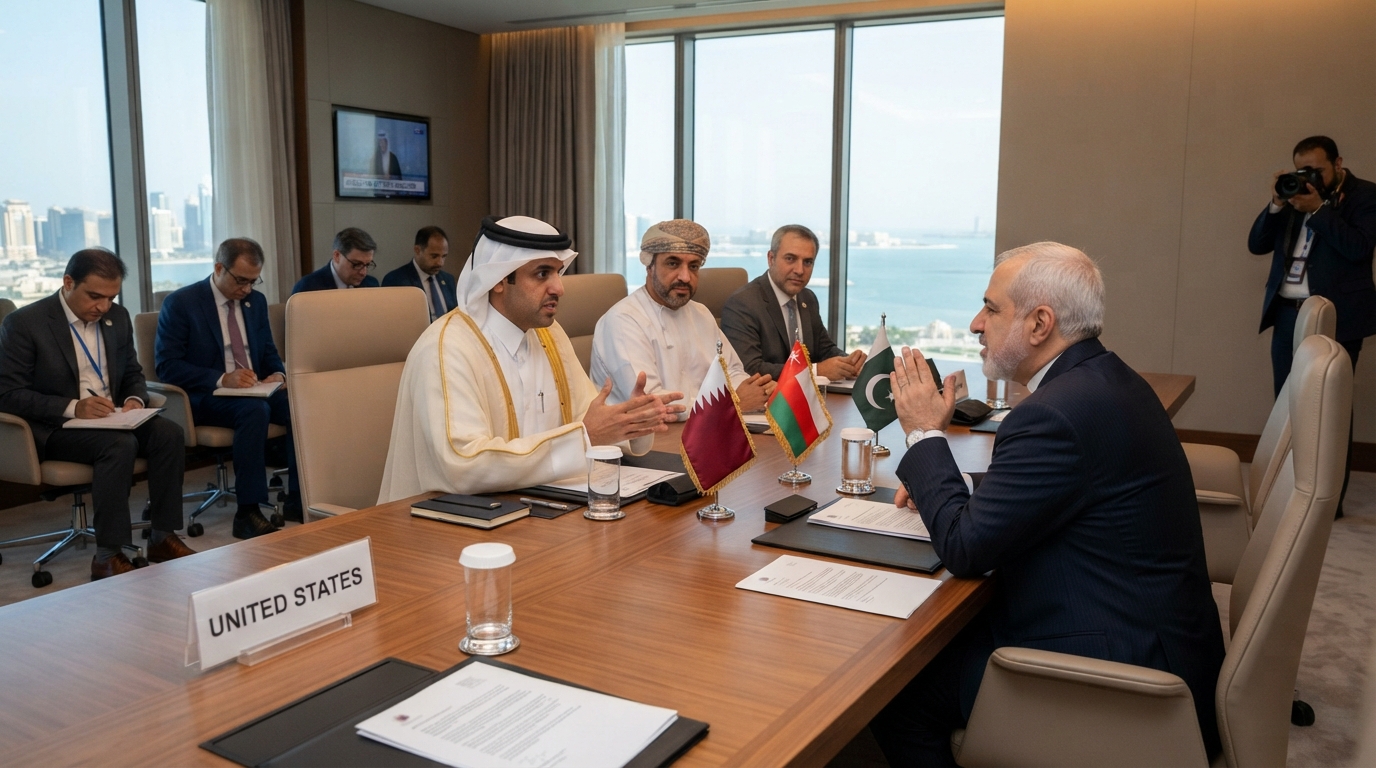
Qatar has confirmed that mediation efforts are ongoing to de-escalate tensions between the US and Iran, though no direct discussions are currently scheduled.
According to Majed al-Ansari, a spokesman for Qatar's foreign ministry, officials from Qatar, Pakistan, and Oman are concentrating on achieving "a short-term resolution that would help us reignite the talks" between Washington and Tehran.
Signals from both sides have been contradictory. Iran's foreign ministry has refuted US President Donald Trump's claim that talks were in progress. Iran maintains that its only negotiations are with Oman, concerning an agreement to reopen the Strait of Hormuz for commercial shipping.
US Secretary of State Marco Rubio acknowledged progress in these discussions but stated that a final agreement had not yet been reached. "We're hoping that will happen very shortly," he informed reporters in Washington. Concurrently, US Treasury Secretary Scott Bessent suggested to CNBC that "a deal today or tomorrow" was possible.
Overnight, the United Kingdom Maritime Trade Operations (UKMTO) reported that an "unknown projectile" struck a cargo vessel in the critical Gulf waterway. Maritime risk management firm Vanguard specified that the engine room of the Liberia-flagged Minoan Pioneer was hit, and one sailor was missing.
The Strait of Hormuz, a crucial passage for a fifth of global oil and gas shipments, has been largely inaccessible since late February, following Iranian attacks on vessels and a US blockade of Iranian ports, stemming from the US and Israel's conflict with Iran.
A preliminary agreement to end the conflict and reopen the strait was signed by the US and Iran in mid-June, but it collapsed within weeks due to a dispute over waterway control and escalating strikes triggered by Iranian attacks.
On Saturday, Trump stated he had canceled a "massive attack" by US and Israeli forces on Iran after Saudi Arabia, the United Arab Emirates, and Qatar advocated for restraint to allow mediators to broker a new deal on the Strait of Hormuz and "the denuclearisation of Iran." The president announced that talks with Iran were set to commence on Monday afternoon.
However, Esmail Baqai, Iran's foreign ministry spokesman, dismissed the notion of direct talks with the US, stating there were no plans for delegations. Instead, he confirmed "constructive" negotiations with Oman regarding "a path to ensure the security of shipping passage through the Strait of Hormuz." Baqai also indicated that an agreement on a new arrangement would be "necessary but not sufficient" to reopen the strait, implying that Iran would continue to impede shipping as long as the US blockade of Iranian ports persisted.
Hours later, Trump responded on Truth Social, labeling Iran's leadership "unbelievably duplicitous," claiming they had requested a meeting and that more talks were scheduled for the "immediate future."
At a Tuesday news conference in Doha, the Qatari foreign ministry spokesman confirmed that efforts by Qatar, Pakistan, and Oman were "still ongoing with all the parties" and were in "very progressive stages." Ansari told reporters, "We are co-ordinating very closely with the Omanis to facilitate the talks between both sides, exchanging ideas, drafts between both sides." He added, "Our focus right now is on avoiding escalation, reopening the strait and reopening the door for diplomacy between the parties," while also noting there was "not anything on the books as far as direct talks."
A senior Pakistani security official also informed Reuters, "A lot is happening in the background... We are talking to both sides."
Neither Iran, Oman, nor the mediators have released details about the potential agreement concerning the Strait of Hormuz. However, Iranian officials reportedly told the New York Times that inbound shipping to the Gulf would use an Iranian-controlled route near its coast, while outbound shipping would use a route close to Oman's coast. The officials also reportedly mentioned that the agreement included a "service fee" for environmental impact, security, and staffing. A US official, however, told the newspaper that the Iranian account was inaccurate and that any "temporary" routes would not require Iranian approval or tolls.