

Outside the Moscow restaurant where bomb killed three
The BBC's Russia editor reports from Kudrinskaya Square, where the blast took place.
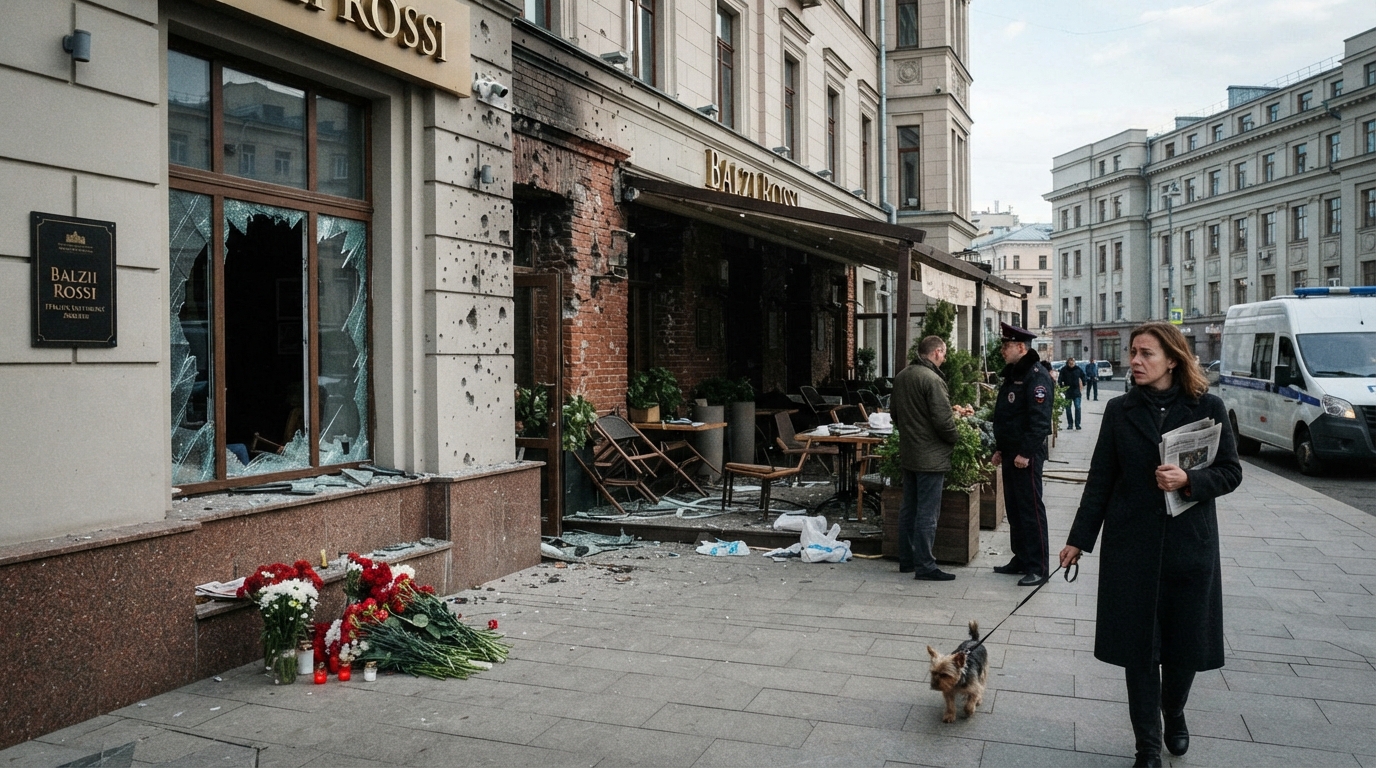
**Scene of Moscow Restaurant Bombing Cleared; Three Dead, 21 Injured**
The police cordon has been lifted at Kudrinskaya Square, outside the Balzi Rossi Italian restaurant in Moscow, where a bomb blast on Saturday night killed three people and injured 21. Investigators have concluded their work at the scene, which hours earlier was swarming with heavily armed police, ambulances, and emergency vehicles.
Signs of the deadly explosion are still visible, including a shattered window and pock-marked walls near the restaurant's summer terrace. Russian state media confirmed the casualty figures.
Russia's National Anti-Terrorism Committee believes a woman attempted to enter the restaurant with an improvised explosive device. Russian news outlets have speculated she might have been a courier, unaware of the package's true contents, attempting to deliver it to a guest at a private function. A security guard reportedly prevented her entry moments before the device detonated.
Unconfirmed reports have circulated about a senior Russian military commander being present at the restaurant that evening. However, official confirmation of the guest list for the private dinner remains unavailable.
The Kremlin has not yet issued a statement. However, the Russian Embassy in Italy released a statement on Sunday, attributing the attack to Ukraine. The statement did not identify the Russian military as a potential target, instead claiming, "It is clear that when planning a terrorist attack on one of the best Italian restaurants in Moscow, the Kyiv terrorists wanted to scare Italians working in Russia…"
Many individuals interviewed at Kudrinskaya Square expressed a belief in a direct link between the restaurant explosion and the ongoing conflict in Ukraine. This sentiment is fueled by several previous bomb attacks on senior Russian military figures, which Moscow has blamed on Kyiv.
"The explosions, the deaths, they frighten me," said Ludmila, adding, "It's probably linked to the war that's going on."
Another resident, Galina, expressed anger at UK support for Ukraine, stating, "This is the work of Britain, this is your work." She then directed personal criticism at the reporter, saying, "I've seen you asking our president nasty questions. It makes me want to come up and punch you."
Alexandra, who was walking her dog near the restaurant when the bomb detonated, recounted, "I heard a loud bang. I realised immediately that it was an explosion. I live here in the building. It's terrible."
Despite the gravity of the incident, Russian state television provided minimal coverage of the bombing over the weekend. The Sunday morning news bulletin on Russia-1 focused on Russian strikes in Ukraine, celebrations for Russian Paratroopers' Day and Russian Railway Workers' Day, and updates regarding Donald Trump and Iran, with no mention of the Moscow restaurant explosion. This limited coverage may reflect an effort by Russian authorities to prevent public alarm.
For Alexandra, however, the impact is profound. "I can't get over this, I can't," she shared. "Because it basically happened right in front of me. It was terrible. I just don't know how I'm going to get over this."