

As child immunisation rates fall across the UK, one clinic in west Yorkshire is taking aggressive steps to boost immunisations
**Child Vaccination Rates Decline in Britain, Experts Point to Access Issues Over Social Media**
The decline in child vaccination rates across Britain is not primarily due to social media misinformation, but rather a more fundamental problem of accessibility and reduced contact with healthcare professionals, according to public health experts. This issue is exemplified by the story of 20-week-old Grayson, whose mother, Lily, struggled to get him vaccinated against polio and diphtheria due to the challenges of early motherhood, postpartum depression, and the daunting prospect of long journeys to a doctor's surgery.
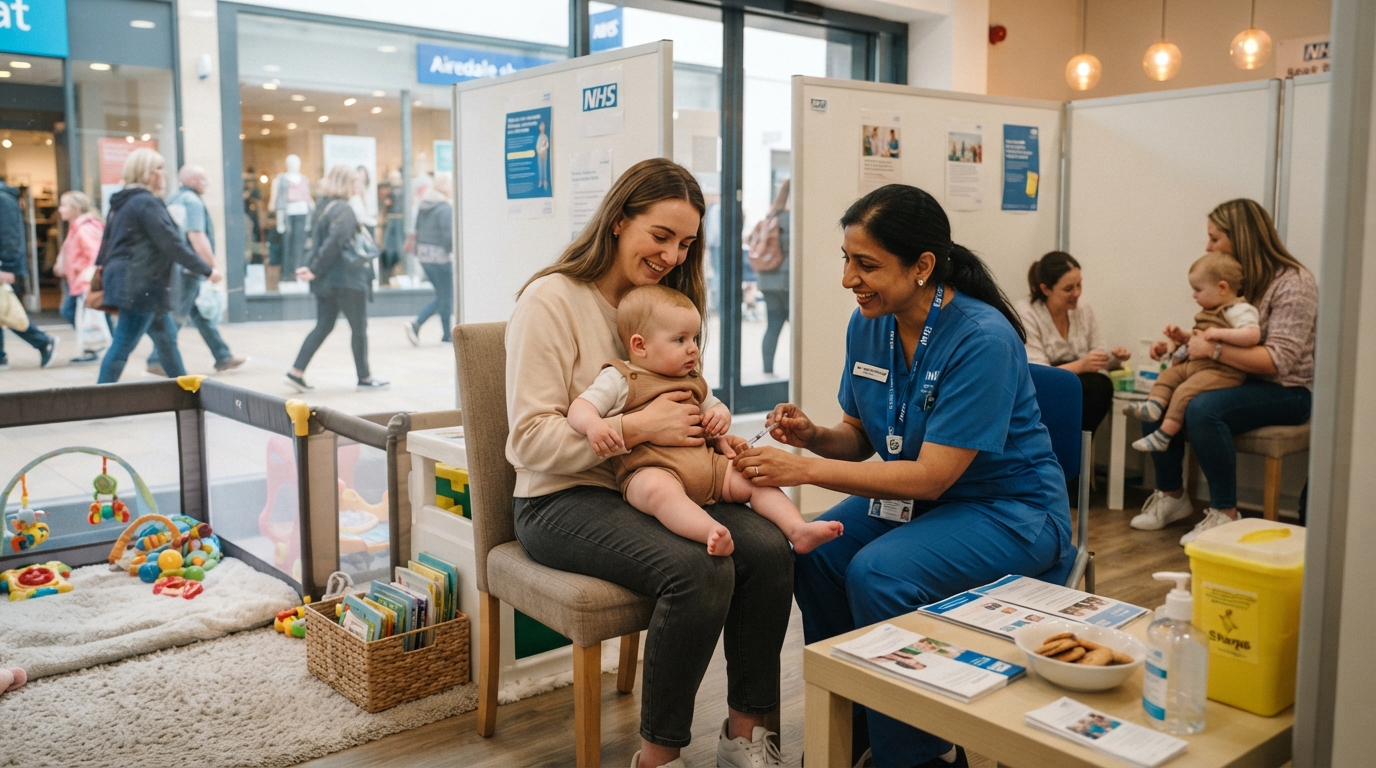
Grayson eventually missed his eight-week vaccinations, placing him on the NHS's "overdue" list. However, Lily discovered a convenient solution: a walk-in vaccination clinic operating out of a vacant retail unit in the Airedale shopping centre in Keighley, west Yorkshire. This innovative clinic, led by Dr. Zoyah Hussain, offers an accessible and welcoming environment, aiming to boost the area's historically low immunization rates.
**A National Problem and Innovative Solutions**
Over the past 15 years, childhood vaccination rates have steadily fallen across Britain. The proportion of five-year-olds in England receiving the four-in-one jab (protecting against polio and tetanus) has dropped from 89% in 2014 to 81%. Similarly, MMR (measles, mumps, and rubella) jab coverage for five-year-olds has decreased from 88% a decade ago to 84%.
Professor Dan Hungerford, an epidemiologist at the University of Liverpool, notes that while the overall decline might not appear "horrific," Britain lags significantly behind other European nations in early-life vaccinations. This decline has prompted politicians to question how the country, the birthplace of Edward Jenner, the "father of immunology," has allowed its immunization rates to fall so low. Some, like a Labour MP on the Health Committee, are even suggesting considering mandatory childhood immunizations, a policy common in some countries but still a taboo in Britain.
Scientists widely agree that vaccines, alongside clean water and sanitation, have been crucial in drastically reducing child mortality. Ben Kasstan-Dabush, a lecturer in global health policy at the University of Edinburgh, highlights the profound impact of immunizations on child survival. The recent measles outbreaks in Birmingham, Bristol, and north London, and the two child deaths from the disease this year, underscore the seriousness of the current decline, which MPs on the Health Committee have called a "national disgrace."
**Beyond Social Media: The Role of Convenience and Healthcare Access**
While misinformation on social media plays a role, public health experts largely agree it's not the primary driver of falling vaccination rates. Instead, they point to a more practical issue: parents of young children have fewer face-to-face interactions with medical professionals than they did a decade or two ago.
Beccy Baird, a senior fellow at the King's Fund think tank, emphasizes that most parents who delay or decline vaccination are not ideologically opposed. Convenience is a major factor; vaccination rates are highest when parents regularly interact with healthcare providers who can remind them about jabs and guide them to vaccination sites.
However, these interactions have become rarer. BBC analysis reveals a 45% decline in health visitors (nurses and midwives who provide in-home care for young children) in England over the last decade. Health visitors play a crucial role in reminding parents about vaccines and, in some cases, administering them directly. Concurrently, the number of fully trained GPs has struggled to keep pace with rising patient demand, and patients are less likely to see the same GP repeatedly, hindering the development of trusted doctor-patient relationships.
**The Keighley Model: A Blueprint for Success?**
The Keighley clinic offers a compelling example of how to address these access issues. Located in a struggling shopping centre, it provides a welcoming, accessible environment. Flora Jennings, a local charity coordinator involved in the clinic, describes it as "inviting, almost like you're walking into someone's home," complete with a playpen and biscuits.
The clinic's central location and flat access are crucial, as many parents struggle with long journeys or multiple bus changes. Dr. Zoyah Hussain and her team engage with parents, often those who initially visit for other services like baby weighing, gently suggesting immunizations. This approach has proven effective, with the clinic vaccinating hundreds of infants since 2023, significantly boosting coverage in a historically low-immunization area. The GP practice running the clinic, Modality AWC, has seen an increase in first MMR doses by 18 months from 78% three years ago to 88% this March, "bucking that national trend," according to senior administrator Bill Graham.
**National Solutions and Ongoing Debate**
The success of the Keighley model suggests that opening walk-in clinics in vacant retail units across the country could be a viable solution. Baird supports this, arguing that small, easy-to-access local venues are more effective than large, intimidating vaccination hubs.
However, some experts remain skeptical, believing that while such schemes help, a larger national solution is needed. Hungerford points to child poverty as a key driver of vaccine refusal, as parents struggling with basic needs may not prioritize immunizations.
More radical solutions are also being discussed. Labour MP Paulette Hamilton suggests a "national conversation" about making child vaccinations "opt-out" rather than "opt-in," similar to policies in some US states where vaccinations are required for school attendance unless an exemption form is filed. Other countries, like Germany and Australia, employ fines or benefit denials for unvaccinated children.
However, these coercive policies raise concerns. Hungerford warns that mandatory vaccination risks excluding vulnerable people from essential services like childcare, while others argue it could further alienate parents from healthcare and erode trust. Bill Graham from the Keighley clinic believes a mandatory approach would destroy trust in his community.
Ultimately, experts acknowledge that Britain's vaccination problem still holds some mystery. Some parents who refuse jabs offer no explanation, and these groups, often from poorer backgrounds with lower educational attainment, are difficult to reach through surveys. Despite this, the Keighley clinic's approach of providing information and a platform for parents to voice concerns, without coercion, offers a hopeful path forward. As Dr. Hussain states, "It's not us forcing it on anyone. This is a choice."