

Ministry of Transport Evaluates Uzbekistan's Logistics Under World Bank's New LPI 2.0 Methodology
Uzbekistan's Ministry of Transport analyzed country performance under the World Bank's new data-driven Logistics Performance Indicators 2.0 (LPI 2.0) methodology.
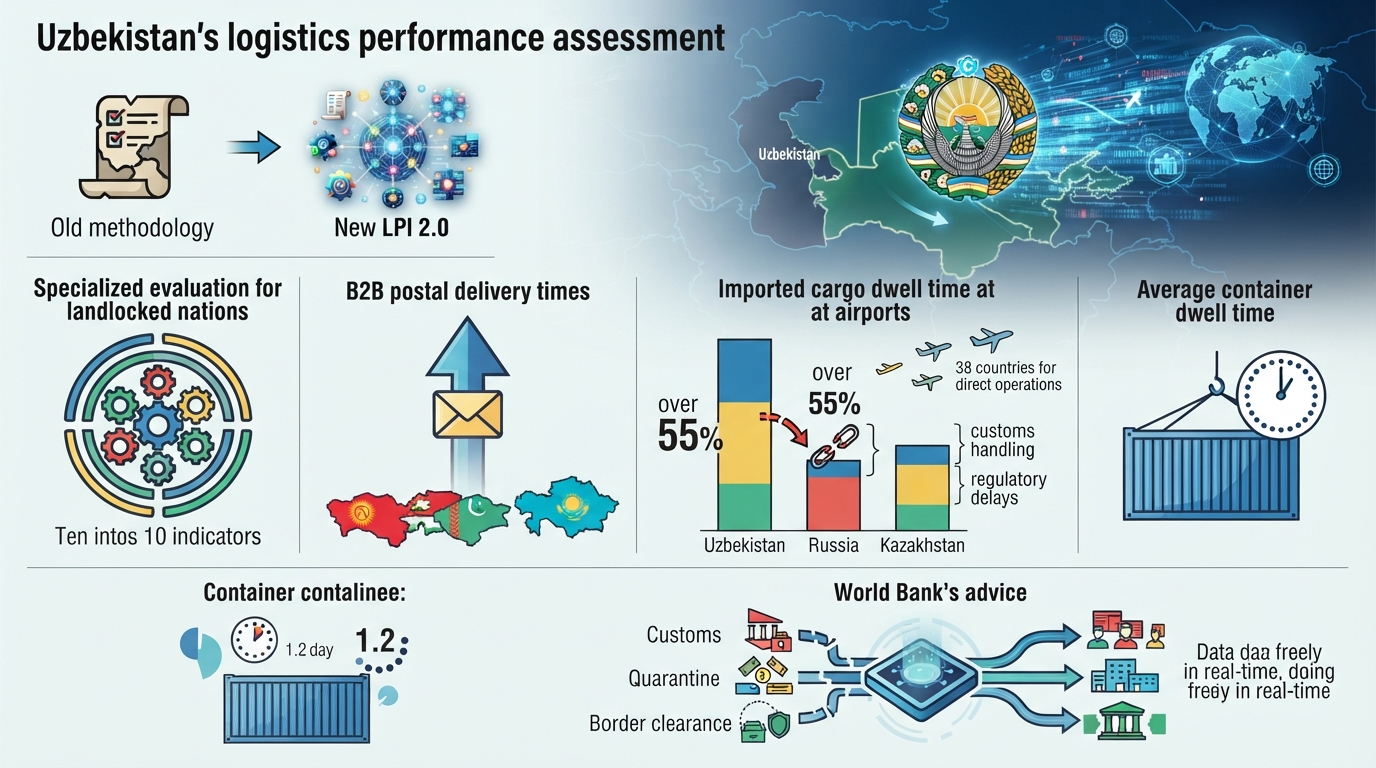
Uzbekistan's Ministry of Transport has assessed the nation's logistics performance using the World Bank's revised Logistics Performance Indicators 2.0 (LPI 2.0) framework. This updated methodology relies on real-time digital tracking data from logistics operations. The evaluation was carried out by specialists from the ministry's Center for the Study of Transport and Logistics Development Problems.
The analysis highlighted that the new LPI 2.0 methodology no longer uses a single index derived from perception surveys. Instead, it employs a system of indicators based on objective data related to cargo movement and logistics activities.
For landlocked developing countries like Uzbekistan, the World Bank has created a specialized evaluation system that considers their unique transport and logistics infrastructure and geographical location. This system comprises ten indicators, with six being core and four supplementary.
The Ministry of Transport underscored that the new methodology does not rank countries or advise direct cross-country comparisons. Consequently, the analysis presents values for leading nations and Uzbekistan's primary partners, expressed in the measurement units specified by the methodology.
The study indicates that Uzbekistan leads Central Asia in business-to-business (B2B) postal delivery times, with an average of 4.7 days. Furthermore, its network of international postal partners for business-to-consumer (B2C) shipments extends to 82 countries.
Imported cargo at Uzbekistan's airports spends an average of 5.2 days. In contrast, Russia's figure is 2.3 days, and Kazakhstan's is 3.5 days. Direct air cargo operations are maintained with 38 countries.
According to the analysis, over 55% of the total dwell time for imported cargo at airports is not due to airport ground handling but rather to control procedures conducted by customs, quarantine, veterinary, phytosanitary, and other government agencies, as well as customs clearance by consignees and their representatives.
Another metric, the average container dwell time at destination points, is 1.2 days, or 28.8 hours. The ministry noted that this figure aligns with levels observed in neighboring countries.
The World Bank advises landlocked countries to prioritize the digitalization of customs procedures, expedite border clearance, and facilitate real-time data sharing to improve the efficiency of logistics processes.