

India wants to join the strawberry superpowers
Indian strawberry farmers rely on varieties imported from the US and Europe, but that could change.
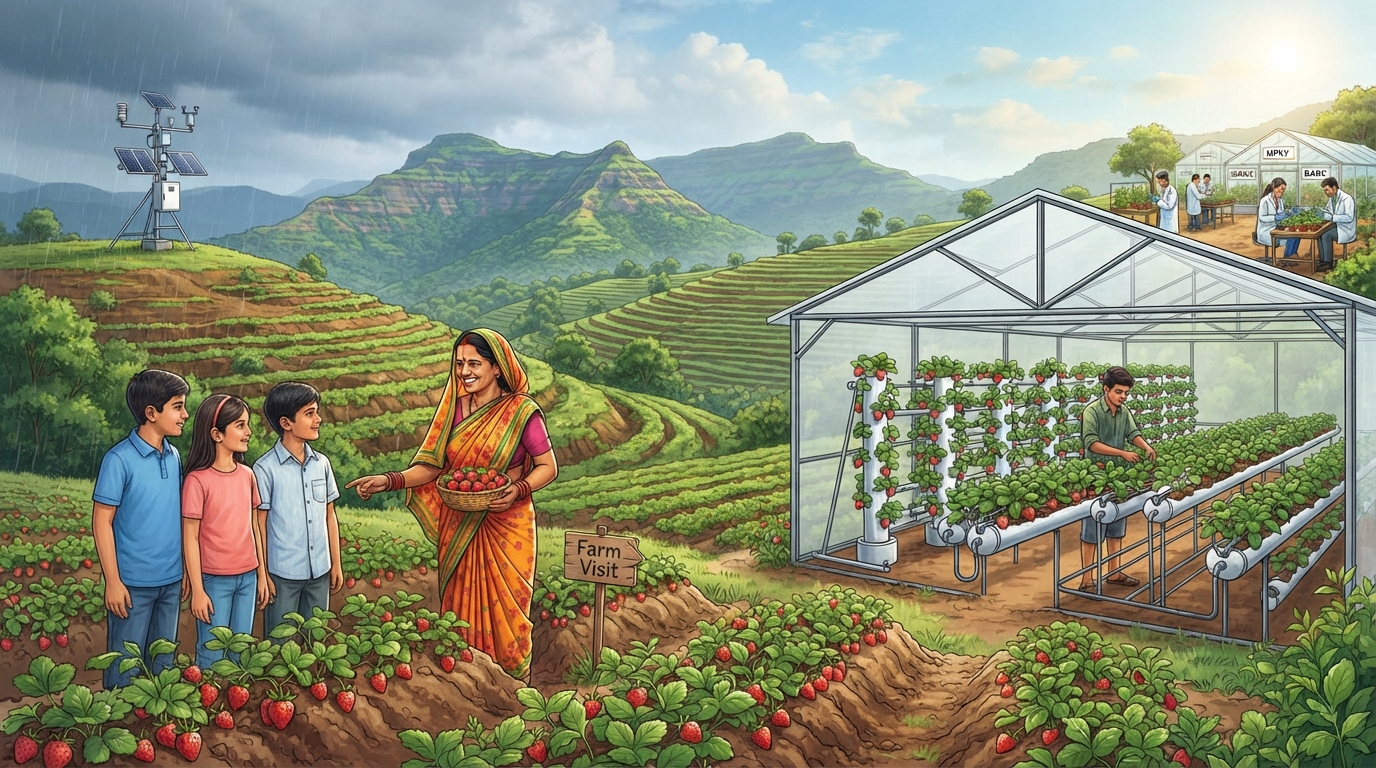
India aims to become a leading strawberry producer, a goal currently hindered by its reliance on imported varieties from the US and Europe.
The Mahabaleshwar mountainous region in western India accounts for approximately 85% of the nation's strawberry cultivation. Its elevation, exceeding 1,000m (3,280ft), provides an extended cool growing season from November to March, complemented by light, well-drained soil ideal for strawberries. However, this doesn't guarantee an easy livelihood for farmers, as it's a labor-intensive and high-risk endeavor.
Sheetal Danavle, who cultivates strawberries on half of her three-acre farm with her husband, highlights the precariousness: "If you have a field full of strawberries and sudden heavy rains hit, the entire crop is ruined and we have to bear massive losses." Strawberry plants, which are not grown from seed, must be replaced annually. Danavle's small farm incurs an annual cost of $2,500 (£1,900) for young plants. She notes, "If the season goes well, you can earn double your investment. But the climate makes it a huge gamble."
Thousands of farmers in Mahabaleshwar grow strawberries, making it one of western India's most profitable horticultural crops. Despite this success, the industry remains dependent on varieties imported from California, Florida, Italy, and Spain, as India has yet to develop its own domestic plant. Developing a high-quality fruit can take 10 to 15 years for breeders in the US and Europe, who then patent their varieties.
Nelson Sequeira, founder and director of Tara Farms Fresh, a licensed strawberry propagator, explains the process: "We import the certified mother plant from the breeder abroad." After import, these plants undergo government quarantine before being planted in a nursery. There, the mother plant produces daughter plants, which are then sold to farmers. Sequeira elaborates, "One single imported mother plant becomes an engine. That single mother plant will shoot out runners to yield an average of 20 daughter plants - with some advanced growers pushing that up to 30 or 40."
This operation is highly technical and precise. Sequeira describes their method: "The plants do not touch the ground. We use large industrial pipes split completely in half to form long, rounded gutter containers." He adds, "Instead of soil, we pack these containers with a specialized coco-peat substrate derived entirely from coconut husk. We then integrate a highly precise drip-irrigation and fogging system to control micro-climates." New strawberry plants are cultivated every year.
While propagators like Sequeira currently rely on foreign mother plants, this could change due to research at Mahatma Phule Krishi Vidyapeeth (MPKV), an agricultural university in Maharashtra. MPKV has partnered with the Bhabha Atomic Research Centre (BARC) on a breeding experiment. Researchers are employing controlled, low-dose gamma irradiation on plant tissues to induce stable genetic mutations.
Dr. Darshan Shashank Kadam, assistant professor of Horticulture at MPKV, states, "The goal is to fast-track the development of India's first indigenous, climate-resilient strawberry cultivar that matches the large fruit size and firm texture of foreign varieties while natively tolerating Indian heatwaves." He acknowledges that this could be a lengthy process, with results potentially taking 10 to 15 years. In the interim, they are assisting farmers by "developing scientific packages of practices for farmers. We have already standardised planting schedules, fertiliser recommendations and growth regulator applications specifically for Mahabaleshwar conditions."
Larger farms with greater resources are investing in new technology. Ketan Yashwant Sodha, founder and CEO of Berry Fresh Agrotech, initially used traditional open-field farming but was frustrated by weather-related losses. He explains, "For the past 10 years, it has consistently rained in India during our peak season - November, December, and the first week of January. When you are in an open field and your plantation is at its absolute peak, a single rain will ruin your entire crop."
In 2022, Sodha began experimenting with hydroponics, a covered cultivation method that eliminates soil and precisely controls water, nutrients, light, and temperature. His initial attempts were challenging. "I suffered immense losses and failed multiple times," Sodha admits. "The soil is forgiving; hydroponics does not forgive. If you make a mistake today, you will wake up tomorrow morning to a disaster - and the recovery time in hydroponics takes twice as long as soil."
However, lessons learned from these setbacks are now yielding results. "We have trailed 19 different varieties, including rare Japanese ones, and we are the only ones in India trailing a specific Netherlands variety this season." Sodha notes that limiting each plant to 750ml of water daily produces "rich, highly concentrated sugars and aromas instead of water-logged, bland fruits." His team also conducts regular "blood work" on the crops, involving laboratory testing of leaves and petioles to measure exact nutrient uptake, allowing for precise nutrient and chemical adjustments in the water supply. By utilizing a semi-open polyhouse, strawberries can be grown year-round, making it "not a seasonal fruit for us," Sodha says.
Sodha is now prepared to expand. "We have built the trial facility, written the SOPs (standard operating procedures), and designed the farm manual. We are talking to investors to expand to a five-acre facility that will accommodate 200,000 plants."
Krishan Bhilare's family has been farming strawberries in Mahabaleshwar for generations. He recalls the introduction of the first American varieties in 1992 and being impressed by the fruit's size. Bhilare is part of a Farmer Producer Organisation (FPO) network that has installed AI-powered weather monitoring towers at four strategic locations. This system uses weather data to predict rainfall, advising farmers to delay spraying expensive chemicals to prevent them from being washed away. The FPO is also constructing vertical towers for growing strawberries on a coco-peat substrate, five layers deep. "By stacking five pots into a single vertical tower, we can scale our density from 25,000 plants to 125,000 plants per acre. We are effectively multiplying our production footprint by five times on the exact same piece of land," Bhilare explains.
However, such investments are often beyond the reach of small farms or represent a significant risk. In 2017, Danavle and her husband experimented with hydroponic strawberry farming. "The experiment was 100% successful and the fruits we grew were entirely organic. It saved us a lot of labour, the workers didn't have to constantly bend down or prune, and it saved us a lot of money on medicines and field manure." Unfortunately, a massive cyclone struck Mahabaleshwar that year. "The cyclone completely knocked down our entire hydroponic setup. Then we did not have the courage to set it up again."
Sheetal returned to traditional strawberry cultivation but with an innovative approach. "I took help of social media. I post videos of how one can grow strawberries and invite tourists to visit my strawberry farm, learn and pick the fruit. They directly now buy from the farm. This has helped, cut the middle man, and make more profit. So, now I am an influencer and entrepreneur."