

India Risks Missing Uzbekistan's Renewable Energy Market
An ORF Middle East analysis says India has the potential to become a long-term renewable energy partner for Uzbekistan but is lagging behind Gulf countries and China.
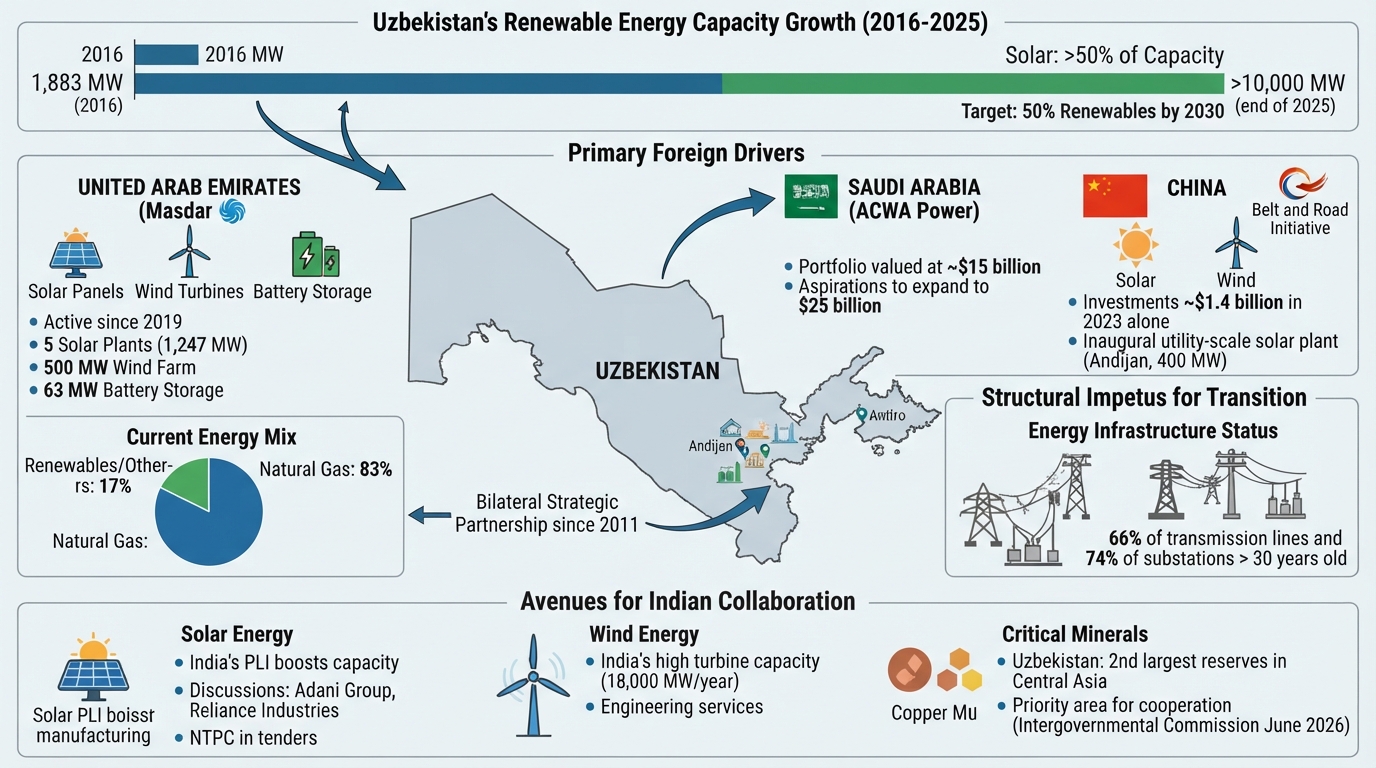
India possesses the technical and institutional capability to serve as a long-term collaborator for Uzbekistan in the renewable energy sector, yet it significantly trails Gulf nations and China in terms of actual project involvement. This assessment comes from an analysis by Parul Bakhshi, a research fellow at the Observer Research Foundation Middle East (ORF ME) in Dubai.
**Scope of the Energy Transition**
According to ORF ME, Uzbekistan's installed renewable energy capacity is projected to surge from 1,883 MW in 2016 to over 10,000 MW by the close of 2025, representing more than a fivefold increase in under a decade. Solar power accounts for over half of this capacity. The nation aims to elevate the share of renewables in its electricity generation to 50% by 2030 and achieve carbon neutrality by 2050. In recent years, Uzbekistan has attracted over US$35 billion in energy sector investments through competitive international tenders for major projects.
**Gulf States and China Lead Investment**
The analysis highlights companies from the United Arab Emirates, Saudi Arabia, and China as the primary foreign drivers of renewable energy expansion in Uzbekistan.
The UAE's Masdar has been active in Uzbekistan since 2019, constructing five solar power plants with a combined capacity of 1,247 MW, a 500 MW wind farm, and a 63 MW battery energy storage system.
Saudi Arabia's ACWA Power has amassed a project portfolio valued at approximately US$15 billion, with aspirations to expand it to US$25 billion by the end of the decade.
Chinese investments in Uzbekistan's solar and wind energy sectors, under the Belt and Road Initiative, reached about US$1.4 billion in 2023 alone. Chinese firms also built the country's inaugural utility-scale solar power plant, a 400 MW photovoltaic facility located in the Andijan region.
**Structural Impetus for Energy Transition**
The authors note that the expansion of renewable energy is propelled not only by climate objectives but also by inherent vulnerabilities within Uzbekistan's energy infrastructure. Natural gas constitutes 83% of the country's energy mix and 82% of its electricity generation.
Since 2020, Uzbekistan has transitioned from being a net energy exporter to a net importer. The value of processed fuel exports more than halved between 2019 and 2023, falling to approximately US$1 billion, while imports more than doubled to US$2.68 billion.
ORF ME estimates that 66% of the nation's transmission lines and 74% of its substations have been operational for over 30 years, indicative of decades of underinvestment during the Soviet era.
The government intends to add 12 GW of variable renewable energy capacity by 2030, comprising 7 GW of solar power, 5 GW of wind power, and 1.5 GW of hydropower.
**Potential Avenues for Indian Involvement**
Analysts identify solar energy as the most evident area for collaboration, noting that India's production-linked incentive (PLI) program has boosted domestic solar module manufacturing capacity to over 120 GW and solar cell capacity to 29.3 GW by mid-2025.
As instances of Indian commercial engagement in Uzbekistan, the authors point to discussions between representatives of Adani Group and Reliance Industries with Uzbek officials, as well as NTPC's participation in solar project tenders and consulting projects within the gas sector.
The analysis also highlights a 2021 memorandum of understanding between India's National Institute of Solar Energy (NISE) and Uzbekistan's International Solar Energy Institute (ISEI), which covers cooperation in photovoltaic equipment manufacturing and technology transfer. However, the authors state that this agreement largely remains unimplemented at the institutional level.
In wind energy, India, with an annual wind turbine manufacturing capacity of around 18,000 MW and the world's fourth-largest installed wind power capacity, could provide technology and engineering services. Uzbekistan's installed wind power capacity grew from 1 MW to 1,652 MW between 2016 and 2025.
Analysts also pinpoint critical minerals as another area for cooperation. Uzbekistan possesses Central Asia's second-largest reserves of copper, molybdenum, gold, and other minerals vital for the energy transition, yet only 16 of the country's 71 identified deposits are currently being developed.
At the 14th session of the India-Uzbekistan Intergovernmental Commission in June 2026, India designated supplies of critical minerals as a priority area for energy cooperation.
**Bilateral Context**
India and Uzbekistan have maintained a strategic partnership since 2011, with bilateral trade reaching US$1.32 billion.
At the fourth India-Central Asia Dialogue, held in New Delhi in June 2025 and attended by the foreign ministers of all five Central Asian states, the joint statement referenced support for the International Solar Alliance, joint exploration of rare earth minerals, and support for Uzbekistan's accession to the International North-South Transport Corridor (INSTC).
The ORF ME authors conclude that India's commercial footprint remains modest compared to the established positions of companies from Gulf states and China, and that the partnerships forged during Uzbekistan's current phase of rapid renewable energy expansion will shape the country's energy sector for decades to come.