

India is a nation of walkers - but its cities forgot them
India's top court has put the spotlight on unsafe footpaths and the country's forgotten pedestrians.
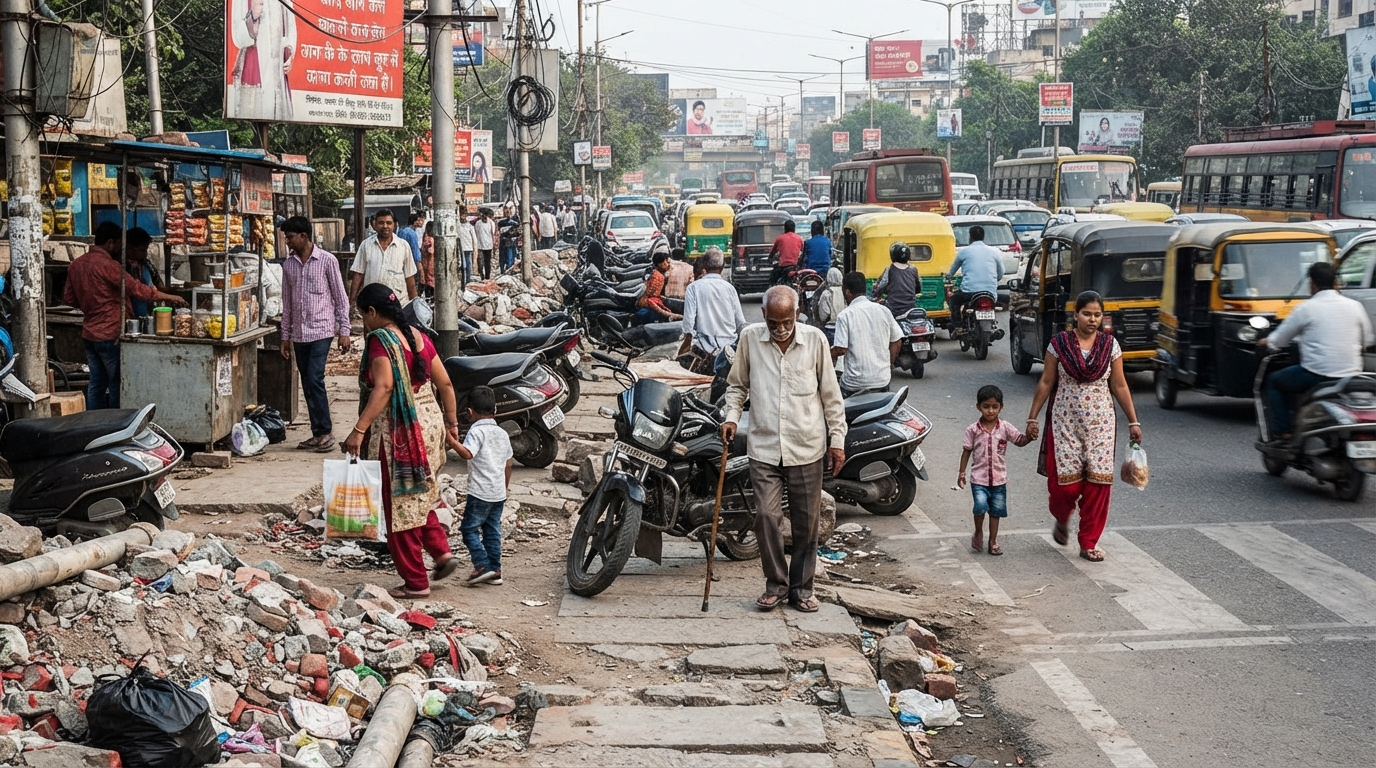
India, a nation where walking is deeply ingrained, has seen its cities increasingly neglect pedestrians. Census-based estimates reveal that approximately 45 million people walk to work daily.
For many, navigating Indian cities on foot has been less about exercising a right and more about overcoming a series of obstacles. The author recounts personal experiences: growing up in Kolkata, where wide pavements were obscured by hawkers; moving to Delhi, where roads seemed exclusively designed for cars; and now living in Gurugram, where footpaths are often impassable due to rubble, garbage, parked vehicles, construction, or inconveniently high elevations.
Therefore, the Supreme Court's declaration in June that the right to walk safely on designated footpaths is a fundamental right felt like a long-overdue common-sense decision rather than judicial overreach.
Walking, the most democratic mode of transport, has been consistently overlooked in Indian cities. This is striking given that India remains fundamentally a nation of walkers. Around 45 million people walk to work daily, significantly more than the approximately 5.4 million who commute in private cars, jeeps, or vans.
Nearly a third of urban workers walk to their jobs, and virtually every bus or metro journey begins and ends on foot. When school runs, shopping trips, and other daily errands are included, walking dominates urban mobility. A 2019 survey of selected cities found that 63% of all journeys were made on foot, making pedestrians the largest group of road users.
Many of these are "captive pedestrians"—individuals who walk out of necessity rather than choice, often due to financial constraints. Women, in particular, rely heavily on walking. Yet, these individuals, who contribute the least to congestion and pollution, frequently face the greatest dangers.
Evidence paints a grim picture. Even where pavements exist, they are often broken, narrow, or inaccessible to the elderly, children, and those with disabilities. They are also frequently blocked by motorcycles, encroached upon by parked cars, or excavated for utility work. Faded zebra crossings are largely ignored. Flyovers, designed to speed up traffic, force pedestrians into perilous detours below.
A significant 2011 study of six Indian cities concluded that Indian streets routinely fail pedestrians due to "poor and unsafe" infrastructure. The Walkability in Indian Cities report by the Clean Air Initiative for Asian Cities (CAI-Asia) gave the surveyed cities a median walkability score of just 47 out of 100. Conditions were worst around public transport terminals—ironically, the very places where most journeys begin and end on foot.
As Geetam Tiwari, a transport scholar at IIT Delhi, observes, pedestrians have been "pushed to the margins of the road networks," forcing them to "jostle for space with motor vehicles."
This neglect comes at a human cost. Officially, pedestrians account for roughly a fifth of road deaths, but independent studies cited by Tiwari suggest the actual share is closer to 30-40%. Pedestrians are also the second-largest group of road accident victims after two-wheeler riders. In Delhi and Mumbai, they constitute over half of all road deaths. A World Bank study estimates that crashes cost India an annual 3-5% of its GDP through lost productivity, healthcare costs, and disability.
The Supreme Court case originated from a tragic incident: a five-year-old boy was crushed by a truck while walking to school with his father. The judges responded with notable eloquence. Justice PS Narasimha wrote that walking is "the simplest of the simple human activity, inextricably connected to life." Roads, therefore, impose a corresponding duty on the state to provide safe footpaths. He declared, "The fundamental right to walk on demarcated footpaths shall override the privilege of a motorised vehicle."
This judgment challenges decades of Indian urban planning, where progress has often been measured by the kilometers of expressways, flyovers, and elevated corridors. Streets were engineered to facilitate rapid vehicle movement, while the pedestrian—a role every citizen inevitably assumes—was largely overlooked by planners.
"People know about the latest cars, but walking has become invisible," says Rishi Aggarwal, who has spent over a decade in Mumbai trying to alter this perception. His advocacy group, Walking Project, uses city walks and public talks to encourage residents to notice what they have stopped seeing: broken pavements, blocked crossings, and unsafe junctions, and to compare them with the standards pedestrians are entitled to expect. "When people become apathetic, they stop observing the street," he states.
In a city where an estimated 15 million walking trips occur daily, Aggarwal argues that not only footpaths but also the millions of people who rely on them have disappeared from public consciousness.
For Rahul Goel, a transportation researcher at IIT Delhi, the root of the problem lies in governance. "Are footpaths maintained and cleaned? Does the city ensure they aren't encroached upon?" he asks. "In Delhi, many roads do have footpaths, but they're often unusable because of poor governance."
Poor design exacerbates the issue. Cars parked perpendicularly to the kerb often obscure or completely block footpaths, and vehicles parked directly on pavements are a common sight. Footpaths are frequently too narrow for the volume of pedestrians. Many are so high above the road that older people, wheelchair users, and those with limited mobility struggle to use them. Others end abruptly, forcing people back onto the carriageway. "If the footpath is discontinuous, it's simply more convenient to keep walking on the road," Goel explains.
He believes the deeper problem is one of priorities. "Urban transport governance is still centred on moving vehicles. Reducing congestion and maximising road space for motor traffic take precedence over pedestrians," he says. Civic agencies are often reluctant to widen footpaths, viewing carriageway space as sacrosanct. This mindset, Goel argues, is reinforced by public pressure.
Traffic jams dominate headlines and social media, compelling authorities to prioritize vehicle movement. In Delhi, many mid-block crossings have been replaced by U-turns to reduce stoppages, forcing pedestrians onto foot overbridges. "People don't just need to walk along a road," says Goel. "They need to be able to cross it safely too."
The result is stark urban inequality. In Gurugram, a high-speed arterial road cuts through busy neighborhoods with few safe crossings. Domestic workers, laborers, and other pedestrians routinely risk their lives dodging speeding traffic, and many are killed attempting to cross. Only after a mounting death toll did authorities begin constructing footbridges.
Across India's cities, those who cannot afford cars or motorcycles are left to navigate dangerous roads that barely accommodate pedestrians. Those who can drive claim an ever-larger share of public space, while walking becomes a leisure activity confined to gated communities, parks, or gym treadmills. In a country grappling with rising obesity and lifestyle diseases, cities have transformed the most basic form of exercise into something not only inconvenient but often perilous.
Clearly, encouraging people to walk will require far more than a court order. "Walking as a fundamental right should lead to pedestrian-friendly cities, not just pedestrian-friendly streets," says Tiwari. This necessitates a fundamental rethinking of urban design. Some countries have adopted default urban speed limits of 30km/h or 20mph to protect pedestrians, regardless of the road type. Achieving this, Tiwari notes, requires redesigning streets by narrowing traffic lanes, altering road surfaces, and introducing other traffic-calming measures.
The judges also reflected on walking as something far greater than mere transit. It can be "necessity for the poor, meditation for some, an act of resistance for others and a path to discovery. Walking, they noted, also helped shape India's freedom struggle." As writer Sumana Roy points out, India's political history has often unfolded on foot—from Gandhi's "salt march" to Dandi to Subhas Chandra Bose's "Delhi Chalo" (March to Delhi) and the many protest marches that followed.
For Tiwari, this broader understanding of walking should also inform urban development. "Walking is more than a travel option," she says. "Therefore a safe walking infrastructure requires more than creating footpaths and safe crossing. Walking spaces have to integrate activities like spaces of street vendors, shaded paths, areas for resting for old people and sometimes space where children can play."
For decades, Indian cities have focused on how to move more vehicles. The top court has now reminded them to ask a simpler question: how do people walk? The author concludes by expressing a desire for something wonderfully unremarkable: a footpath that simply carries them from one end of the street to the other.