

Hundreds arrested over French wildfires, but who is to blame?
The government is trying to attribute blame for the unprecedented fires which tore through the country last month.
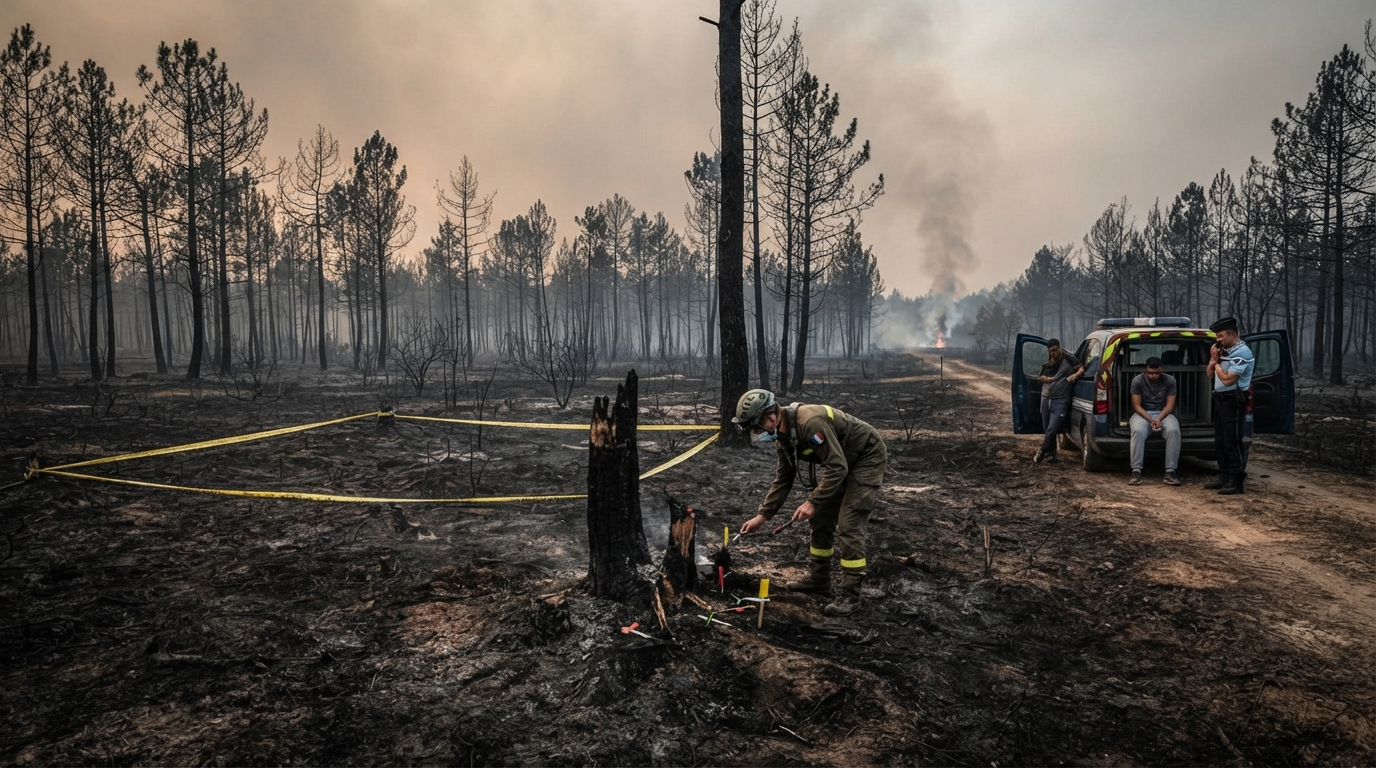
Hundreds have been apprehended in connection with French wildfires, raising questions about accountability.
In late July, an emergency response was initiated in the Gironde region due to significant wildfires. With this year's wildfires causing more destruction in France than at any point since World War Two, many are seeking answers.
A primary factor is the changing climate, a consequence of humanity's well-documented reliance on burning fossil fuels, leading to escalating temperatures.
However, given that records indicate human activity is responsible for nine out of ten French wildfires, the government in Paris is attempting to assign blame. This comes despite accusations that the government itself was inadequately prepared for the infernos that have now charred over 300,000 acres this summer.
The interior ministry has reported 420 arrests of individuals suspected of either intentionally or accidentally starting fires, including 166 minors.
In one instance, a 23-year-old man stands accused of deliberately igniting 10 fires within five days last month in the southeastern Var area. If convicted, he faces a potential 15-year prison sentence and a €150,000 (£128,000) fine.
Numerous others have been swiftly tried and sentenced, such as a man who received a three-year jail term for starting three recent fires in the Raon-L'Étape forest in the Vosges region. L'Est Républicain, the newspaper that covered the story, noted that "Only a few square metres of vegetation went up in smoke."
Conversely, some prosecutions have been perceived as overly harsh and unjust. Reports indicate that a homeless man and an individual with severe autism have been jailed for discarding cigarette butts.
"I was amazed at the number of arrests, it feels excessive," admitted Muriel Gestas, a lawyer who has represented several individuals accused of arson, including two firefighters. She expressed doubt that many of these cases would result in convictions.
The newspaper Le Monde also expressed skepticism, questioning the thoroughness of police investigations given the limited timeframe. It argued that the authorities' lack of transparency regarding specific charges, particularly concerning intent and how current numbers compare to past seasons, prevents any meaningful historical comparison.
Nevertheless, Bordeaux prosecutor Renaud Gaudeul informed Le Monde that a stringent approach was warranted by the prevailing circumstances. "The conditions for a charge of endangering lives are met for those who throw a cigarette butt or light a barbecue in wooded areas. It only takes a tiny spark for it to start," the newspaper quoted him as saying.
Determining the origin of a fire is, predictably, challenging. "In periods of drought such as this one, all you need is a simple lighter," explained Eric Dufayet, a fire investigator.
Once a fire is extinguished, Dufayet's initial task involves mapping its perimeter along the burnt vegetation and then tracing it back to its point of origin. If the wind has been consistent, the outline often forms a "V" shape, allowing his team to work backward along the path of the flames.
"If someone deliberately starts a fire, they may not have used only one device," he noted, which increases the likelihood of finding DNA or fingerprint samples.
Experts believe that arson accounts for only a small percentage of fires. Most are thought to be accidental, with potential ignition sources including construction work, faulty electrical equipment, cigarette butts, and barbecues.
"With cigarettes, it's called the '30' rule," said Eric Dufayet. He elaborated that for a fire to start, there must be "a temperature of at least 30C (86F), a maximum of 30% humidity, wind of less than 30km/h (19mph), and at least 30% of the cigarette unburnt." He added that in the current drought, these conditions make it even easier for a fire to spread rapidly.
French President Emmanuel Macron described the fires as "completely unprecedented."
According to Michel Lejoyeux, a professor of psychiatry and addictive behavior at Paris 7 University, individuals who start fires fall into three categories: the careless, those who benefit (e.g., from an insurance payout), and pyromaniacs.
"The pyromaniac doesn't get money, has no spirit of revenge, has no utility of the fire, but he likes the fire," he stated. However, Lejoyeux noted that pyromania is a rare and difficult-to-diagnose psychiatric disorder, accounting for few arson convictions.
Lawyer Muriel Gestas, who has handled several such cases, suggested that some firefighters accused of starting fires might have sought to be perceived as heroes. For others, particularly volunteers earning tax-free overtime, the motive could be financial.
Amid concerns about how officials are pursuing suspects, broader anxieties about wildfires show no signs of diminishing. Forecasts indicate that France's next heatwave is imminent.
President Emmanuel Macron asserted that criticism should not be the immediate priority. "We will have to replant and rebuild a different kind of forest because we must adapt to the structural conditions of climate change," he said this week. "The time for reviewing lessons learned will come," he insisted. "In the meantime, the country must remain united."
Nevertheless, the environmental damage, destruction of hundreds of homes, impact on tourism, local businesses, and air quality caused by these fires have left the French public with many unanswered questions.