

France fire crews face searing heat in battle to contain flames
Firefighters are battling flare-ups in 40C heat, as some locals have refused to heed evacuations in the Gironde region.
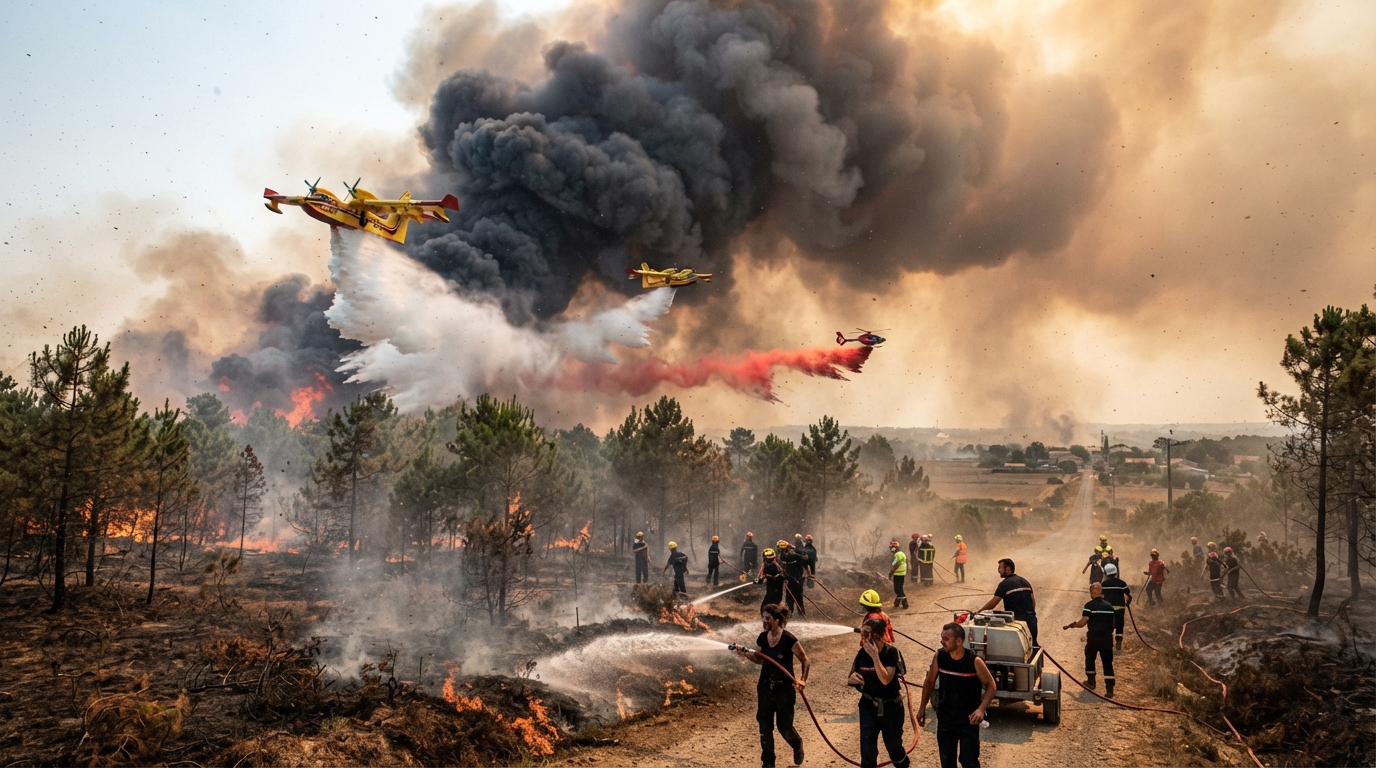
French firefighters are contending with extreme heat as they battle to control widespread blazes, with planes deploying water to combat the rising temperatures.
The sight and sound of three Canadair aircraft, acting as an aerial brigade, are striking. They approach in formation before sharply turning towards a dense column of black smoke. Each aircraft then releases over 1,000 gallons of water onto the fires below. Following this, a series of helicopters deploy streams of red fire retardant.
Once the smoke subsides, firefighters enter the forest on foot to manage the latest outbreaks. These flare-ups are the primary concern for the thousands of personnel and volunteers fighting wildfires that have persisted for a week, forcing tens of thousands of residents and tourists to evacuate. With temperatures reaching approximately 40C, the spontaneous re-ignition of fires poses a constant threat.
After about 20 minutes, one fire under observation is brought under control, only for another to suddenly ignite across the road. "Leave now!" an understandably agitated officer shouts as he drives by. The smoke intensifies, signaling it's time to depart.
The immense scale of the infernos in France's southwestern Gironde region makes it difficult to pinpoint the origin of the smoke. It simply descends as one travels west from Bordeaux, passing through deserted roads and villages. The soil, powdery and covered in countless pinecones and dried leaves, explains the rapid spread of the wildfires.
Pierre Alexandre initially refused to evacuate his bungalow when asked by firefighters. "When [the police] said I had to leave, I said no!" he admitted. The fire's epicenter began in the woodland adjacent to his home. He displayed a photo of himself on his roof in what appeared to be darkness, clarifying it was taken in the afternoon after he instructed his wife and daughter to leave. He gave his 19-year-old son, Clement, the option to stay, which he accepted. "I told him: 'Be careful because in front of us is a nightmare, we don't know what will happen,'" Pierre Alexandre recounted.
His desire to protect his home is understandable, but did he truly believe he and Clement could halt the wildfires alone? "No, we're not firefighters," he conceded.
For professional firefighters, controlling these wildfires is akin to a deadly game of "cat and mouse" or "Whack-a-Mole," an effort of containment rather than a definitive solution. Supporting the professionals is a large contingent of volunteers who drive towards the danger to deliver water or spray it themselves.
"If it's too late, at least we tried," declared Hugo, 26, defiantly, as he refilled his water tank. "Fifty thousand hectares has already been destroyed, what will we tell our children?" Hugo, who grew up in the area, returned from his home in Bali to safeguard his mother's house in Arès, a village precariously close to the wildfires.
"It's horrible, it's our home, it's our region, it's our forest, it's where we grew up, it's where our family live, where we live, it's horrible. I feel a lot of sadness," said Maëlys, 23, her face smudged with soot. "I am a nurse and I'm here to help," she added. Maëlys explained that her friends own large water tanks, which they use to extinguish new flare-ups to prevent their spread. "In the morning I am at the hospital working, and in the afternoon I'm in the forest helping," she stated.
Fire crews have converged on the southwest from all parts of France, from Brittany in the north to cities like Marseille and Lyon in the south. When not directly fighting flames, they saturate the soil and vegetation to prevent future fires from advancing. This process, known as "noyer," translates to "drowning" in French. While the Gironde wildfires may be relatively contained for now, they are far from extinguished.
Additional reporting by Paul Pradier and Matt Logan.