

His criminal case consisted of 12,192 pages - what kind of person was Osman Nasir?
The poet seeks the truth in a time when justice is unknown. While in prison, he asks Stalin to reexamine his criminal case.
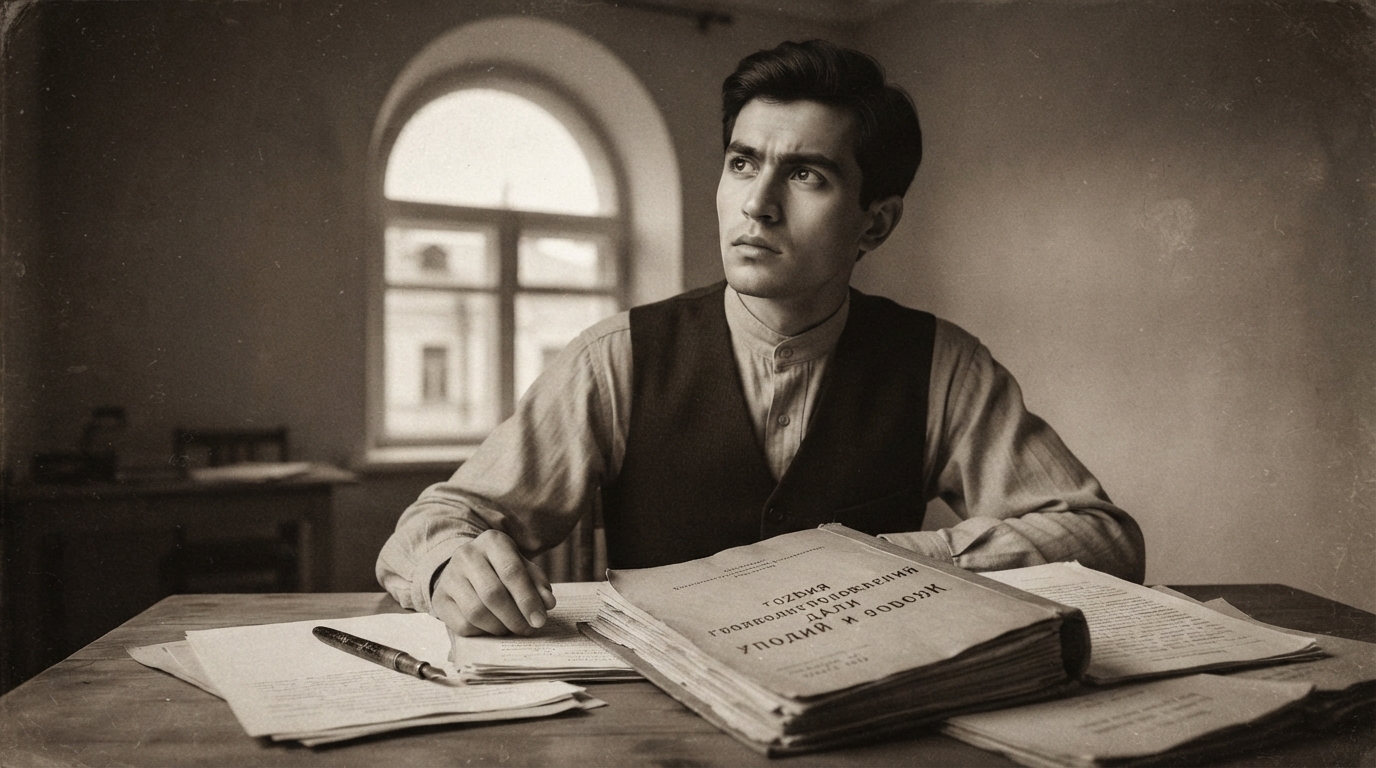
**Usman Nasir: Who was the person behind the 12,192-page criminal case?**
On November 13, 1912, in the Tanhogor neighborhood of Namangan, a bright representative of Uzbek literature, poet, translator and playwright Usman Nasir was born. His father Mamatkhodja died of hunger and illness in 1916. The poet later recalled these difficult times as follows:
My father died, I became a wanderer,
They called me an orphan.
I was tormented by strange days,
They chased me out into the streets...
Usman, who lost his father early, made a living with his mother by serving in the homes of wealthy people.
Later, Usman Nasir's mother, Holambibi, married the merchant Nasir Hoji, who spoke Russian, and in 1921 they moved to Kokand. Thus, the poet enters the rich literary environment of Kokand.
In the most beautiful period of his childhood, when he should have been playing and laughing with his peers, Usman was constantly beaten and insulted by his stepfather. The poet's friend Temur Fattah recalls an incident in his memoirs: one day, when Holambibi was not at home, the pilgrim beat the young Usman until he was exhausted, tied his hands behind his back, and hung him by his feet in a well. Tohirjon Sobirov, who happened to be there, rescued him from the well. After that, his mother was forced to take Usman from the "Yangi Hayot" school and send him to the "Dor-ur Shafaqa" school, where orphans study. Having escaped from his oppressive father, Usman immersed himself in poetry with all his might. He joined the “Sanoyi Nafisa” circle led by Abdulahad Qahhorov and began to practice poetry.
In 1927, the wall newspaper “Bizning Kozgu” was published on the occasion of the rally of women reporters of the city of Kokand. Schoolchildren submitted articles, poems, and essays to it. Among them was the first poem by Usman Nasir called “The Pen of Truth”. Later, at the initiative of the domla Mukhtarkhan, this poem was republished in the 8th issue of the magazine “Yangi Yo’l”.
The poet, who wrote with admiration for the reporters that “You write the truth, You walk the world…”, unfortunately, the people of the pen did not protect the poet.
The life path of Usman Nasir was colorful. For example, in 1929, among the first graduates of the nine-year school, he went on an excursion to Moscow and Leningrad. During the trip, Usman's worldview broadened. He entered the Moscow State Institute of Cinematography and the Samarkand Pedagogical Academy, but due to health and behavioral problems, he could not graduate from both universities.
According to the memoirs of Sabir Abdulla, Usman Nasir studied Kokand classical literature with Amin Umari. Temur Fattah says that they read the four-volume works of Sergei Yesenin, published in 1926. The poet's poem "Monologue" mentions the characters of Desdemona, Othello, and Shakespeare. This shows that Usman Nasir was aware of Eastern and Western literature and summarized their essence and essence in his poems.
Turob Tola describes the poet as “a poet who breathes the breath of Navoi, Fuzuli, Babur, Furqat, recalls the protections of Dante and Petrarch, and makes Pushkin and Lermontov speak in Uzbek.” Usman Nasir’s first collection was “Conversation with the Sun,” published in 1932.
The poet’s creative heritage consists of five poetry books, four dramas, and three epics. The names in his works are skillfully chosen, which bind a person to them without a thread. For example, the names of the main character Atlas in the play “Atlas” or Nakhshon in the epic “Nakhshon” are unique and original. Also, the poems “Heart,” “Monologue,” “Traveler,” and “Nile and Rome” prove that Usman Nasir is an innate talent.
In his article “About Usman Nasir,” Otkir Rashid describes the poet as follows: “In his work from 1927 to 1932, journalism, a journalistic attitude to events, journalistic pathos and rhetoric are more prominent. Therefore, his poems sounded like slogans and appeals. This feature showed that Usman’s work was responsive to the demands of the times... Although thematic relevance and diversity prevailed in the poet’s work in this early period, these years were a period of search for artistic mastery and creative independence.”
Usman Nasir was also a translator. In 1937, on the occasion of the centenary of the death of the Russian poet A.S. Pushkin, he translated his work “The Fountain of the Garden of Eden” into Uzbek. Nodira Rashidova said in one of her interviews: “In 1937, a plenum dedicated to Pushkin will be held in Moscow. Uzbek writers will also be invited to that plenum. When the chairman of the USSR Writers' Union, Bezimensky, comes up to the podium and gives a speech, he talks about Pushkin's translation of the poems of the German writer Goethe and gives examples from that translation. Then Usman Nasir, who was sitting in the very back seat, stands up and says, “Excuse me, Nikolai Alexandrovich, these are not Goethe's verses, but Schiller's!” says. Then the chairman of the association is stunned and invites him to the stage. When my uncle introduces himself, Nikolai Alexandrovich asks him if he has read Schiller. Osman Nasir says that he has not only read it, but also memorized it, and recites Schiller's epic from memory. Bezimensky is amazed. He hugs my uncle tightly by the shoulder, looks at the hall and says, "Let everyone see! Pushkin has appeared in the East!" After that, articles about Osman Nasir were written in Moscow newspapers.
He also translates M. Lermontov's "Demon" ("Iblis") and the tragedy "Egmont" into Uzbek. In the 30s of the 20th century, the head of the Uzbek Radio Committee, Kurban Beregin, came to the conclusion that this work should also be performed in Uzbek, and entrusts Osman Nasir with the translation. However, due to the arrest of Usman Nasir in August 1937, the person who translated the tragedy "Egmont" into Uzbek remains a mystery. As a result of Naim Karimov's research, secret information hidden from us by the past was revealed.
On the night of January 27, 1937, a creative evening was held at the Writers' Union of Uzbekistan to celebrate the tenth anniversary of the work of 25-year-old Usman Nasir. Oybek highly appreciated the poet's work, saying: "Usman Nasir is a great poet. It is worth celebrating his 25th anniversary. Maybe we will erect a statue to him. He is the Lermontov of the Uzbeks."
It is also our duty to the reader to tell about the joys of the poet's life. Usman Nasir had many friends and they constantly participated in parties. The poet loved to read poetry in such places, especially in front of young girls, reciting poems dedicated to them.
The harsh policy of repression of 1937 also penetrated Uzbekistan. This policy first of all affected the literary pillars Cholpon, Fitrat, as well as Usman Nasir. At that time, Usman Nasir was a young and innocent man, who was already 25 years old, had not yet started a family. On July 12, 1937, Usman Nasir was expelled from the Writers' Union of Uzbekistan, and on July 13, he was arrested by NKVD officers. The poet's pen was sharp, enlightening, and he was always in the center of attention and recognition of his fans, which is why some envious people filed complaints and statements accusing him of being a "nationalist". His criminal case consisted of 12,192 pages.
The difficulties of the era, the investigative process of the NKVD officers are well known. Those who were imprisoned could not return from there, and if they were not guilty, the NKVD officers would fabricate charges. Usman Nasir was sentenced to ten years in prison by a court on October 5, 1938, on charges of being a “nationalist”, “deliberately distorting the translation in order to lower the level of Pushkin’s works”, and “having murderous intentions against the Russians”.
The poet searches for the truth from a time when he does not know what justice is. While in prison, he writes a letter to Stalin asking him to re-examine his criminal case. Constant efforts are not in vain. On December 15, 1944, the Military Prosecutor’s Office overturns the verdict in the case of Usman Nasir. Unfortunately, the acquittal system is very late. Usman Nasir died on March 9, 1944, from heart failure and pulmonary tuberculosis.
In order to perpetuate the poet's memory, Abubakir Rajabi was one of the first to publish the poet's two-volume "Selected Works" in 1969. Nodira Rashidova and Naim Karimov wrote books and articles about him.
In conclusion, we will quote Abdulla Oripov's opinion about the poet: "Usman Nasir is a dew that has not yet flowed through the fragrance of great and eternal poetry, it is a half-smile that has not yet turned into laughter and has frozen on our lips forever."
Zebo RAHMATULLA qizi,
journalist