

Could tech replace firefighters in the battle against wildfires?
Tech is being used to watch for wildfires but firefighters are still needed to put them out.
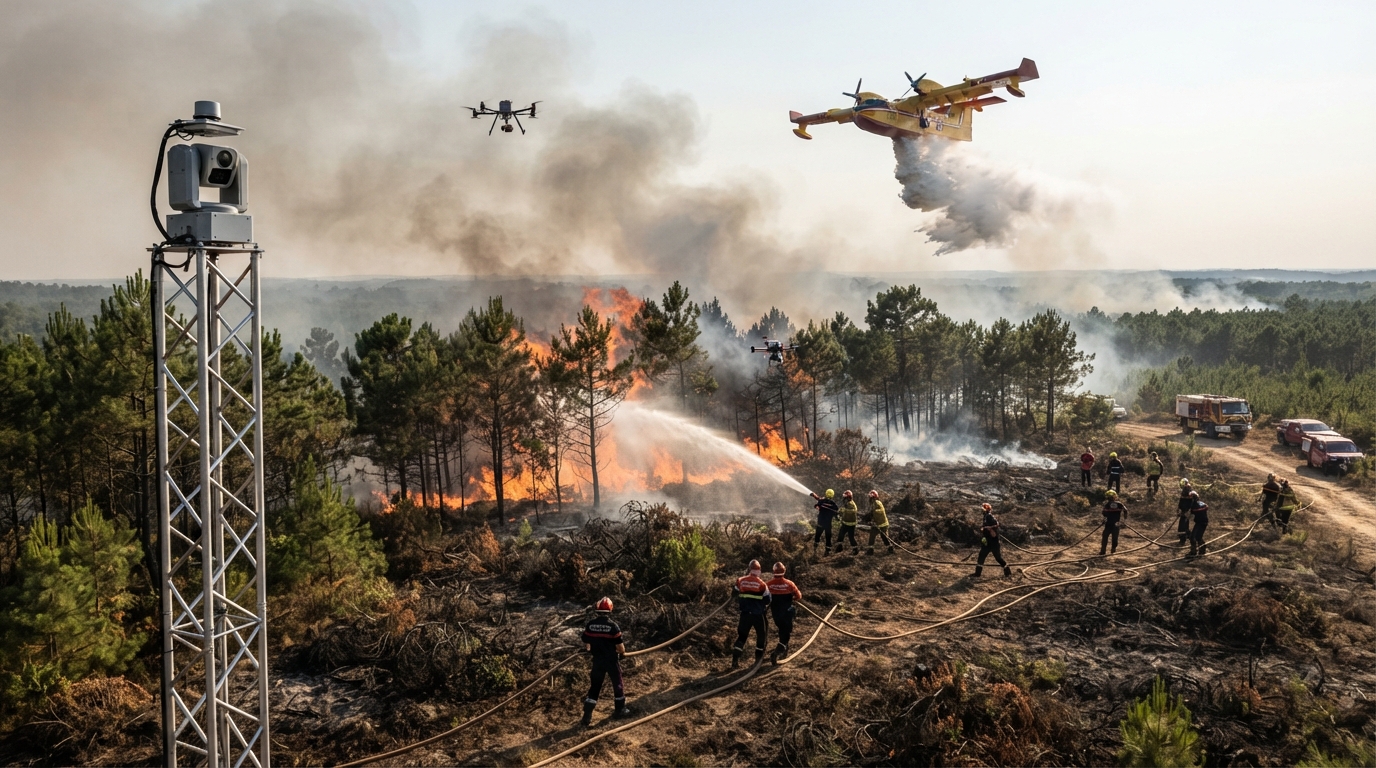
This summer, France's Gironde region has been ravaged by destructive wildfires, prompting a familiar and terrifying scene: firefighters battling blazes and planes dousing them with water. Hundreds of thousands have been displaced across France, Spain, and Portugal as wildfires consumed forests and rural areas. In France, four firefighters have died and 150 have been injured.
The question arises: why are humans and decades-old planes still the primary tools, when drones are deployed in conflicts like Ukraine?
Chief Sergeant Guillaume Millet, a firefighter with 24 years of experience and head of the CFDT union's Fire and Rescue Service branch in the Gironde, the region most affected by wildfires in France this summer, notes that while fire suppression techniques remain largely unchanged, forest fire detection technology has advanced significantly.
"The major shift, particularly in my department, is the implementation of AI-assisted cameras to monitor forests and pinpoint fire origins," Millet explains. He adds, "In the Gironde, cameras have replaced the human lookouts who staffed watchtowers in every town during the summer months." These lookouts were often students.
Millet states that this transition has reduced false alarms. "An AI-assisted camera can distinguish with near-total certainty between smoke and, for instance, dust kicked up by a tractor in a field." These cameras also boast an impressive range, detecting fires up to 20 km (12 miles) away.
Early detection is crucial, as established fires are far more challenging to control. In the Gironde, the system was installed by Midgard, while another French start-up, FireTracking, handles installations in other parts of France.
"As soon as the system detects a fire, firefighters receive an alert on their phones. They open the application and view the camera's feed with a x40 zoom," explains Jean-Simon Chaudier, CEO of FireTracking. "Alongside this real-time video, there's a map showing the fire's exact location, nearby houses, and a minute-by-minute simulation of its expected spread, factoring in weather, humidity, and other conditions," he adds.
Every minute is critical. Chaudier recounts, "For the past 10 days, for example, we have feedback from a firefighter that our AI detected seven fires 15 minutes before the first phone call. If you can help a firefighter save 15 minutes, it's the difference between a catastrophe and a fire that can be limited to two or three hectares."
Chaudier emphasizes the speed at which fires escalate: "After one minute you can put out a fire with a glass of water, after two you need a tank of water, after three minutes you need to send a Canadair." He refers to the amphibious planes that collect water from rivers, lakes, and the sea to dump on flames, serving as a primary tool in forest firefighting globally.
FireTracking's cameras currently survey one million hectares, primarily in France. The cost for the French department of Indre-et-Loire, where the company installed 11 detection sites, was "a total of €1.2m [$1.4m; £1m] to cover the entire 6,000 sq km area [2,300 sq miles]," according to Chaudier. This area is largely agricultural, and crop fires pose a significant and costly problem, with approximately 300 occurring annually in this department alone.
AI fire detection is expected to improve in the coming years. The French civil protection service has a program called Condor, which is testing solar-powered drones equipped with electro-optical cameras and AI for continuous patrols. Other projects involve sensors placed within trees, such as Spain's SenForFire, which measures gases released before flames become visible.
Regarding drones, firefighter Guillaume Millet states that they are being tested in France for sea rescue, deploying lifebuoys and survival kits, but no drone technology has reached a comparable stage for firefighting.
"In fact, the usefulness of technology is very limited in this area," Millet says. "It can help us with detection but it's not technology that puts out fires; you need people to pull the hoses through the forest to attack them." He asserts that even aircraft cannot replace this human effort. "When a Canadair drops 6,000 litres of water on a wildfire it reduces its intensity but then firefighters on the ground have to finish what the Canadair started."
The French are also becoming accustomed to Dash planes that spray fire retardant (ammonium phosphate in an orange powder) ahead of flames to slow the ignition of vegetation. However, this, too, is not a substitute for the physical effort and water delivered by ground crews. At least, not yet.
A French start-up named Daidelos is seeking investment for a heavy-lifting, petrol-engine drone. If developed, it would be capable of hovering over a fire and spraying it with 1.2 tonnes of water. Other companies are developing drones that drop grenades designed to explode upon contact with extreme heat, covering the surrounding area with a chemical powder that smothers, cools, and disrupts the combustion process. The hope is that this could provide an autonomous first response, enabling rapid detection and drone activation to extinguish fires as they begin, though it would be ineffective against an established wildfire.
French researchers are also working on drones that could fly close to flames, not to fight the fire directly, but to gather crucial information. This would involve assessing risks such as smoke, sudden weather changes, and the collapse of burning trees or structures, before firefighters move in.
Technology is already assisting firefighters in detecting fires more quickly and responding more effectively. It may soon make their job less hazardous. However, according to Gironde firefighter Guillaume Millet, replacing them is improbable.
"It's always the firefighters on the ground, pulling the hoses, who extinguish the fires," he states. This has been the case since the establishment of the first modern fire brigade in the Netherlands in the 1670s, and it is not expected to change soon.