

AIFC Estimates Uzbekistan Capital Market at US$22 Billion
The Astana International Financial Centre valued Uzbekistan's equity market capitalization at US$22 billion as regional capital markets continue to evolve.
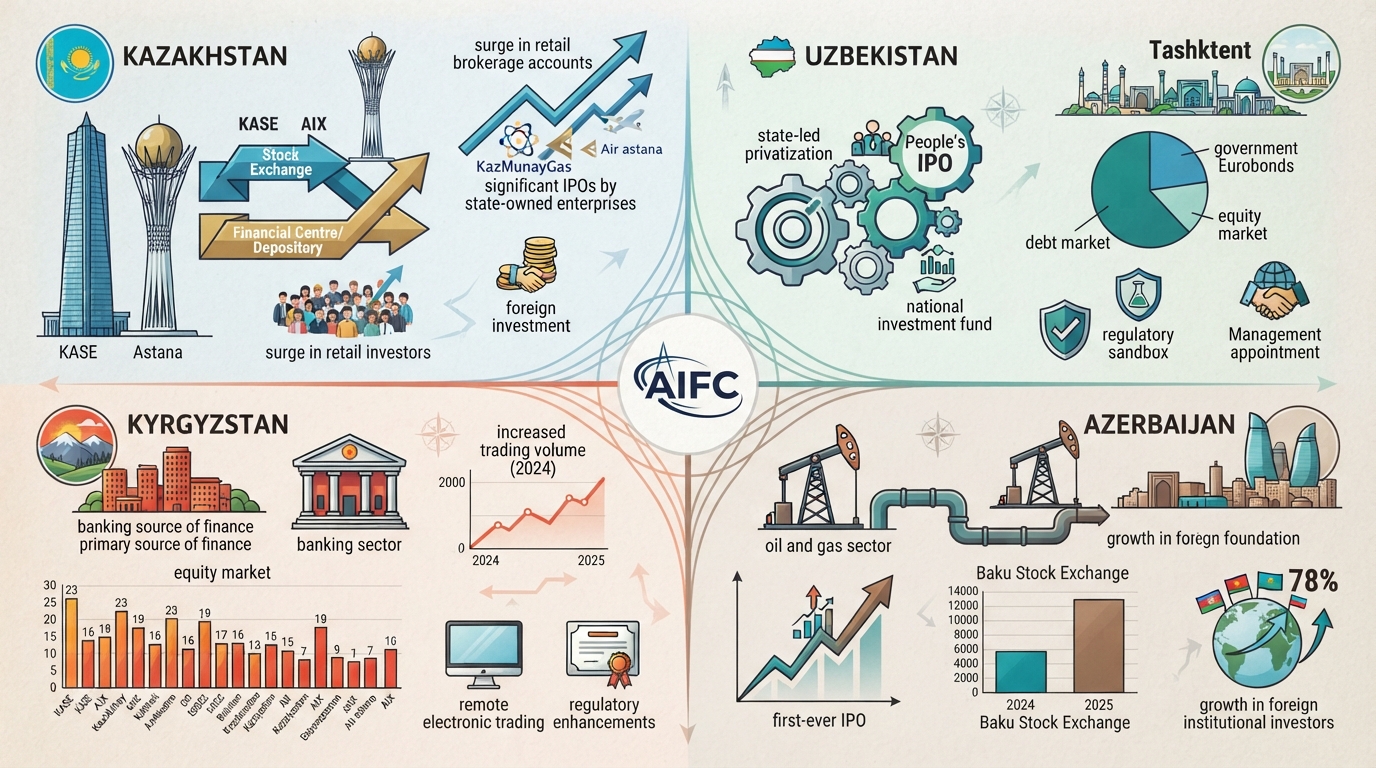
Uzbekistan's capital market is estimated to be worth US$22 billion, according to a report from the Astana International Financial Centre (AIFC) titled "Capital Markets in Kazakhstan, Uzbekistan, Kyrgyzstan and Azerbaijan: Prospects and Trends." This valuation comes as Uzbekistan's nominal gross domestic product (GDP) has grown from US$66.4 billion in 2020 to US$115 billion in 2024.
The AIFC report indicates that Uzbekistan's capital market is evolving under a state-led privatization agenda, which includes the "People's IPO" initiative. Despite this, the ratio of listed companies' market capitalization to GDP remains low by global benchmarks, having decreased from 16.4% in 2020 to 6.7% in 2024. The report attributes this to the nascent stage of the market's development.
The debt market is highlighted as the most active segment of Uzbekistan's domestic capital market. In 2025, the government issued US$1.5 billion in sovereign Eurobonds, primarily to fund the budget deficit and support mortgage lending. By the close of 2024, the total state and state-guaranteed debt was approximately 32.6% of GDP.
The National Agency for Prospective Projects of the Republic of Uzbekistan oversees the capital market, serving as the regulatory, licensing, and development authority for the securities market. The report also points out the implementation of a regulatory sandbox to test new financial products.
Key developments in 2025 include the appointment of Franklin Templeton to manage the Uzbekistan National Investment Fund, which holds a portfolio of 18 state-owned enterprises. The report also mentions the inaugural corporate bond issuance by Navoi Mining and Metallurgical Combinat and the planned bond program by Almalyk Mining and Metallurgical Combinat.
Among the four nations, Kazakhstan possesses the most advanced capital market infrastructure, according to the report. Kazakhstan's nominal GDP reached US$291.2 billion in 2024, with a government target of US$450 billion by 2029.
A distinctive feature of Kazakhstan's market is the presence of two exchanges: the Kazakhstan Stock Exchange, operating under national civil law, and the Astana International Exchange, which adheres to English common law principles within the Astana International Financial Centre's jurisdiction.
As of the end of September 2025, the total volume of outstanding bonds in Kazakhstan was approximately US$81.4 billion, or about 43% of GDP. The number of retail brokerage accounts has surged, from 103,000 in 2020 to 2.17 million at the Astana International Exchange Central Securities Depository and 4.62 million at the Kazakhstan Central Securities Depository by September 2025. Individual investors contributed over 62% of secondary equity market turnover in 2024. Concurrently, the National Bank of Kazakhstan increased its base rate to 18% in October 2025 due to renewed inflationary pressures.
The report also notes significant initial public offerings (IPOs) by state-owned companies such as Kazatomprom, KazMunayGas, and Air Astana, which expanded the private investor base. FTSE Russell currently classifies Kazakhstan as a frontier market.
In Kyrgyzstan, the capital market is in its formative stages, with the banking sector being the primary source of economic financing. The country's nominal GDP was US$17.4 billion in 2024, with projections to reach US$28.2 billion by 2030. By September 2025, shares of 23 issuers were traded on the Kyrgyz Stock Exchange, with a total market capitalization of approximately US$2.6 billion.
The report highlights a significant increase in market activity during 2024–2025, with trading volume on the Kyrgyz Stock Exchange reaching US$573.9 million by early June 2025, surpassing the total for 2023. This growth was largely driven by primary issuances of government securities, while secondary market liquidity remains low. In 2025, the government enhanced the exchange's regulatory framework by enabling electronic document submission for listings and allowing foreign issuers access.
Azerbaijan's capital market operates within an economy heavily reliant on the oil and gas sector. The country's nominal GDP increased from US$42.7 billion in 2020 to US$74.3 billion in 2024. A notable achievement for the equity market in 2024 was the country's first-ever IPO and the launch of remote secondary stock trading.
By October 2025, seven companies had completed IPOs, collectively raising approximately US$340 million and contributing to an increase in the Baku Stock Exchange's total market capitalization to US$18.4 billion. The Baku Stock Exchange's development strategy for 2024–2026 aims to boost bond placements by state-owned enterprises, institutional investors, and corporate issuers.
The report also observes a 78% increase in foreign institutional investors' holdings of Azerbaijani securities, attributed to a partial relaxation of foreign exchange restrictions by the Central Bank of Azerbaijan and improved regulatory transparency.