

After deadly Kyiv strike, Ukraine warns interceptor shortage is costing lives
Without Patriot interceptors, Ukraine's skies are wide open and people are fully exposed to Russia's missile barrages.
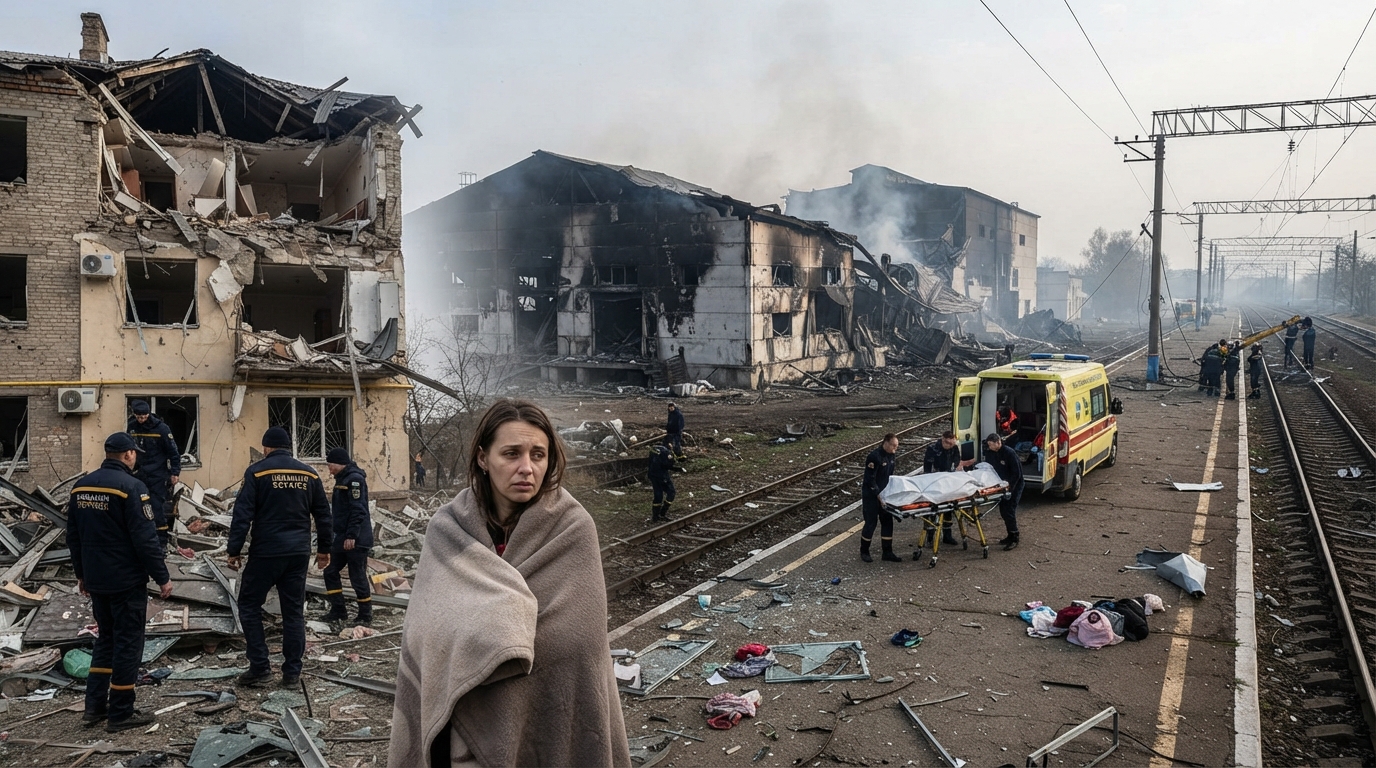
Following a fatal assault on Kyiv, Ukraine issues a warning that a scarcity of interceptor missiles is resulting in fatalities.
Anastasiia Dudley's residence suffered severe damage to its uppermost floor due to a proximate missile impact.
At the Kvitneva railway station, situated near Kyiv, personnel are seen transferring white body bags from the cratered platform into awaiting ambulances.
Footwear, spectacles, and fragments of attire delineate the site where eight individuals perished during Russia's most recent extensive aerial bombardment of Ukraine.
Overnight, Moscow launched 115 drones and 24 ballistic missiles. While the majority of drones were neutralized, Kyiv's diminished air defenses failed to intercept any of the missiles.
The attack claimed 21 lives and left dozens more wounded.
As medical teams depart, another crew swiftly moves in to mend the overhead power lines, enabling the resumption of train services. This rapid restoration and cleanup has become an all too familiar routine for Ukrainians.
The latest Russian offensive obliterated storage and logistics facilities, ranging from online retailer warehouses to a postal sorting center.
In Kvitneva, it remains unclear whether the railway itself or the adjacent warehouse, which was also struck and continued to smolder hours later, was the intended target. Further down the road, another warehouse remained engulfed in flames over 12 hours post-attack.
The assault commenced shortly after midnight with minimal warning, marking one of the most intense nights of bombardment Kyiv has experienced in recent months.
Nearby, Anastasiia Dudley's home was almost entirely demolished, yet she and her mother survived, shaken but unharmed.
Footwear, spectacles, and fragments of attire mark the location where eight individuals were killed overnight Wednesday.
Anastasiia has endured years of conflict, but she describes Wednesday as her "scariest night" since the onset of Russia's full-scale invasion of Ukraine in February 2022.
She gazes at the precariously leaning walls of her house, which she states was hit by a drone a few hours before missiles struck the nearby warehouse and station.
"You see two floors - the first and the second, but it was a three-floor house with a roof," she explains. The building's top floor has been severed. "So no roof, no third floor, and extensive damage on the second floor. It's pretty unstable."
Ukrainians have lived through four and a half years of war, but now air defenses are increasingly vulnerable, leading to dozens of deaths at a time.
For years, Ukraine has relied on US provisions of Patriot interceptor missiles to neutralize Russian ballistic missiles.
However, the US has utilized a significant portion of its stockpiles during its conflict with Iran and is hesitant to relinquish more. After initially offering Ukraine the license to manufacture Patriots in early July, President Donald Trump last week denied that the US had agreed to "give away that kind of technology."
Yet, without them, Ukraine's skies are exposed.
"Ballistic missile interceptors could have saved the lives of those killed today," stated President Volodymyr Zelensky.
Last week, following another deadly attack in which only one out of 27 missiles was intercepted, he warned that a shortage of interceptors "encourages Russia to launch such attacks that take human lives."
On Wednesday, Zelensky again directly linked the delays in supply to the "horrific casualties and destruction" regularly witnessed across Ukraine.
"Quite literally every single day, the lives of people here in Ukraine depend on the decisiveness of our partners in Europe and America," he later remarked, adding that he had discussed obtaining interceptor missiles with NATO chief Mark Rutte.
Ukraine possesses an undisclosed number of Patriot systems, but it is the Patriot interceptor missiles that are in short supply.
At least two interceptors are required to bring down each incoming ballistic missile, and the system has a range of approximately 160km (99 miles), making effective unit placement challenging.
Russia, meanwhile, employs an average of 20 to 30 ballistic missiles each time it conducts large-scale strikes on Ukraine.
Ukrainian military expert and former intelligence service officer Ivan Stupak likens Kyiv's situation due to the lack of interceptors to owning a supercar in the garage but having no fuel.
"Imagine you own a Lamborghini but have no fuel," he tells the BBC. "You have one of the best cars in the world, but you can't drive anywhere... The situation with Patriot is similar. The systems are there, but there are no interceptor missiles."
A lack of Patriot missiles leaves the entire country vulnerable, including the valuable Patriot systems themselves.
"Now the question is how to protect the systems themselves from being destroyed," Stupak states. "Because they could very well become priority targets for the Russian Federation."
"Until we receive more interceptor missiles, these systems need to be relocated or concealed somehow so the Russians cannot detect and destroy them. Right now they're extremely vulnerable."
A Russian strike claims 21 lives as Ukraine emphasizes its need for more missile interceptors.
Trump now expresses uncertainty regarding allowing Ukraine to manufacture Patriot missiles.