

Yemen government announces major operation to retake Houthi territory
The Yemeni president's announcement comes amid an exchange of strikes between the Houthis and the Saudi-led coalition.
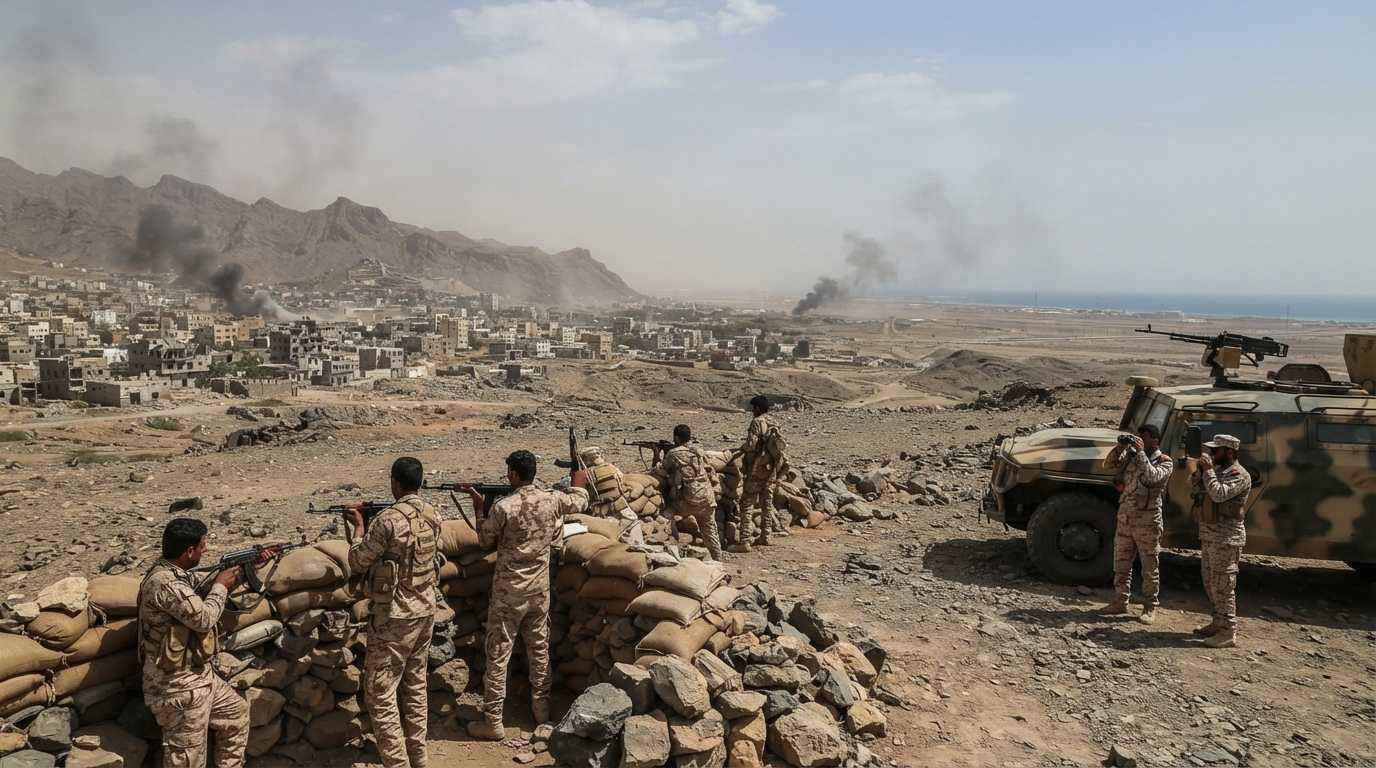
Yemen government announces major operation to retake Houthi territory
Yemen’s Saudi-backed government has announced a major military campaign to reclaim territory from the Iran-backed Houthis.
The move follows several days of exchanges of fire between the Houthis and the Saudi-led coalition. On Sunday, the Houthis said they had hit sites belonging to Saudi national oil company Aramco.
The group said the strike was in response to what it described as 50 Saudi-led coalition air and missile strikes in Yemen over 12 hours. Saudi Arabia has not yet responded.
The conflict intensified in September, when the Houthis took control of the country’s entire Red Sea coast, including the strategically important Bab al-Mandab Strait shipping lane, further disrupting global oil supplies.
Yemen’s capital, Sanaa, which has been under Houthi control for more than a decade, has faced sustained attacks as government forces seek to weaken the group’s military strength.
Strikes on the Houthis have also spread across Yemen, including the Saada region, the group’s northern stronghold.
On Sunday, Yemeni President Rashad al-Alimi said in a televised speech: "Today, I announce the start of military operations to retake the remaining territory of the republic and extend the authority of the state and its institutions across the entire national territory."
It is still unclear, however, whether this marks a new stage in the conflict.
The front line in Yemen remains centered on the key city of Taiz, which is still held by the internationally recognised government.
The Houthis are locked in a fierce fight with government forces for control of the area as they try to secure coastal territory and, in turn, the Bab al-Mandab Strait.
On Sunday, the Houthis cut a crucial supply route connecting Taiz with Aden, the Yemeni government’s interim capital, AFP news agency reports.
AFP also reports, citing three Yemeni military sources, that the Houthis now control the area and the supply route, effectively surrounding Taiz.
"They've achieved the military objective of isolating Taiz from Aden, even if they haven't fully taken control of it," Farea Al-Muslimi, a research fellow at the Chatham House think tank, told AFP.
Beyond Yemen, the Houthis are also seeking to damage the Saudis by targeting the country’s economic lifeline — oil.
On Sunday, Yemen’s Houthi military spokesman Yahya Saree said the group had carried out a ballistic missile and drone attack on Aramco sites in the capital, Riyadh, and the oil-rich Khurais area in the kingdom’s east.
"Both operations successfully achieved their objectives," the spokesman said in a statement. "The strikes were precise, causing large fires at the targeted sites."
This is not the first time the group has claimed to have struck Saudi oil facilities. Saudi Arabia has not yet commented on Sunday’s alleged attack, but it has previously rejected some claims as misleading, mocking the Houthis for "chasing imaginary victories".
Still, it again highlights the cost Saudi Arabia — and, by extension, the global economy — could face if it launched a new full-scale war against the Houthis.
In response, Saudi Arabia has also been striking Houthi targets, according to the Houthi-run Al-Masirah TV channel. It said at least two people were wounded in strikes on Sunday.
On Saturday, Yemen’s government also said its forces had struck Houthi targets across the country, including in Sanaa, Saada and the group’s positions near Taiz in the south-west.
Yemen is among the world’s poorest countries and remains trapped in a severe humanitarian crisis.
War broke out in 2014, when the Houthis seized the capital, Sanaa, from the Saudi-backed government, before taking control of large parts of the country’s north.
Riyadh entered the war the following year, leading an international coalition.
After several years of relative calm, the war flared again in July amid the widening conflict in the Middle East.
The Houthis have imposed a blockade on Saudi energy exports, which have already been reduced by Iran’s closure of the Strait of Hormuz.