

Wing
"You rarely come to the village, you missed out on pilaf at so many weddings," he said, first entertaining me generously. Then, as if
**The Wing**
I happened to read about winged horses in one of our newspapers. Like many others, I have read a lot about flying horses, steeds that leave the wind behind, and magical steeds that rise into the sky with a single charge of the rider and vanish into the clouds.
Once upon a time, there were herds of horses in our village near the mountains. When we helped the horse herders and took the horses to water, we involuntarily felt as if we were riding those flying magical steeds, crossing Ongortogh mountain in our imagination, and returning after seeing so many lands that were yet to be discovered by us.
Take the flying horses in fairy tale books. Spreading the sheep and lambs across Takavoytepa and Monchoqtepa, we would pull out books with yellowed pages and tattered covers from inside our shirts and start reading. There was no fairy tale that did not involve a horse. The horse recognizes its rider, leads him home if he gets lost, protects him from attacks by predators along the way, senses disaster in advance and perks up its ears, and if you do not care for it properly, it gets upset and stops eating its feed. When the time comes for it to be slaughtered, feeling its fate, tears stream down from its eyes.
I too believed that winged horses existed. I had believed it since my youth. Our uncle Solivoy the buzkashi rider—a famous rider from our village who spent his life on horseback and broke through the crowd in many a buzkashi—answered my question:
“Ah, nephew, there were flying horses, mostly in ancient times.” Later, I also asked Eshon the rider, whose eyes would light up whenever horses were mentioned. They all said, “Yes, there were.” But no one said, “I have seen one.”
During my student years, I went to the village and happened to arrive at the wedding of a young man named Murodxon. In our parts, circumcision weddings take place in the dead of winter, when the snow is almost knee-deep. A fattened horse is slaughtered, its meat is cooked in a large cauldron, and soup is served to the people in the early morning.
At Murodxon’s wedding, just as I was soaking bread in the soup, one of my school friends said, “Mirzajon the master of ceremonies is asking for you.” Mirzajon was a young man devoted to horses and hunting, someone whose heart would not be at peace if he did not fatten and slaughter a horse every year, and stuff its horse-meat delicacy into the intestine. In his youth, he would not lift his head from fairy tale books. Thinking he must have some business if he was asking for me, I finished my soup and went down to the basement of the wedding house.
I saw Mirzajon slicing the cooked meat and horse-meat delicacy into thin leaves. Saying, “You rarely come to the village, you’ve missed the food at so many weddings,” he first treated me generously. Then, as if it were a secret others shouldn't hear, he whispered softly in my ear:
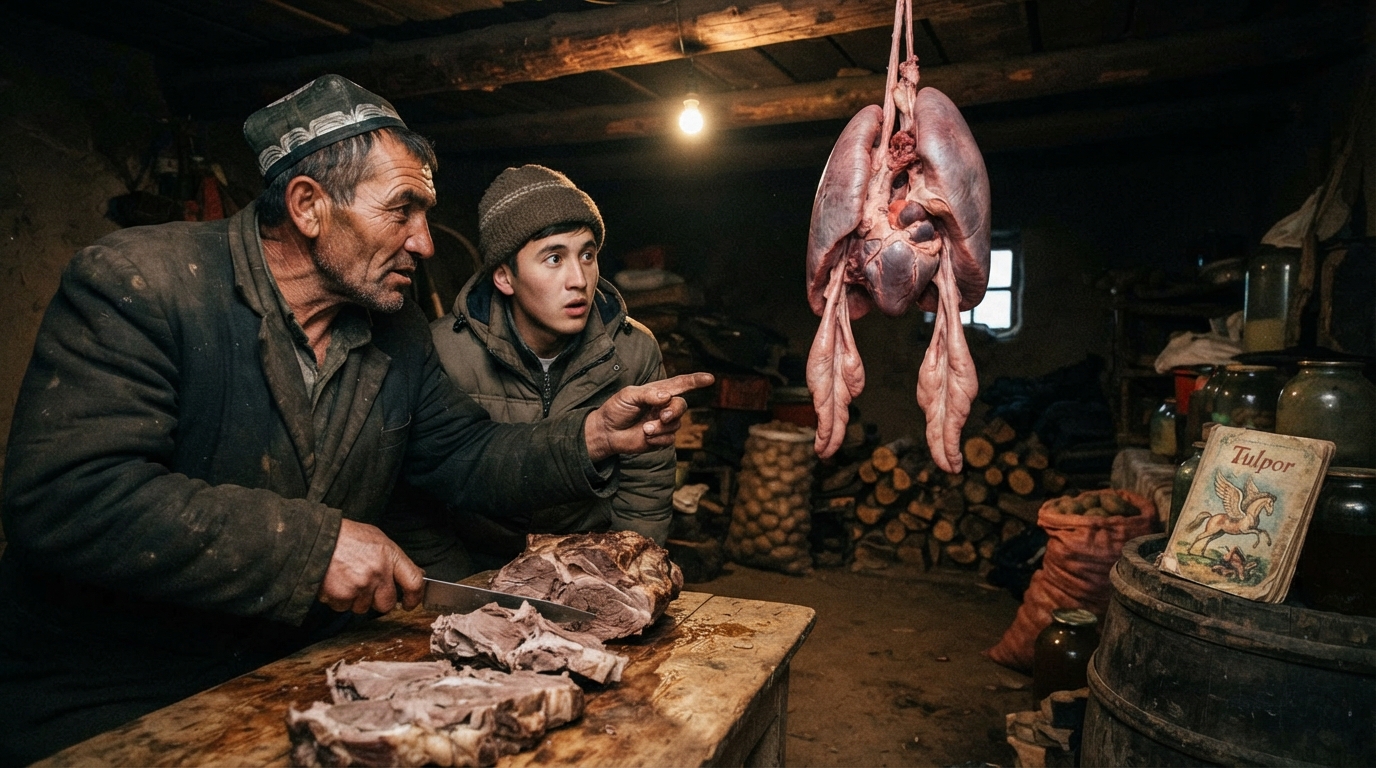
“The horse slaughtered for the feast had wings...”
Saying this, he pointed to the horse's lung hanging from the wooden pillar of the basement. Usually, after the wedding is over, relatives, friends, and those who served at the wedding gather to hold the “head-cooking” ceremony. At that ceremony, the lung of the slaughtered horse is used in samosas. When I looked, under both lobes hung a growth. Their length was more than a span.
“This is what they call a wing,” said Mirzajon, pointing to the growth. “When such horses breathe, these growths originating from the lungs also fill with air. Because of this, the horse takes even deeper breaths and gallops like the wind...”
Later, I related this incident in a couple of places, and horse enthusiasts did not say, “Ah, no, winged horses are different.” But then again, who really knows...