

Why Zimbabwe tycoon 'Sir Wicknell' was loved and hated in Africa
Wicknell Chivayo divided opinion in life and continues to do so in death.
Why Zimbabwe tycoon 'Sir Wicknell' was loved and hated in Africa
Wicknell Chivayo, who owned a fleet of personalised luxury cars and had a particular fondness for white Rolls-Royces, was a figure who split opinion in life and continues to do so after death.
The Zimbabwean tycoon, who died in a helicopter crash last week alongside his wife Lucy Muteke, styled himself as "Sir Wicknell" — a reference to the extravagance that defined his lifestyle, and a nickname used by some for the 45-year-old who packed enough controversy into a short life to fill several lifetimes.
He was relentlessly self-documenting, shaping much of his public image on social media, where he posed with stacks of cash and announced the cars and money he gave to people he deemed worthy.
Chivayo took pleasure in showing his access to heads of state across Africa and in displaying his possessions, giving video tours of his collection of costly cars, mostly Rolls-Royces, with vanity plates, watches and a huge array of designer shoes.
Supporters saw a fabulously wealthy man sharing his fortune. Critics were repelled by the flashy displays, questioned where his money came from and what political ties he had, and viewed his lifestyle as a glaring symbol of inequality.
Yet Chivayo seemed unmoved by the criticism. As his wealth grew, he became increasingly unapologetic about flaunting it in a country where nearly half the population lives below the international poverty line, according to the World Bank.
"He gave to those few on an island of wealth in a sea of poverty," Pedzisai Ruhanya, director of the Zimbabwe Democracy Institute think-tank, told the BBC, explaining that his donations largely went to influential people.
He dismissed Chivayo's generosity as showboating for the ruling Zanu-PF party — an effort to secure the backing of key politicians and even church leaders.
Still, grief has poured in, especially from those who benefited from his generosity, along with tributes from politicians, religious leaders and business figures.
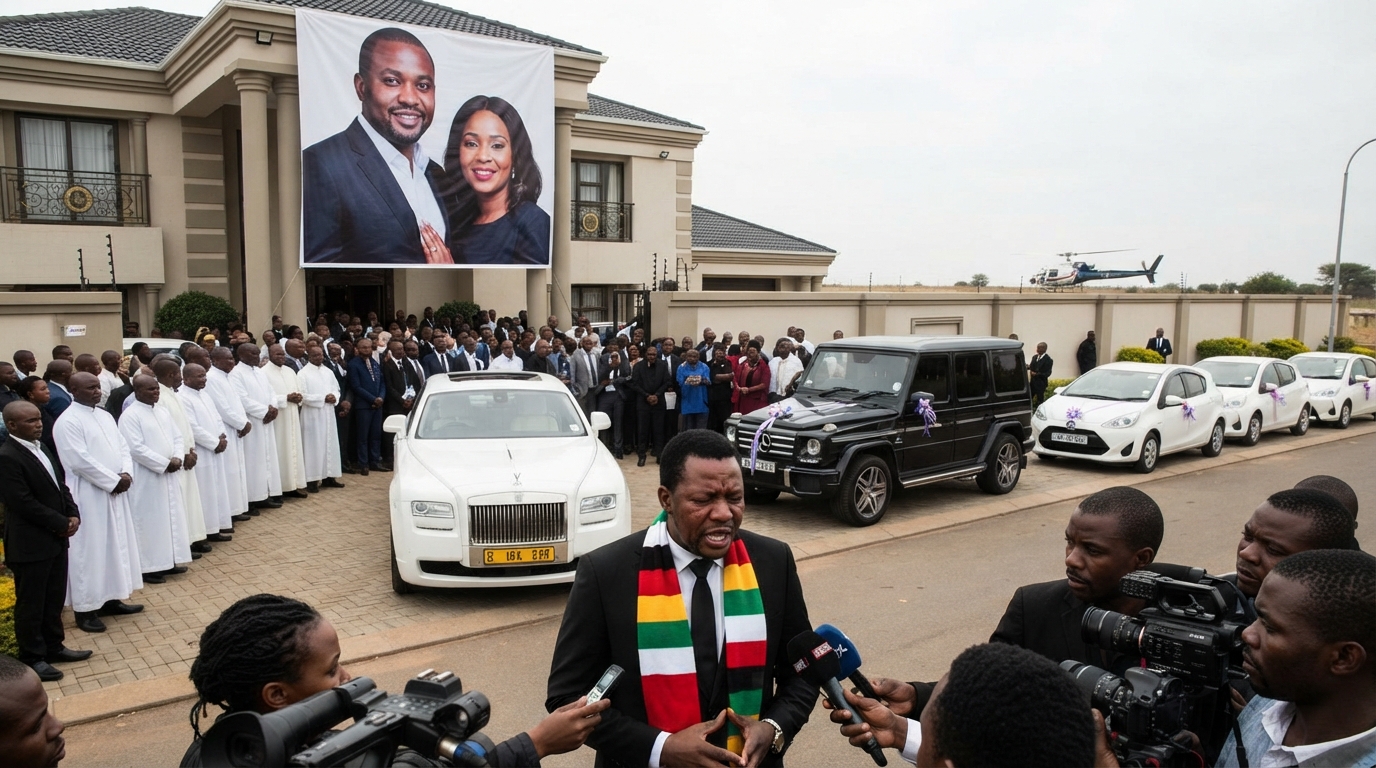
Among those gathered at the Chivayos' lavish home in Harare before their burial on Thursday was Cleopas Mukungunugwa, a young and prominent Zanu-PF social media influencer who received two luxury cars from Sir Wicknell.
Standing outside the mansion, where a giant poster of the couple is on display, he told local media he was devastated by his patron's death, and said "Sir Wicknell" often told him what to write in his posts.
"He was criticised by many on social media and our goal was to bolster his reputation as a philanthropist," he said.
Wicknell Chivayo's death last week has dominated conversation in Zimbabwe.
Chivayo left high school at 15 after his family could no longer afford the fees following his father's death when he was 10.
His first job was as a wages clerk for a bus company. From there, he moved into his first independent hustle — selling mobile phones and trading foreign currency, often on the black market during the height of the country's hyperinflation crisis.
In 2005, he was sentenced to five years in prison for money laundering involving 837,000 South African rand, then worth $137,500, £72,000. After two years were suspended, he served three years at Chikurubi Maximum Prison.
Details of his career after his release are unclear, but he entered the energy sector and became what one state-run newspaper called a "tenderpreneur" — making money through government contracts.
He led Intratrek Zimbabwe, which partnered with Chinese electrical giant CHiNT Electric. This was during a period when legislation required all companies in the country to transfer economic control to black Zimbabweans under a policy known as indigenisation.
In 2014, Intratrek was chosen to build a 100MW solar power station in the southern town of Gwanda. A contract worth more than $170m was signed the following year. It became one of the biggest controversies of Chivayo's business life.
Zimbabwe Power Company, the state-owned utility that awarded the contract, tried to end it when Intratrek failed to deliver, but the courts ultimately ruled that the agreement remained valid.
A parliamentary inquiry later described Intratrek as a "briefcase company" being used as a front to attract investment.
Chivayo admitted Intratrek did not have the expertise to build solar plants, saying it was the local partner while CHiNT supplied the technical capability.
Intratrek received an advance of more than $5m for the Gwanda solar plant, but it still has not been built.
Just weeks before Chivayo died, Intratrek received a government notice to proceed with the project and was given 24 months to finish it.
As accusations mounted, the businessman simply smiled and charmed his way through the storm — even winning over President Emmerson Mnangagwa, who was initially unimpressed when he first came to power.
In 2018, Mnangagwa cited Gwanda as a warning about the dangers of doing business with "fly-by-night briefcase businessmen", adding ominously that "Chikurubi is not full". The state-run Herald newspaper said the warning was aimed at Chivayo.
Yet within a few years, the relationship had turned into a bromance. In one of several photos showing the striking informality between them, Chivayo is seen lounging, almost lying, on a sofa beside Mnangagwa, apparently completely at ease in the president's presence.
His access was not limited to Zanu-PF — he also posted pictures with opposition figures, including the late Morgan Tsvangirai and Nelson Chamisa.
But he became a highly visible presence around Mnangagwa, speaking warmly of the president and openly backing Zanu-PF.
He faced allegations over the procurement of materials for the 2023 elections, in which Mnangagwa won a second term.
Investigations alleged that South African supplier Ren-Form massively inflated prices and then paid hundreds of millions of rand to a company linked to him. Chivayo denied wrongdoing, and Zimbabwe's anti-corruption commission later said it found no evidence linking him to procurement fraud. Ren-Form also denied any wrongdoing.
In April, he offered the country's 360 legislators $10,000 each, prompting accusations that he was trying to influence an upcoming vote on a controversial constitutional amendment that would have extended Mnangagwa's final five-year term by two years to 2030.
He withdrew the offer after a backlash and denied it was meant to sway the vote.
When the legislation was signed into law several months later, Zanu-PF posted a video clip of him with the caption: "Billionaire Sir Wicknell Chivayo celebrates… singing '2030 Ndeya Emmerson Baba!' while cruising at 51,000 feet aboard his Gulfstream G550".
President Mnangagwa (L), seated next to Chivayo, was the guest of honour at a major apostolic church gathering in August.
Access to power became part of Chivayo's social-media identity. In June, Eswatini's King Mswati III granted him citizenship of the southern African kingdom and a diplomatic passport — photographs and videos showed him kneeling before the monarch.
He had an impressive camera roll, with images of him alongside other African presidents such as Nigeria's Bola Tinubu, Tanzania's Samia Suluhu Hassan, Malawi's Peter Mutharika, Mozambique's Daniel Chapo and Zambia's Hakainde Hichilema, and he was part of the delegation that met South Africa's Cyril Ramaphosa when he visited Mnangagwa's farm earlier this year.
Some ties went beyond formal meetings. In August, Chivayo and his wife attended the engagement of Kenyan President William Ruto's daughter Charlene at the president's family home.
Afterwards, Ruto personally drove the couple to their waiting helicopter.
Chivayo filmed the ride from the passenger seat. True to form, he boasted: "Being driven by the president of the republic. God is the greatest."
Ruto wrote on X after the death: "I will remember him for his friendship, his energy, and his deep conviction in the possibilities of our continent."
But in Kenya, the Zimbabwean businessman was viewed with deep suspicion because of his closeness to Ruto — a sentiment loudly expressed on social media since his death.
Many of the comments are unprintable, but as Kenyan blogger Cyprian Nyakundi put it, while listing some of the controversies surrounding Chivayo: "As a Kenyan, I distance myself completely from President Ruto's glowing tribute to Wicknell Chivayo. Those condolences and that 'dear friend' language are his own, not mine, as a Kenyan."
One commentator on X said his death had "united Africans in celebration".
"When a man's passing brings more relief than sorrow, the reaction itself tells a powerful story. It is time for those in power to reflect and reevaluate!"
Chivayo shared a clip of Kenya's President William Ruto driving him and his wife to their helicopter after his daughter's engagement.
At home, there has also been pushback against those who say speaking ill of the dead is un-African, as the tycoon's death has become the trending topic in Zimbabwe.
At a shopping centre in Harare over the weekend, Christabel Moyo voiced what many have been saying.
"What is African - getting rich from inflated state contracts and using that money to support Zanu-PF?" the 42-year-old accountant asked.
"He was busy doling out cars and cash to the rich while the Zimbabwean public health system is collapsing."
The remarkable gifting spree for which he will be remembered began around 2023. Musicians, sports and business figures, politicians and religious leaders were among those who received cars and cash in what some saw as a blatant attempt to buy support for the ruling party.
He began with relatively modest Toyota Aquas, but the gifts soon became far more expensive.
Top musician Jah Prayzah, who is close to Zanu-PF, was given three luxury cars, along with about $400,000, over three years.
The singer postponed his wedding — due to take place last weekend — because of the helicopter crash, saying: "Wicknell was more than a friend to us."
Another major recipient was Bishop Nehemiah Mutendi, head of the Zion Christian Church, which is fiercely loyal to Zanu-PF. The cleric received millions in cash donations and four luxury cars.
Chivayo regularly attended the Johane Masowe weChishanu African apostolic church, one of Zimbabwe's largest, whose followers are often seen worshipping outdoors in white robes.
It also received dozens of cars, buses and cash from the businessman as he pushed the influential sect closer to the ruling party, bringing Mnangagwa as guest of honour to a huge church gathering in August.
Veteran musician Thomas Mapfumo, who had turned down Chivayo's offer of gifts, was due to perform at the tycoon's birthday party in November.
But not everyone accepted Chivayo's generosity. Eunor Guti, widow of Zimbabwe Assemblies of God Africa founder Archbishop Ezekiel Guti, refused a luxury vehicle and $250,000 in cash.
In 2024, veteran musician and government critic Thomas Mapfumo, who lives in the US, rejected Chivayo's offer of a luxury car and house, saying he could not be "bribed" and later calling his money "dirty".
However, this year he did accept $1m to perform at Jah Prayzah's wedding and Chivayo's birthday party in November.
Some long-time admirers of Mapfumo, who arrived in Harare on the eve of the helicopter crash, accused him on social media of compromising his principles, though the 81-year-old musician denied it.
Chivayo's generosity was not limited to individuals — he also donated 20 ambulances to Zimbabwe's struggling public health system and provided buses and other support to schools.
Those close to him say his philanthropy was not always done for show. Prominent lawyer Wilson Manase said after the tycoon's death that when he had fallen seriously ill in Dubai, Chivayo flew there to visit him.
In an interview with state broadcaster ZBC, the lawyer, who had been promised a car in Chivayo's last tweet, described him as "pure hearted" and deeply religious.
The tycoon had two young children with his first wife Sonja Madzikanda, from whom he separated in 2024 and with whom he was still locked in a messy court battle over the divorce settlement.
He also made sure not to forget his roots. On the day he died, he had visited his rural home in Gandami, south-east of Harare, where he was building a $1m eight-bedroom mansion to be officially opened in November for his birthday.
He said it would bring "Borrowdale Brooke to Gandami" — a reference to one of Harare's most exclusive residential estates. He had also pledged $500,000 to improve the local primary and secondary schools and a clinic.
Chivayo's death leaves Zanu-PF without one of its most colourful campaigners.
But it also leaves behind unanswered questions — with many Zimbabweans still wondering exactly how he rose from such humble beginnings to become a multi-millionaire able to hand out such extravagant gifts.