

Why rising commodity prices do not yet mean windfall profits: How the rent tax works in Uzbekistan
In Uzbekistan, a special rent tax at a rate of 25% applies to a number of mining projects. It takes into account not only the value of the extracted raw materials, but also the accumulated costs of a specific project. Dilshod Sultanov, in a column for Gazeta, explains why it cannot simply be replaced by an increase in the mining tax.
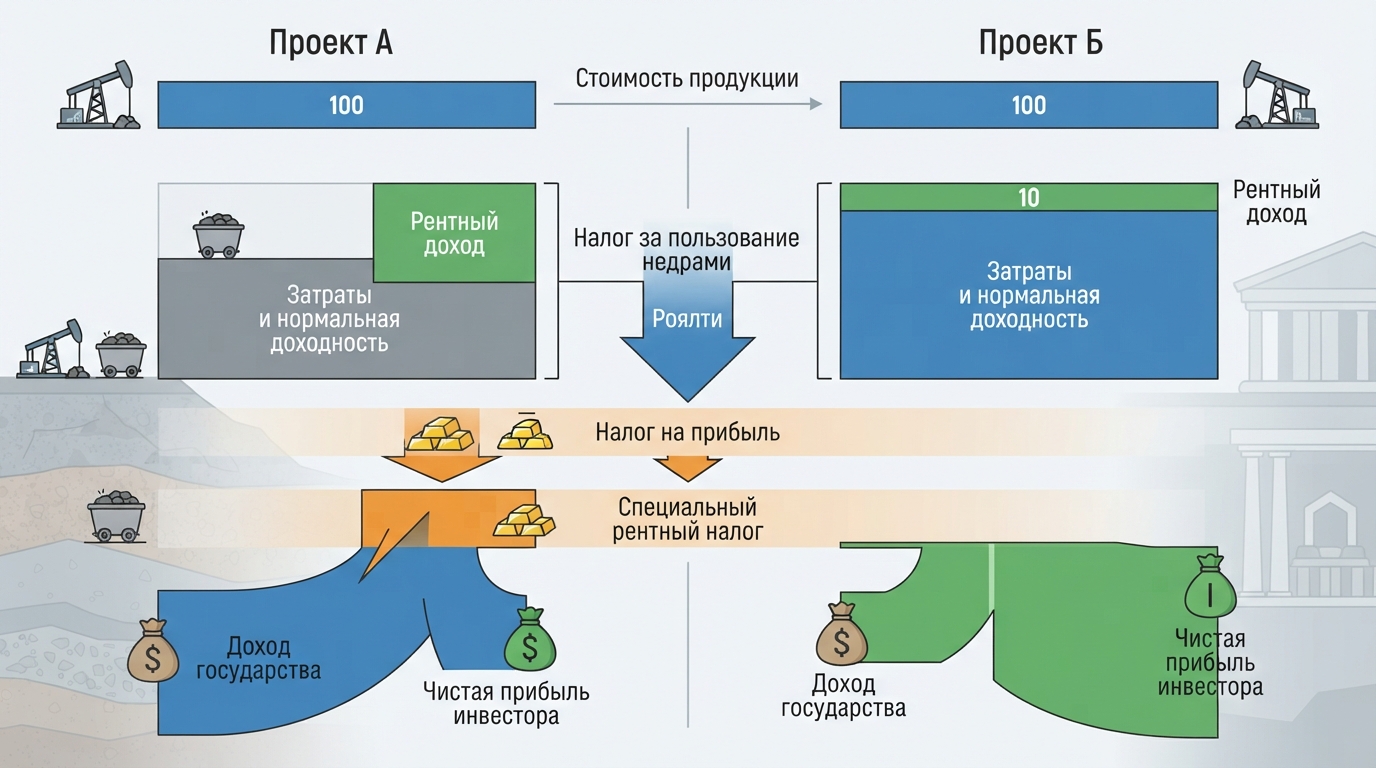
Why rising commodity prices do not yet mean windfall profits. How the rent tax works in Uzbekistan
Why does a high global price for gold, copper, or other commodities not in itself mean windfall profits for a specific deposit? And why is a separate rent tax needed alongside the corporate income tax and the subsoil use tax?
Subsoil is not an ordinary production asset. An investor takes on the risks of exploration, construction, and operation, but a successful deposit is capable of generating income that exceeds both the recovery of incurred costs and the normal return on invested capital. Part of this additional income is related to the quality and scarcity of the natural resource — this is resource rent.
Normal return is understood as the minimum level of income that compensates the investor for the cost of invested funds, the duration of the project, and the associated geological, production, and market risks. Such a return makes capital investment economically justified, but does not guarantee profit and does not have a single value for all deposits.
When global prices for gold, copper, or other minerals rise, it seems logical to simply increase the royalty (subsoil use tax). But a high price does not yet mean that every deposit receives a windfall profit.
Therefore, the task of the tax system in the extractive sector is broader than collecting regular corporate income tax. It must secure for the state a share of the resource rent, including that which arises during periods of high global prices.
The high price of minerals is visible, but it does not show the size of the rent. Accounting profit is also not equal to rent, as it includes a normal return on capital, depends on depreciation and financial structure, and is usually calculated for a legal entity rather than an individual project.
At the same time, the limitation for each project is important in order not to erode the tax base through other types of activities or transfer the expenses of other deposits.
In an ideal symmetrical model, the state participates in both positive and negative cash flows of the project. In practice, the budget usually does not reimburse expenses directly. Instead, the negative balance is carried forward to future years and increased by a set uplift.
Capital and operating expenses form the negative balance of the project. The tax arises only after subsequent revenues cover this balance, taking into account the accrued uplift. Therefore, the project does not pay rent tax during the period when it is still recovering its investments.
The purpose of the rent tax is to give the state a share of the income that remains after recovering the allowable costs of the project. Capital and operating expenses reduce the accumulated result, and the uncovered negative balance is carried forward with an uplift. Financial expenses, however, do not reduce the rent base. The longer costs remain unrecovered, the larger the amount the project must cover before rent income appears.
In the analysis "Cash Flow Analysis in Extractive Industry Tax Regimes," experts from the International Monetary Fund (IMF) note that for many countries, the combination of three instruments provides significant advantages:
In the Organisation for Economic Co-operation and Development (OECD) review of critical raw materials in Central Asia, it is noted that Uzbekistan has a special rent tax on mineral extraction at a rate of 25%. At the same time, the OECD recommends retaining this tax, testing its parameters on economic models, and considering a limit on the deduction of historical costs on which the uplift is accrued.
Thus, the rent nature of the tax is determined neither by its name nor by a high rate. It is determined by whether the tax base takes into account the accumulated result of an individual project, cost recovery, the investor's normal return, and the timing of income generation. This is precisely what distinguishes a special rent tax from royalties and corporate income tax.
In Uzbekistan, from January 1, 2022, the taxation regime for mining projects was restructured as a three-tier design: along with the corporate income tax, a subsoil use tax and a special rent tax are applied.
The special rent tax applies to categories of mining projects established by law. At the same time, for subsoil plots where extraction began between January 1, 2024, and December 31, 2025, an exemption from this tax is provided for the entire development period. For other projects, the liability arises only after covering accumulated expenses, taking into account the established uplift.
This design was driven by the need to maintain the investment attractiveness of projects and ensure the state receives a share of resource rent and price windfalls.
90
130
150
190
It represents a regulatory mechanism for carrying forward unrecovered expenses and only to a certain extent takes into account the time value of money.
Individual countries tax the additional income of mining companies in two main ways: they increase royalties when the global commodity price rises, or they introduce an additional income tax.
An increased income tax takes into account the company's expenses, but is usually calculated for each financial year. It does not show whether a specific project has paid off, taking into account the investments and losses of previous years. Therefore, a high income tax rate in itself does not turn it into a rent tax. Meanwhile, the rent tax takes into account the result of the deposit over a longer period and arises only after its payback.
Another way to increase budget revenues when global prices rise is to increase the tax rate, which is calculated based on the volume or value of the extracted raw materials. This approach has an important advantage: the budget receives additional revenues immediately, without waiting for the company to generate a profit.
But it also has a limitation. Such a tax barely distinguishes between a cheap and an expensive deposit if the value of the sold raw materials is the same.
Let's imagine two deposits that sell metal at the same price and receive the same revenue.
At the first deposit, the ore is richer, and there are already roads, electricity, and processing facilities nearby. At the second, the ore lies deeper, requires complex processing, and more expensive transportation.
The royalty for these projects will be the same, although their profits differ greatly. For the first project, an increased tax can extract part of the windfall profit. For the second, it can extract part of the normal profit and even the funds needed to recover investments.
This is especially important for new, capital-intensive, and geologically complex deposits, where windfall profits may be small even at a high commodity price.
Indicator
Project A
Project B
Conclusion
Value of products
100
100
Price and revenue are the same
Costs and investor's normal return
55
90
Project economics differ
Rent income
45
10
Ability to pay is unequal
Royalty on gross value
Same
Same
Tax does not see differences
Therefore, raising royalties following the global price does not allow for an accurate determination of windfall profits. Such a tax does not take into account costs, project payback, and the complexity of the deposit. The higher its rate, the greater the risk that the development of expensive reserves will become unprofitable.
This does not mean that royalties should be abolished. A moderate tax ensures budget revenues from the very beginning of the deposit's operation — even before the project shows a profit. But royalties should not be the main way to extract windfall profits.
A special rent tax determines windfall profits more accurately, but administering it is more difficult than a regular extraction tax. The state needs to verify not only the volume of raw materials and their sale price, but also the company's expenses.
When administering such a tax, several main risks must be taken into account:
These risks do not mean that the rent tax should be abandoned. They mean that its rules must be clear, verifiable, and the same for all projects. Investors and tax authorities must understand which expenses are accepted, how the accumulated result is calculated, and when the tax arises.
To achieve this, it is necessary to continue improving the qualifications of tax authority employees and form a specialized team for administering the rent tax. If necessary, detailed guidelines on the application of the special rent tax should be developed jointly with interested parties.
The state does not need to choose between budget revenues and the development of new deposits. These tasks can be combined if each tax performs its function.
A moderate subsoil use tax ensures revenues from the start of development. The corporate income tax extracts part of the company's normal profit. The special rent tax allows the state to receive additional income when the deposit has paid off and has actually begun to bring in windfall profits.
Therefore, raising royalties following the global price or introducing a progressive income tax do not replace the rent tax. A more correct path is to retain the special rent tax, make its rules understandable to everyone, and improve the quality of expense audits.
In this case, the state participates in the windfall profit, but does not make the development of new, complex, and expensive deposits unprofitable.