

Why Japanese firms are being so slow to use AI
Japanese risk aversion and conservatism blamed for slow AI take-up by the country's business sector.
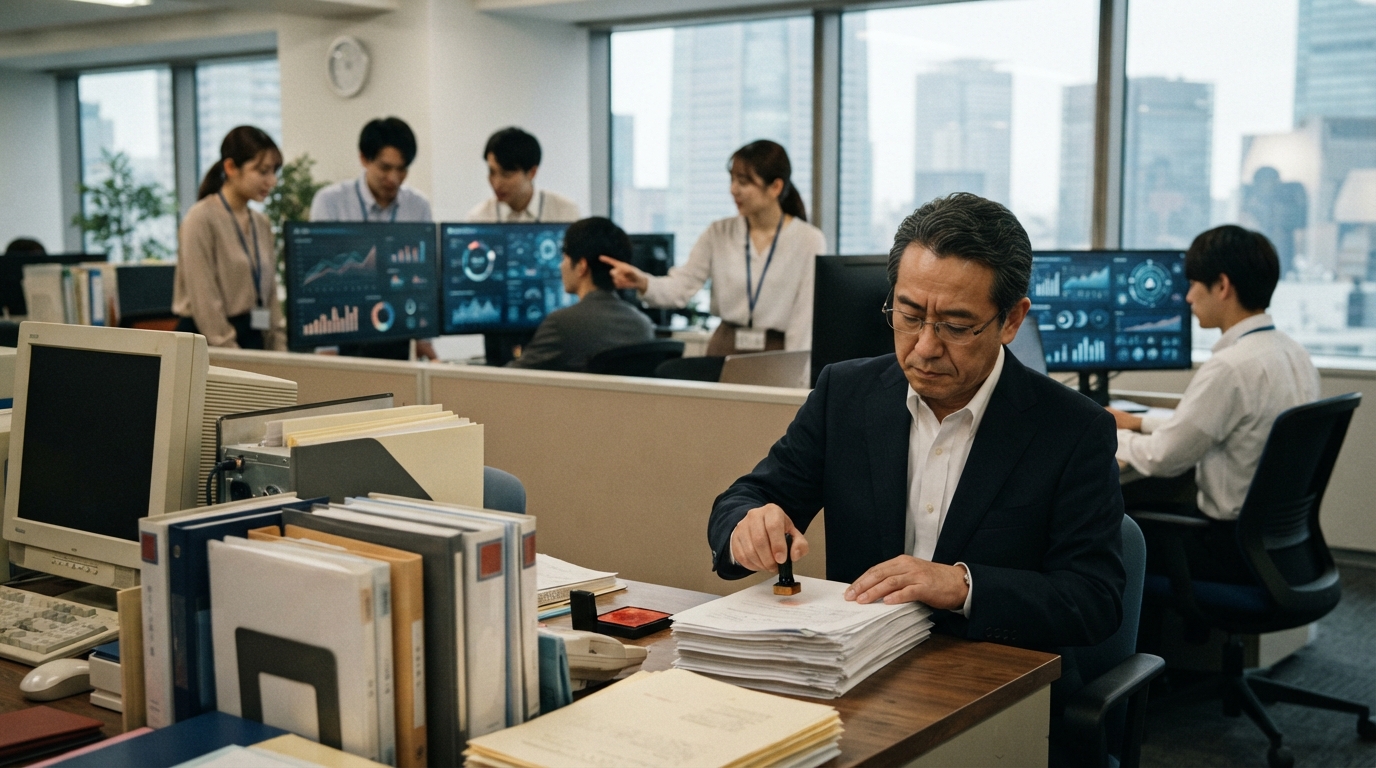
Japanese companies are exhibiting a notable reluctance to integrate artificial intelligence (AI), despite facing severe labor shortages, an aging population, and persistent productivity issues. This slow adoption contrasts sharply with the pace seen in the US and UK.
Japan's approach to AI is likened to a traditional Noh play, where characters on stage acknowledge the urgency for action with solemn agreement but remain motionless, a scenario that heightens drama but fails to address immediate national challenges.
Data from the Organisation for Economic Co-operation and Development (OECD) at the end of last year indicates that only 8.4% of Japanese workers utilize AI in their jobs. This figure pales in comparison to the US, where 50% of workers use AI, and the UK, with 32%. Singapore, which reportedly has the second-highest AI adoption globally after the United Arab Emirates and the highest in Asia, sees 56% of its workforce using AI "multiple times a week."
Austin Xu, co-founder of the US startup Kuse AI, attributes Japan's hesitation to a conservative and risk-averse corporate culture. His company recently established an office in Japan to market its AI systems. Xu notes that Japanese organizations prioritize process and consensus, leading to slow adoption, especially given their near-zero tolerance for AI errors in client-facing roles. He suggests some companies would rather leave positions vacant than allow machines to handle them.
In contrast, Xu describes the US approach as one where AI agents are given more autonomy to boost productivity. He states that in the US, AI tools are introduced as helpers and gradually integrated into workflows, with a prevailing attitude among bosses to "let it try, then correct it." He believes Japanese companies require more conclusive proof before fully trusting AI.
Parrisa Haghirian, a professor of international management at Kyoto University of Advanced Science, concurs, highlighting that the challenges of AI adoption in Japan mirror those of any organizational change, leading to limited and cautious use, particularly in the workplace. She contrasts this with the more entrepreneurial culture of the US, emphasizing Japanese firms' sensitivity to error, uncertainty, and reputational risk. Consequently, generative AI in Japan is primarily confined to low-risk tasks like writing, summarizing, or information gathering, rather than core operations, decision-making, or overall process improvement, due to its perceived unreliability.
The healthcare sector in Japan is particularly slow in adopting AI, with some hospitals still relying on paper patient files. An anonymous hospital employee described the situation as "like the Stone Age," with paper documents accumulating at an "staggering scale."
Recognizing the broader issue of low AI adoption, the Japanese government is actively promoting the technology. Last year, the AI Promotion Act was passed by parliament, aiming to encourage AI investment through light-touch regulation. Tokyo has pledged to make Japan "the world's most-friendly country for developing and utilizing AI." The government believes increased AI use can improve Japan's productivity, which currently ranks as the worst among the G7 advanced nations.
The Ministry of Finance reports a substantial increase in AI adoption by businesses, with 75% of companies now using the technology, up from 11% five years ago. However, critics argue that within these businesses, only a small fraction of staff actually use AI, and their usage is very limited.
Professor Yasushi Ogasawara, an expert on Japan's social system and technology at Meiji University, points to a shortage of tech-savvy individuals in the workforce. He notes that despite a fondness for gadgets like smartphones, digital literacy in Japan is low. A report earlier this year projected a shortfall of nearly 800,000 IT professionals in Japan by 2030. Many companies also contend with outdated computer systems, with approximately 60% being over 20 years old.
Ogasawara also suggests that Japanese companies face greater pressure to avoid contributing to unemployment than to develop AI that could lead to job losses. He states that while the government discusses AI, reskilling, and digital skills, adapting human resources to digital skills is challenging because maintaining full employment remains the top priority.
Despite these hurdles, there is a shift in recruitment, with some companies now prioritizing "AI literacy" in their hiring of new graduates. Larger private sector firms, such as the general trading company Kanematsu, are recruiting AI-savvy graduates like Uta Yamaguchi, who joined in April. Yamaguchi reports frequent AI use for tasks such as drafting emails, summarizing complex documents, and recording and summarizing meetings. However, she notes that AI systems capable of autonomously handling multi-step work are still virtually nonexistent in Japan, unlike in the US, though her forward-thinking employer has begun to implement them.
Ogasawara concludes that "change in Japan is limited," adding that "Japanese society expects painless reform, so I think it can be said that drastic reform is difficult, to say the least." Without embracing disruption, the productivity gains Japan needs may remain out of reach.