

Why is Ukraine so reliant on Starlink and can Europe plug the gap?
Ukraine needs another satellite internet service, but a decent alternative to Elon Musk's network doesn't exist - yet.
Why is Ukraine so dependent on Starlink, and can Europe fill the void?
Ukraine urgently needs a new satellite internet service, but for now there is no fast, dependable replacement for Elon Musk’s Starlink network.
A sudden slowdown in the service in Ukraine last week, which affected Kyiv’s ability to defend itself against Russian attacks, highlighted just how exposed the country is and has sharply raised Europe’s urgency to build its own military-grade satellite network.
There are some alternatives, but all of them trail behind Starlink, the world’s biggest satellite constellation.
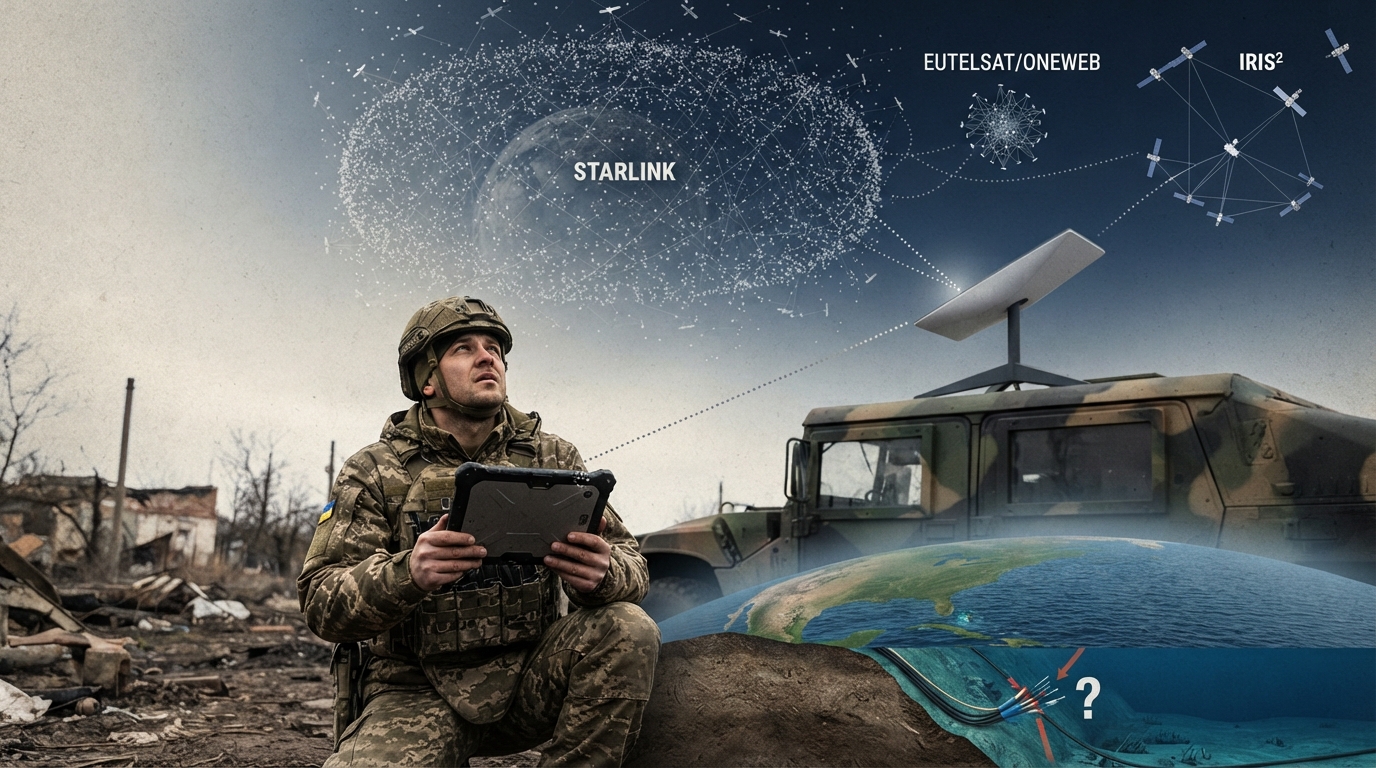
France’s Eutelsat, through its OneWeb internet service, is the leading alternative — but it has only around 600 active satellites, compared with Starlink’s more than 10,000.
The EU is developing a new network meant to compete with Starlink, Iris², but it will not be operational until 2029.
For Ukrainian troops on the ground, several of whom spoke anonymously to the BBC, dependable connectivity can mean the difference between life and death.
“God forbid they shut it off completely, it would be an absolute catastrophe,” said one. “I don’t give a damn how much an alternative costs when our lives are on the line.”
For now, Ukraine’s best option is to join Govsatcom, the EU’s satellite-sharing network — but it cannot be used for military warfare, such as controlling drones.
Starlink and its military-grade counterpart, Starshield, are both owned by Elon Musk’s SpaceX and have dominated the global satellite market for years.
Ukraine uses Starlink for battlefield communications and Starshield for military tasks such as drone warfare. The system can deliver fast, real-time connectivity, which is vital for defence and for intercepting Russian attacks.
“You can’t employ drone warfare without this kind of high-speed internet connection,” said Vincent Tourret, a researcher at the French Institute of International Relations.
“Ukraine’s defence cannot depend on Trump’s or Musk’s whims,” French MEP Christophe Grudler tweeted.
It remains unclear who authorised the Starlink restrictions, with a muddled blame game continuing between the Pentagon, Donald Trump and Elon Musk.
Although Starlink has been one of Ukraine’s biggest assets in the war, the “flipside of that dependence” has now been exposed, said Kari Bingen, director of the Aerospace Security Project at CSIS.
“This is a critical military capability that Ukraine relies on, but doesn’t control.”
Starlink is not the only satellite network available to Ukraine, so if it fails there are other choices — but experts say they are not as fast, and the troops the BBC spoke to agreed.
“Starlink gives us the upper hand when it comes to passing commands — even one or two seconds are critical when we can transfer data and orders faster, and you can really feel that advantage on the battlefield,” one soldier said.
The terminals used to connect to the satellites are also significant. Starlink’s are relatively small and light, so they can be mounted on almost any vehicle or drone.
Eutelsat’s terminals “are slightly larger, so they can be fitted on the roof of a car, or on tanks, but they can’t necessarily sit on small drones,” said Eva Berneke, the former chief executive of the French satellite company.
They are also about five times more expensive, she added.
Rhetoric from the White House — including Donald Trump’s harsh criticism of Nato and his threats toward Greenland — has set off “some pretty brutal alarm bells” in the EU, Berneke told the BBC.
She had been at Eutelsat for only a month when Russia launched its full-scale invasion of Ukraine in 2022, and said she saw a clear rise in urgency among European authorities as they looked to her company to help fill gaps left by Starlink if it could not be relied upon.
Comments from Elon Musk have further intensified the push for an alternative: “Be quiet, small man... there is no substitute for Starlink,” he tweeted, external, at Poland’s foreign minister last year after the politician said he would “look for other suppliers” if SpaceX proved unreliable.
Europe has recognised that its security depends on space, and it must “strengthen its satellite capacities, urgently,” a European Commission spokesperson told the BBC.
At present, it has Govsatcom, a network launched in January to share existing satellites among EU member states. Ukraine is not a full member, though it is seeking to become one, and the Commission is in talks with Kyiv about joining Govsatcom.
But even if Ukraine could connect tomorrow, the network could not be used for warfare operations such as piloting drones, which is what Starshield is used for.
That could change by the beginning of next year, however, when the European Commission hopes commercial companies such as Eutelsat’s OneWeb will join the programme. That would give Ukraine some — but not all — of the military network capabilities it needs.
Eva Berneke told the BBC she is confident the company will be able to “support quite a lot of Ukraine’s key military needs”. But meeting its communications needs is another matter, because, as with most countries, they are broad and enormous.
Eutelsat could not comment on Govsatcom, but told the BBC that “as the only European operator of a fully operational [Low Earth Orbit] constellation, we are committed to providing resilient connectivity to the businesses, governments and communities we serve”.
No timetable has been set for when Ukraine will be able to join the Govsatcom network. When it does, it will likely serve as a dependable back-up to Starlink and Starshield.
But that is better than nothing, Vincent Tourret said. “If Starlink is shut down, it’s good to have another way to stay connected, but it won’t be enough for strikes or interceptions, at this stage.”
Govsatcom is viewed as a short-term safety net until the stronger and more secure network, Iris², becomes Europe’s answer to Starlink and Starshield. The European Commission says it will be a defence-first programme, focused on governments, the military and emergency services. Ukraine has been guaranteed access from day one.
Part of the EU’s space programme, the European satellite companies Eutelsat, SES and Hispasat are leading the project in a consortium called SpaceRISE.
It will still have far fewer satellites than Starlink, with 348 in low and medium Earth orbit — but that should not be seen as a drawback, Kari Bingen said.
“Think about a flash light beaming down — those satellites will be able to cover a greater amount of the Earth, so you need fewer of them,” she explained. “They’re all trade offs — I would not take it as a negative, that Iris² is planning for less satellites.”
Tourret was more doubtful: “It’s no gamechanger and no great saviour, I’m afraid”.
A highly produced video on the EU Space Policy website says: “With Iris², Europe will no longer depend on others for satellite connectivity.”
So does that mean Ukraine could turn off Starlink? No — that would not be wise.
“Users need to think about communications resilience,” Bingen said. “So if something happens to one system, you have other ways to maintain connectivity.”
Eva Berneke compared it to mobile phones: “If you don’t have 5G, you go back to 4G. And if you don’t have 4G, you might use 3G, so you have multiple networks for resilience. It’s the same idea in warfare.”
But while a phone may not load images as quickly on 3G, for a drone operator it can be fatal: “That is not a nice situation to have to be in when you’re fighting a war.”
Iris² is not the only possibility.
A joint venture between European satellite makers Airbus, Leonardo and Thales, called Project Bromo, is also hoped to become another rival to SpaceX, but it is still in the very early stages.
Space projects take a long time, Berneke said, and require “a lot of money”.
Designing the programme, building the satellites, launching them and then getting enough of them into orbit for full coverage takes many years.
“Even if you gave me €8bn right now, I don’t think I could have anything up there before 2032-2033,” she said.
Military activity in space is nothing new, and has existed since the dawn of the space age in the 1950s. But the war in Ukraine has shown how central it is to modern warfare.
“Communication is so important, and terrestrial communication platforms, whether it’s 5G or fibre, can be attacked on the ground,” Berneke said. “It is a lot harder to shoot down an entire satellite network. That’s not something any military can do right now.”
Yet while attention turns to the skies, most of the world’s communications still travel through undersea cables — about 99% in fact. But these are vulnerable to attack, and this week the UK government announced new measures to protect its cables after a rise in suspicious activity by Russian vessels.
“In a crisis or conflict, there are serious concerns that undersea cables will be cut... so if that happens it’s good to have satellite communication as a backup,” Kari Bingen said.