

Why Indian law students don't want top judge at their graduation ceremony
Students from two premier law universities say they don't want Chief Justice Surya Kant to attend their convocations.
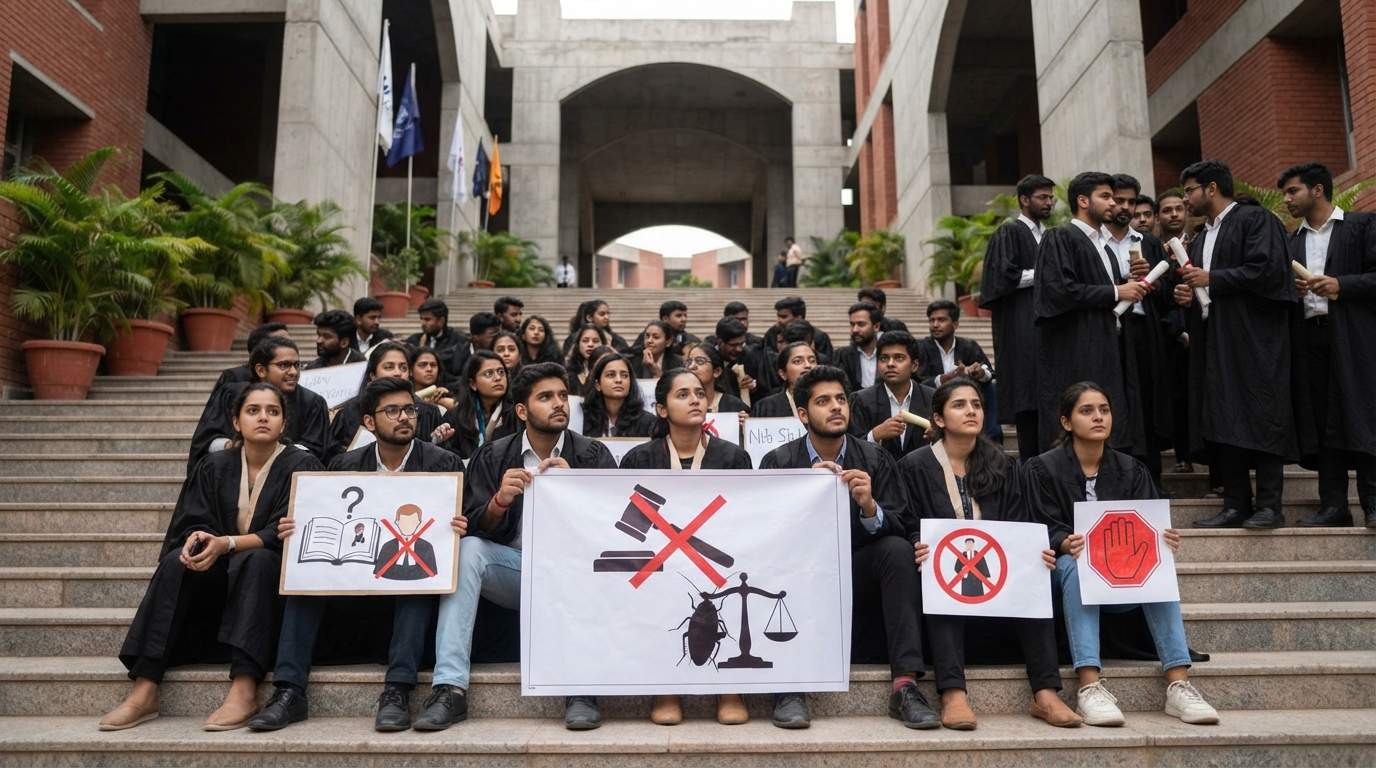
Chief Justice Surya Kant's recent remarks have sparked outrage among India's youth, leading students from two prominent legal universities to request that he not be invited as the chief guest at their graduation ceremonies.
The controversy began on July 23 when numerous graduating students from Nalsar University of Law in Hyderabad emailed college authorities, asking that CJI Kant not preside over their passing-out ceremony. This demand has since garnered support from approximately 450 of the university's 1,400 students, including many juniors.
Traditionally, the presence of the country's top judge at convocation is a source of pride for aspiring lawyers. However, Nalsar students were upset by reports that, a day earlier, the chief justice had declined an urgent hearing on police brutality during the July 20 parliament march in Delhi, led by the Cockroach Janta Party (CJP). Kant has since stated he was misquoted.
The CJP itself originated from a remark attributed to the chief justice, who reportedly used terms like "parasites" and "cockroaches" to describe some young people. Kant also claimed he was misquoted on that occasion.
The crackdown on CJP protesters in the capital, where police and paramilitaries were seen attacking unarmed students demanding education reforms with batons, wooden sticks, and teargas, shocked Indians and made international headlines. At least four youths sustained pellet gun injuries, marking the first reported use of such weapons for crowd control in the capital.
Indian media reports indicated that when a lawyer brought the matter before Kant on July 22, the chief justice reportedly said, "don't waste our time," and when asked to view videos of police excesses, he replied, "we don't have time."
This statement drew criticism from opposition parties, senior lawyers, and activists, with the Nalsar students' email following a day later. "We feel that receiving our degrees from a dignitary who appears dismissive of serious allegations of police brutality against protesting citizens sits uncomfortably with what we have been taught to value during our time at Nalsar," the students wrote. "We would, therefore, request the university to strongly reconsider the choice of chief guest for this convocation."
Kant later clarified that he had not refused to hear the petition but merely requested it be filed properly. Since then, the Supreme Court has begun hearing cases involving allegations of violence and concerns about police potentially using face-recognition technology to harass protesters.
However, the anger against the chief justice intensified last Thursday after Manan Kumar Mishra, chairman of the Bar Council of India, threatened to bar Nalsar's graduating students from enrollment. "No student who graduated from Nalsar will be enrolled until further orders from Bar Council of India," he announced, also asking the university for a report on the students behind the campaign against inviting the CJI.
The backlash against Mishra, a Member of Parliament from the ruling Bharatiya Janata Party, was swift and widespread, including from Chief Justice Kant himself, who asserted the students' right to protest and stated that the Bar Council had no business interfering in what was "a dialogue between law students and me."
Within hours, Mishra retracted his threat. "After considering the representations and reactions of senior advocates, members of the Bar, law students and public spirited citizens, and being satisfied that the 2026 batch of Nalsar, Hyderabad, had no role in any disturbance or movement, the Bar Council of India has decided to close the proceedings altogether. No further action is required," he posted on X.
In a subsequent apology letter addressed to "dear young friends," he wrote: "If anything connected with the present controversy, any of my words, or letter, has hurt the feelings of our law students, I sincerely regret and apologise for the same."
His apology failed to appease the students. Over the weekend, students and alumni from a second premier law university, the National Law School of India University (NLSIU) in Bengaluru, issued an open letter condemning Mishra's comments.
The NLSIU students stated they did not want Mishra to attend their convocation, expressed solidarity with Nalsar "in their request to reconsider the choice of the chief guest," and added that for the same reasons, they did not want the chief justice invited to their convocation either.
On Sunday, Kant reportedly stated that he had "never accepted the Nalsar invitation" to be the chief guest at their convocation, so the "question of me attending does not arise," according to the Times of India.
However, his clarification is unlikely to end the controversy. Student anger against the chief justice's reported remarks has been simmering since May, stemming from an off-the-cuff court comment where he likened some unemployed youth to "cockroaches and parasites."
"There are youngsters like cockroaches, who don't get any employment and don't have any place in the profession. Some of them become media, some of them become social media, some of them become RTI [right to information] activists, some of them become other activists, and they start attacking everyone," legal website LiveLaw quoted him as saying.
The remark drew significant criticism, and despite Kant's later clarification that it was taken out of context and aimed only at youth with "fake and bogus degrees," the damage was done.
This comment led to the creation of the Cockroach Janta Party, an online satirical movement that attracted millions of students and young people. CJP founder Abhijeet Dipke previously told the BBC that he launched the platform because he was "a bit disappointed and baffled" by the comments of the chief justice of India, "who is the custodian of our constitution, of our rights."
Although not a formal political party, the CJP has emerged as a formidable challenge to Prime Minister Narendra Modi's government in recent years, with weeks of protests in Delhi. The protests concluded on July 25 after Dharmendra Pradhan resigned as education minister, a demand from the CJP for him to take moral responsibility for repeated exam paper leaks.
As the latest dispute demonstrates, the repercussions of the protest continue to resonate within India's leading law institutes and its highest court.